
Discussion in the Meeting with the Creative Intellectuals (1946)
Read More »Tag: Dictatorship of the Proletariat
Che Guevara
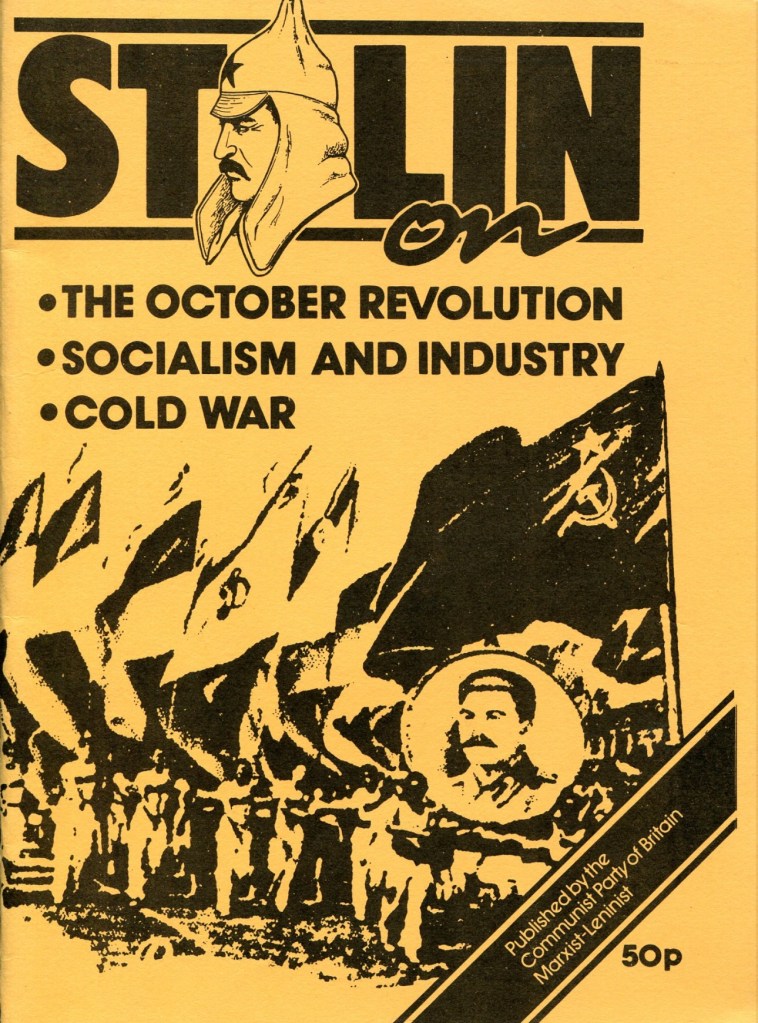
Stalin on: The October Revolution, Socialism and Industry, Cold War
The State: A Product of the Irreconcilability of Class Antagonisms
The State: A Product of the Irreconcilability of Class Antagonisms
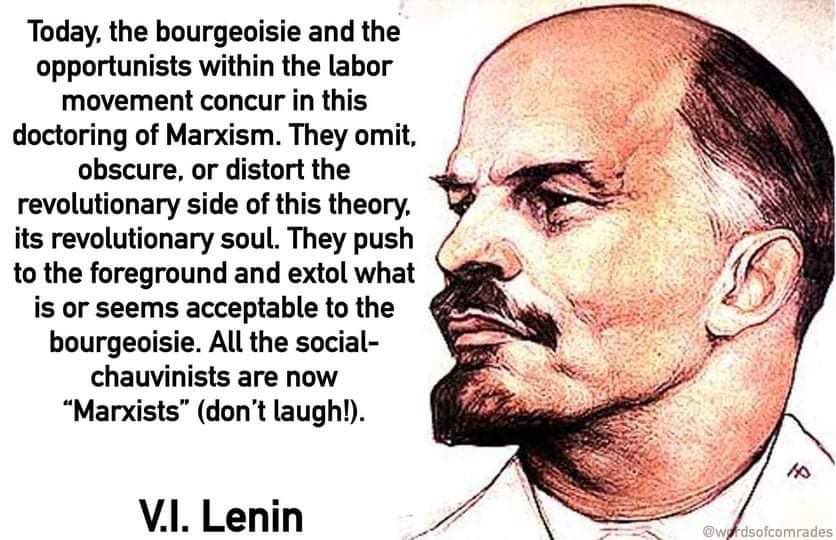
What is now happening to Marx’s theory has, in the course of history, happened repeatedly to the theories of revolutionary thinkers and leaders of oppressed classes fighting for emancipation. During the lifetime of great revolutionaries, the oppressing classes constantly hounded them, received their theories with the most savage malice, the most furious hatred and the most unscrupulous campaigns of lies and slander. After their death, attempts are made to convert them into harmless icons, to canonize them, so to say, and to hallow their names to a certain extent for the “consolation” of the oppressed classes and with the object of duping the latter, while at the same time robbing the revolutionary theory of its substance, blunting its revolutionary edge and vulgarizing it. Today, the bourgeoisie and the opportunists within the labor movement concur in this doctoring of Marxism. They omit, obscure, or distort the revolutionary side of this theory, its revolutionary soul. They push to the foreground and extol what is or seems acceptable to the bourgeoisie. All the social-chauvinists are now “Marxists” (don’t laugh!). And more and more frequently German bourgeois scholars, only yesterday specialists in the annihilation of Marxism, are speaking of the “national-German” Marx, who, they claim, educated the labor unions which are so splendidly organized for the purpose of waging a predatory war!
There are decades where nothing happens; and there are weeks where decades happen.
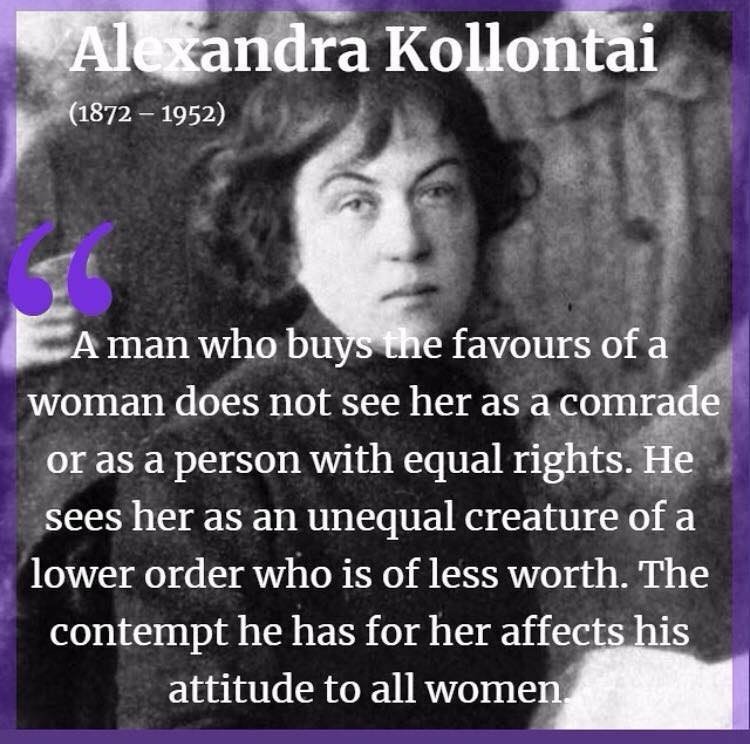
Alexandra Kollontai: Prostitution and ways of fighting it
Alexandra Kollontai: Prostitution and ways of fighting it
What is the fundamental quality of the working class? What is its strongest moral weapon in the struggle? Solidarity and comradeship is the basis of communism. Unless this sense is strongly developed amongst working people, the building of a truly communist society is inconceivable. Politically conscious communists should therefore logically be encouraging the development of solidarity in every way and fighting against all that hinders its development – Prostitution destroys the equality, solidarity and comradeship of the two halves of the working class. A man who buys the favours of a woman does not see her as a comrade or as a person with equal rights. He sees the woman as dependent upon himself and as an unequal creature of a lower order who is of less worth to the workers’ state. The contempt he has for the prostitute, whose favours he has bought, affects his attitude to all women. The further development of prostitution, instead of allowing for the growth of comradely feeling and solidarity, strengthens the inequality of the relationships between the sexes.
MAO ZEDONG: COMMUNISM AND DICTATORSHIP
There is yet a third argument, most assuredly a very important argument, even more important in reality. If we use peaceful means to attain the goal of communism, when will we finally achieve it? Let us assume that a century will be required, a century marked by the unceasing groans of the proletariat. What position shall we adopt in the face of this situation? The proletariat is many times more numerous than the bourgeoisie; if we assume that the proletariat constitutes two-thirds of humanity, then one billion of the earth’s one billion five hundred million inhabitants are proletarians (I fear that the figure is even higher), who during this century will be cruelly exploited by the remaining third of capitalists. How can we bear this? Furthermore, since the proletariat has already become conscious of the fact that it too should possess wealth, and of the fact that its sufferings are unnecessary, the proletarians are discontented, and a demand for communism has arisen and has already become a fact. This fact confronts us, we cannot make it disappear; when we become conscious of it we wish to act. This is why, in my opinion, the Russian revolution, as well as the radical communists in every country, will daily grow more powerful and numerous and more tightly organized. This is the natural result. This is the third argument…..
There is a further point pertaining to my doubts about anarchism. My argument pertains not merely to the impossibility of a society without power or organization. I should like to mention only the difficulties in the way of the establishment of such form of society and of its final attainment…. For all the reasons just stated, my present viewpoint on absolute liberalism, anarchism, and even democracy is that these things are fine in theory, but not feasible in practice….
Marxism-Leninism-MZT?
ON THE PEOPLE’S DEMOCRATIC DICTATORSHIP
ON THE PEOPLE’S DEMOCRATIC DICTATORSHIP
In 1924 a famous manifesto was adopted at the Kuomintang’s First National Congress, which Sun Yat-sen himself led and in which Communists participated. The manifesto stated:
The so-called democratic system in modern states is usually monopolized by the bourgeoisie and has become simply an instrument for oppressing the common people. On the other hand, the Kuomintang’s Principle of Democracy means a democratic system shared by all the common people and not privately owned by the few.
 Ms. Cat’s Chronicles
You must be logged in to post a comment.