Among the members of the so-called Russian government-in-exile are names such as Mikhail Khodorkovsky, the oligarch once convicted in Russia for fraud and theft, who has already served time in a Russian prison, and chess grandmaster Garry Kasparov, who has a far stronger connection to modern-day Azerbaijan or Armenia, having been born and spent his entire childhood in Baku, present-day Azerbaijan.
Sweater Girl is back with another lesson. This time she’s teaching Gene Sharp tactics. I really need to research her background. Yes, Trump leans into authoritarian theatrics, but the people amplifying these tactics aren’t fighting for socialism, and the funding streams behind them aren’t exactly grassroots. There’s an infrastructure here—front groups, donor networks, polished manuals—dressed up as spontaneous resistance. The aesthetics say “community,” but the playbook says something else entirely.
The video opens with a provocation—What if we weren’t afraid to get arrested? It’s time to learn about OTPOR!—but skips over the basic context of the organization being invoked. Angela Baker’s recommendation fits a pattern I’ve seen before: presenting Otpor as a neutral protest model while leaving out the political landscape that shaped it. Blueprint for Revolution, the book she cites, was written by Srđa Popović, one of Otpor’s leaders. The group received support from the National Endowment for Democracy, USAID, and pro‑democracy funding networks that included George Soros’ foundations, which Soros later acknowledged supporting during the 2000 uprising against Milošević. None of this automatically discredits the material, but it does mean the playbook isn’t organic or context‑free.
I was listening to Scott Horton’s new podcast Provoked with Daryl Cooper when they mentioned something I hadn’t heard anywhere else: that Alex Pretti was carrying a SIG Sauer P320, it allegedly misfired, and the resulting confusion led to ICE shooting him. That claim immediately stood out because none of the reporting I’ve seen on the incident mentions a misfire, let alone one involving the P320.
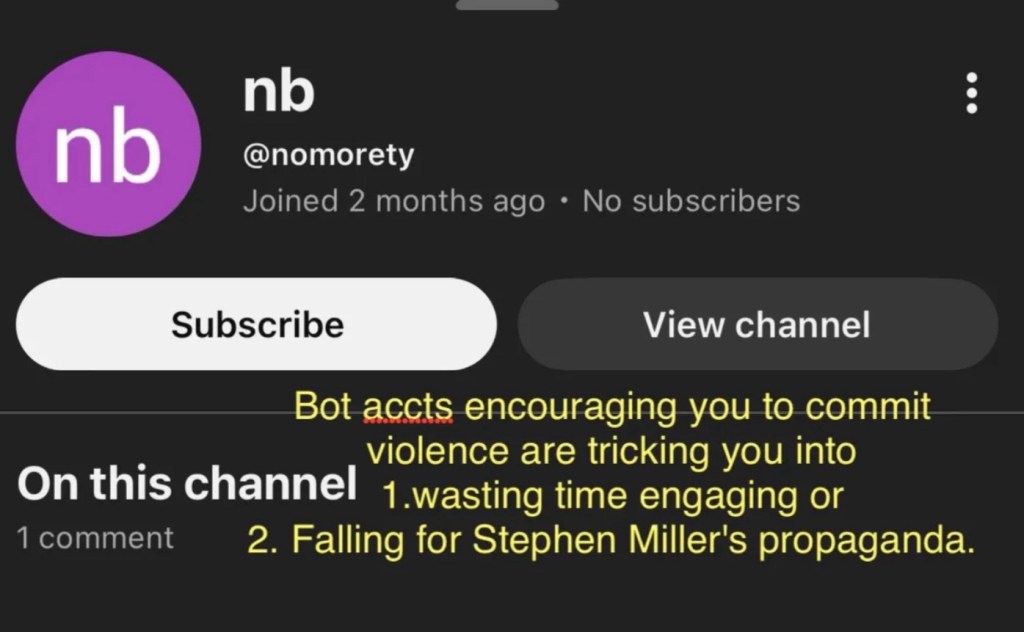
I’m sitting down to film now, but I wanted to remind you that the bots and agent provocateurs are working overtime right now in my comments and all over the Internet.
I just blocked more than a dozen accounts telling Americans to riot or shoot ICE agents or commit other acts of violence. Please understand that when the regime is trying this hard to get you to do something, and all of the bots are aligned in their messaging and messaging aligns with the desires of Stephen Miller, we cannot possibly be foolish enough to fall for it.
Hold the line. Do not give up and lay down. Do not give in to their manipulations and your rage and make stupid devastating mistakes right now. We must move in ways that are tactical and well-planned and help our cause.
(Internet slang, intransitive) To post violent threats on the Internet, ostensibly as an everyday citizen, but actually working as an undercover federal agent. “How do you do fellow channers? Any bombings planned for today?” “Stfu glowie, stop fedposting”.
Leaked files reviewed by The Grayzone show the US gov’t covertly funded Nepalese youth groups in the run-up to a violent coup. The “Gen Z” shadow army mobilized as the US sought to neutralize Chinese and Indian influence over Kathmandu – now controlled by a leader chosen by an informal social media poll.


 Ms. Cat’s Chronicles
You must be logged in to post a comment.