
For the record, I am not an anarchist; I simply have a deep love of quotes and like to look up their origins. My research often reveals that favorite sayings are frequently misattributed or heavily paraphrased.
Read More »
For the record, I am not an anarchist; I simply have a deep love of quotes and like to look up their origins. My research often reveals that favorite sayings are frequently misattributed or heavily paraphrased.
Read More »
Health Update
The sinus infection has returned—thankfully, not as severe as last time. I’m cautiously optimistic it stays that way, though another round of antibiotics seems inevitable (and unwelcome). On a brighter note, the back pain is finally easing up. One step forward, one flare-up at a time.
Edit: Spoke too soon. The pain is back.
Read More »“The president is determined to not just dismantle – but completely destroy – [Venezuelan dictator Nicolas] Maduro’s Cartel de Los Soles and obliterate their operations in the Western Hemisphere,” a source close to the White House said.
…
Maduro, Venezuela’s president since 2013, has been a particular focus of the administration.
The Justice and State departments announced Thursday they would award $50 million to anyone providing details leading to his arrest for violating US drug laws.
Related:
María Corina Machado and Marco Rubio Escalate Interventionist Narratives Against Venezuela
China’s Belt and Road Initiative (BRI) is the most ambitious infrastructure and economic integration project ever devised, linking over 140 countries across Asia, Africa and Europe. Much unlike the political West, Beijing is trying to project power through economic means, a starkly different approach to that of the most aggressive power pole in human history.
Political West’s “Divide And Rule” Strategy of Destabilizing China’s Belt and Road Initiative (BRI) (archived)
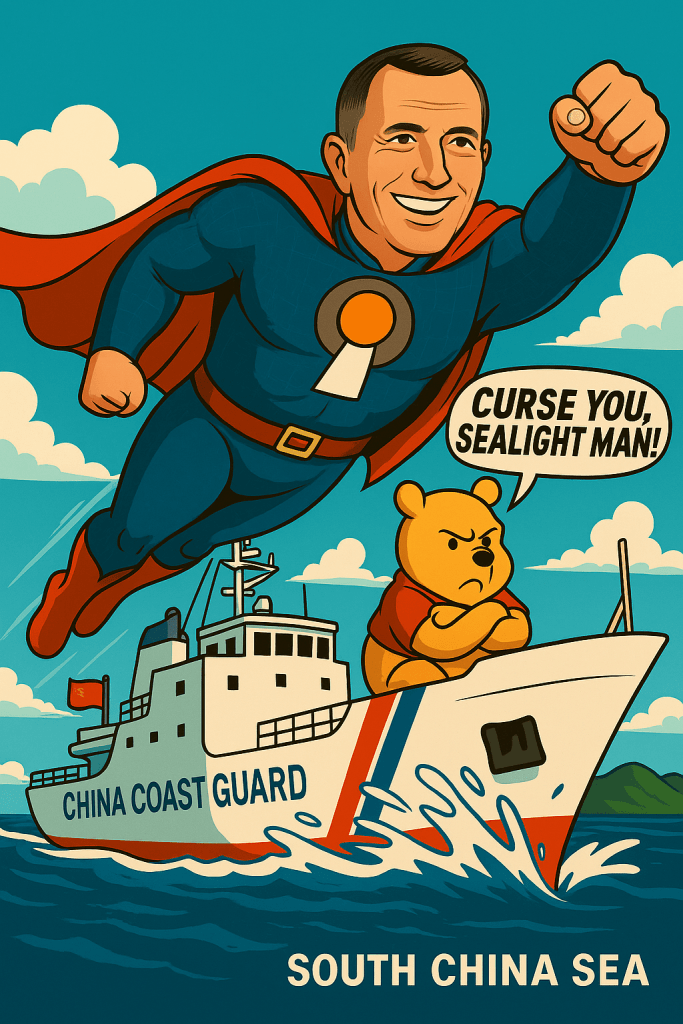
Capes, Cameras, and the Cult of Visibility: The SeaLight Crusade as White Savior Theater
By Tina Antonis
The South China Sea is more than a maritime dispute—it’s a theater of narrative warfare. While headlines focus on Chinese aggression and Philippine resistance, a quieter campaign unfolds in the background: one of satellite feeds, curated imagery, and Pentagon-backed storytelling. At the center of this effort is SeaLight, a project that claims to illuminate truth but often casts shadows of its own.
As explored in my article at Antiwar.com, SeaLight doesn’t just document—it performs. It reframes geopolitical tension through moral spectacle, positioning its creators as heroic arbiters of transparency. But when the messenger wears a cape and the funding flows from defense budgets, we must ask: is this clarity, or choreography?
Stage Left: The White Savior Enters
In the comic-strip cosmology of Ray Powell’s SeaLight project, transparency wears a cape. Clad in heroic postures and backed by satellite imagery, Powell casts himself as the guardian of maritime morality—unarmed, except with satellite feeds, theatrical flair, and strategic messaging.
Yet beneath the cartoon and Pentagon-funded optics lies a familiar archetype: the white savior, rebranded for the South China Sea.
China Is Imperialist? Says Who?
Calling China a “maritime occupier,” Powell positions himself as a bulwark against aggression. But that moral pose collapses under scrutiny. He speaks for a country with over 800 foreign military installations and a documented history of over 250 military interventions since 1991—wars in Iraq, Afghanistan, Libya, Syria, Somalia, and dozens more, all under the banner of peace, freedom, or preemption.
By comparison, China’s post–Cold War footprint includes no sustained foreign occupations and only scattered border conflicts and peacekeeping missions. The imbalance is staggering. And Powell’s framing doesn’t just ignore it—it performs around it.
As David Vine argues in The United States of War, this vast base empire is not a passive network—it’s an architecture of perpetual war. These outposts make military engagement not an exception but a structural habit, cloaked in strategic necessity and sold as global stewardship.
Powell’s cartoon rhetoric—calling China an occupier—obscures the scale of U.S. militarism. The term “occupation” is deployed not to analyze, but to project. When adversaries hold territory, it’s a crisis; when the U.S. spans the globe with armed installations, it’s policy.
Framing Conflict: The Optics of Consent
This isn’t irony. It’s performance. Powell’s language manufactures a moral frame for confrontation—costumed in transparency, but driven by escalation. The cape is literal. The conditioning is deliberate. And the stage is set for war.
SeaLight’s mission is not just visual documentation—it’s narrative warfare. As the Japan Times openly notes, its “chief weapon is photography, applied purposefully, generously and consistently over time.” These images—enhanced, curated, and distributed across media—are not neutral. They’re constructed to shape public perception, sway international opinion, and ultimately manufacture consent for confrontation.
Assertive transparency becomes a kind of ideological scaffolding—a stage on which geopolitical tension is dramatized, simplified, and morally polarized. The goal isn’t simply to reveal conflict; it’s to condition audiences for escalation.
And when the messenger dons a superhero’s cape, the spectacle transforms into something deeper: a story of rescue, of virtue, of intervention. This is not analysis—it’s soft propaganda dressed in heroic metaphor.
Consent for war doesn’t begin with missiles. It begins with mythmaking.
Berlin, 26 May 2025 – In a chilling act of imperial hubris, German Chancellor Friedrich Merz has declared that Germany, in lockstep with its NATO overlords, has unshackled the range restrictions on missiles supplied to Ukraine, greenlighting strikes deep into Russia’s heart. This brazen escalation, announced today, is no mere policy shift; it is a deliberate provocation, a reckless lunge towards a global conflagration that could sear humanity’s future. The West, cloaked in the sanctimonious rhetoric of “defending Ukraine,” is goading Russia into a corner, gambling with the lives of millions in a game of geopolitical brinkmanship.
Germany’s Missile Range Decision: A Perilous Step Towards Global Conflict
Visualize the movement against the Vietnam War. What do you see? Hippies with daisies in their long, unwashed hair yelling “Baby killers!” as they spit on clean-cut, bemedaled veterans just back from Vietnam? College students in tattered jeans (their pockets bulging with credit cards) staging a sit-in to avoid the draft? A mob of chanting demonstrators burning an American flag (maybe with a bra or two thrown in)? That’s what we’re supposed to see, and that’s what Americans today probably do see — if they visualize the antiwar movement at all.
There are a few ways to think about Elon Musk’s announcement this week that he’s stepping back from DOGE. The first is that he’s leaving a job he officially doesn’t have. The second is that he’s returning to a job (Tesla CEO) that he’s supposedly been doing this whole time. The third, and perhaps most interesting, is that none of this actually makes any sense at all.
RFK Jr. Is Headlining the Rx and Illicit Drug Summit. This Doesn’t Bode Well.
On April 21, the first day of the 14th annual Rx and Illicit Drug Summit, organizers announced a surprise presenter for the closing plenary on April 24: Robert F. Kennedy Jr., newly minted Secretary of the Department of Health and Human Services and vocal proponent of building labor camps for people who use drugs.
Read More »
 Ms. Cat’s Chronicles
You must be logged in to post a comment.