
Trump Promotes NED-Soros Interference in Honduras
Read More »
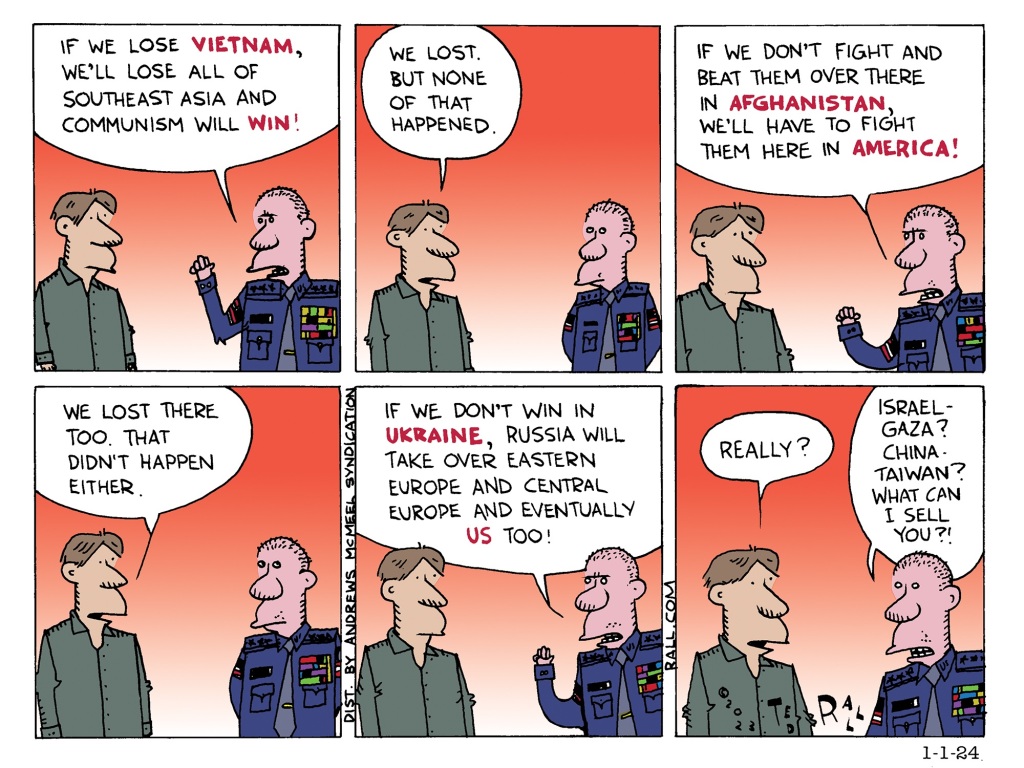
Tag: Domino theory
Pre‑Scripted Contest: U.S. Sets Narrative for Honduras Election
The U.S. government, through its network of front organizations, is already laying the groundwork to frame Sunday’s election in Honduras as disputed—before a single ballot has even been cast.
Honduras heads toward elections amid allegations of fraud and military interference
Local media outlets have also reported on X that members of the ruling party have assaulted supporters of other political parties. One such complaint was made by Liberal Party legislator Iroshka Elvir. “When we were in District 15, groups of LIBRE supporters in El Pedregal blocked the road with sticks and stones, and verbally assaulted our candidates,” Elvir said.
Related:
Iroska Elvir is married to Salvador Nasralla, who is running for President of Honduras.
Read More »It’s Not Only About Venezuela: Trump Intends a Wider Domino Effect
John Perry and Roger D. Harris
It’s increasingly obvious that the US military threats against Venezuela have a wider agenda. Their game plan is regime change, but not only in Venezuela. This is the objective – on a longer timescale in some cases – across several of the countries in the Caribbean Basin, aiming to cleanse the region of governments deemed undesirable to Washington.
Read More »
Gimenez: The Tweets and the Foreign Lobbying Firm
US Authorizes CIA Violence in Venezuela, Then Blames Venezuela For It…
The US already openly announced the CIA is conducting operations inside Venezuela, then says “Venezuela” is doing it to themselves to blame the US or its terrorist proxies inside Venezuela…
The NYT had reported:
“The new authority would allow the C.l.A. to carry out lethal operations in Venezuela and conduct a range of operations in the Caribbean.
Read More »
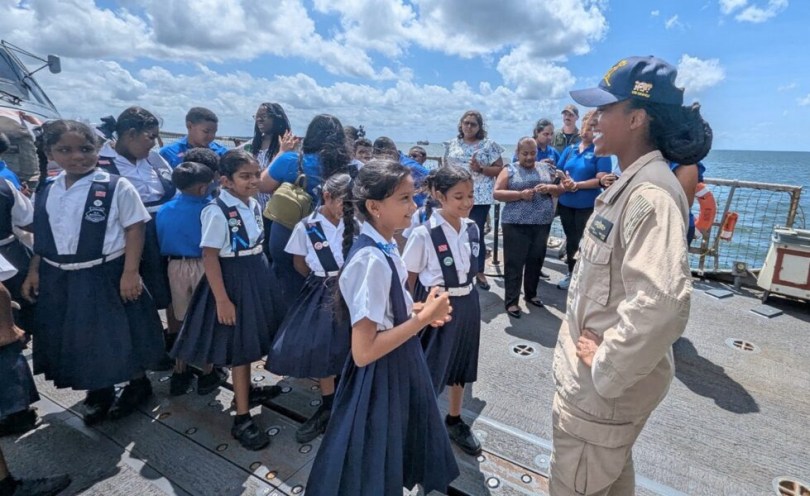
US Embassy in Trinidad and Tobago Doing School Outreach During Joint Military Exercises
Sobers: US troops to return to Trinidad and Tobago for joint military training
Sobers said the US embassy would participate in outreach activities across both islands. Building the TTDF’s capacity, he reiterated, was critical, especially to help combat the flow of illegal drugs and weapons into the country.
Related:
Read More »People of the United States: Listen to Maduro
People of the United States: Listen to Maduro
FAIR USE STATEMENT: This video may contain copyrighted material the use of which has not been specifically authorized by the copyright owner. This material is being made available within this transformative or derivative work for the purpose of education, commentary and criticism, is being distributed without profit, and is believed to be "fair use" in accordance with Title 17 U.S.C. Section 107.
The Atlantic: Why Venezuela?
MacArthur’s Last Stand Against a Winless War
If war breaks out in Asia, the U.S. won’t send ground troops. Take note, Philippines!
MacArthur’s Last Stand Against a Winless War
Never get involved in a land war in Asia, MacArthur had told Kennedy, because if you do, you will be repeating the same mistake the Japanese made in World War II—deploying millions of soldiers in a futile attempt to win a conflict that cannot be won.
…
Kennedy appreciated MacArthur’s soothing judgment on Cuba (and would soon change the military’s top leadership—perhaps in keeping with MacArthur’s views), but then shifted the subject to Laos and Vietnam, where communist insurgencies were gaining strength. The Congress, he added, was pressuring him to deploy U.S. troops in response. MacArthur disagreed vehemently: “Anyone wanting to commit ground troops to Asia should have his head examined,” he said. That same day, Kennedy memorialized what MacArthur told him: “MacArthur believes it would be a mistake to fight in Laos,” he wrote in a memorandum of the meeting, adding, “He thinks our line should be Japan, Formosa, and the Philippines.” MacArthur’s warning about fighting in Asia impressed Kennedy, who repeated it in the months ahead and especially whenever military leaders urged him to take action. “Well now,” the young president would say in his lilting New England twang, “you gentlemen, you go back and convince General MacArthur, then I’ll be convinced.” So it is that MacArthur’s warning (which has come down to us as “never get involved in a land war in Asia”), entered American lore as a kind of Nicene Creed of military wisdom—unquestioned, repeated, fundamental.
Wisconsin will now require Asian American history to be taught in schools
Wisconsin will now require Asian American history to be taught in schools
Related:
Why are the Hmong in Wisconsin?
Unlike past immigrant groups, the Hmong were political refugees who fled their country because of war and persecutions. The Hmong refugees were legally admitted to the United States by the U.S. government and were initially resettled by church organizations such as Catholic Charities and Lutheran Social Service. Area churches sponsored Hmong families here in Wisconsin and other states in the U.S. The 2010 U.S. Census has shown that there are 49,240 Hmong Americans living in Wisconsin. Community with significant Hmong population include: Milwaukee, Wausau, Sheboygan, La Crosse, Madison, Eau Claire, Green Bay, Appleton, Oshkosh, Manitowoc, Stevens Point, Wisconsin Rapids, Menomonie, and Fond du Lac.
A Look Back at the CIA’s Dirty War in Laos
Laos was (and remains) a very poor country that at the time of the encounter with the CIA was predominantly composed of illiterate peasants working the land in the form of subsistence agriculture. It was colonized by France in 1893; however, unlike in neighboring Vietnam, and to a lesser extent in Cambodia, there was hardly any investment or development of infrastructure or education in Laos. There was no Laotian “collaborating elite,” as was the case with French-speaking and French-educated Vietnamese Catholics. Furthermore, though a small place with a small population, Laos contains an estimated 49 different ethnic groups. A lot of the tension was more along tribal than ideological lines. The CIA, under the leadership in Laos of its highly strategically capable director, Bill Lair, chose to ally particularly with one of the tribes, the Hmong, under their charismatic but brutal head, Vang Pao. After the U.S. lost the war in Laos (at the time of the defeat by Vietnam, 1975), the promises made to the Hmong that they would be offered refuge and welfare in the U.S. were not kept. Though some did make it to the U.S., most Hmong today live in squalid conditions in camps in Laos or in neighboring Thailand.
Under what was code-named Operation Momentum, the CIA engaged in a sustained and relentless bombing campaign, starting in 1961. There was more bombing of Laos than there was of Germany or Japan during World War II. Throughout the war there was on average, the author states, one bombing attack every eight minutes. Ultimately, some 10% of the Laotian population was killed and 25% made refugees. The author reveals that according to a secret U.S. government assessment of the bombing campaign, 80% of all casualties were civilians. With much of the fighting concentrated in the Plain of Jars, he estimates that the population in the course of the 1960s declined from 150,000 to 9,000 in that region. But the narrative of the end of the war does not bring to an end the tragic story of the bombing: One-third of the bombs remained unexploded, and they continue killing and maiming to this day.
…
Operation Momentum transformed the CIA from an organization that primarily gathered intelligence into one that engaged in killing and the covert overthrow of regimes considered unfriendly to the U.S. The CIA tried on a number of occasions to assassinate Fidel Castro. The overthrow of “unfriendly” democratically elected regimes included that of the prime minister of Iran, Mohammed Mossadegh. The CIA also provided political and military support to some of the world’s harshest dictators, such as Mohammad Reza Shah Pahlavi in Iran, Rafael Trujillo in Dominican Republic, Mobutu Sese Seko in Zaire (Congo) and Ferdinand Marcos in the Philippines.
 Ms. Cat’s Chronicles
You must be logged in to post a comment.