Capes, Cameras, and the Cult of Visibility

Capes, Cameras, and the Cult of Visibility: The SeaLight Crusade as White Savior Theater

By Tina Antonis

The South China Sea is more than a maritime dispute—it’s a theater of narrative warfare. While headlines focus on Chinese aggression and Philippine resistance, a quieter campaign unfolds in the background: one of satellite feeds, curated imagery, and Pentagon-backed storytelling. At the center of this effort is SeaLight, a project that claims to illuminate truth but often casts shadows of its own.

As explored in my article at Antiwar.com, SeaLight doesn’t just document—it performs. It reframes geopolitical tension through moral spectacle, positioning its creators as heroic arbiters of transparency. But when the messenger wears a cape and the funding flows from defense budgets, we must ask: is this clarity, or choreography?

Stage Left: The White Savior Enters

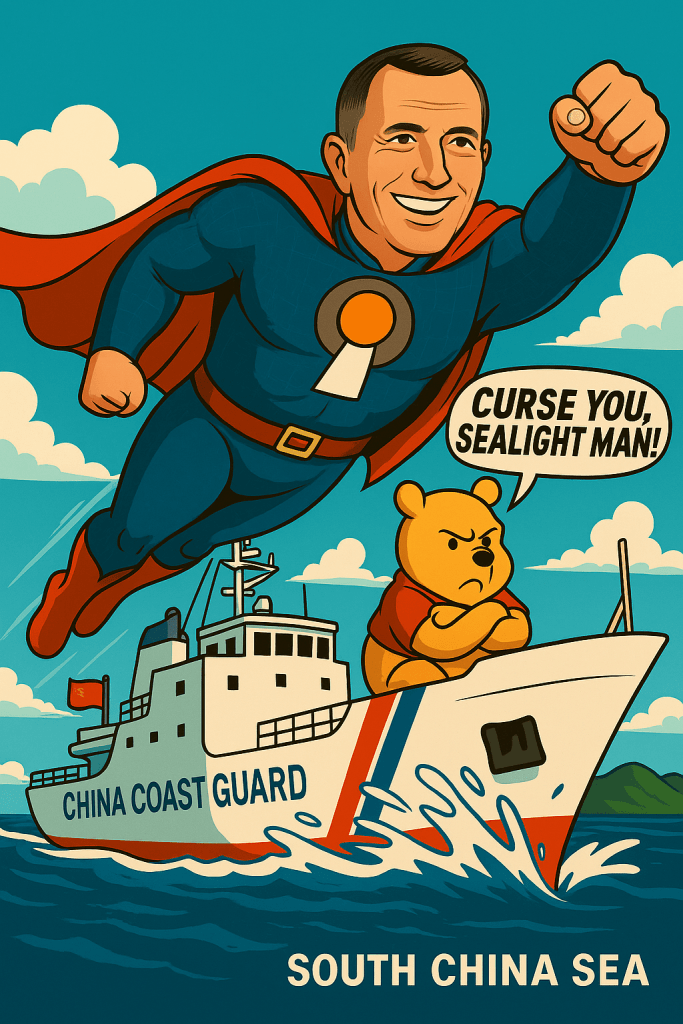
In the comic-strip cosmology of Ray Powell’s SeaLight project, transparency wears a cape. Clad in heroic postures and backed by satellite imagery, Powell casts himself as the guardian of maritime morality—unarmed, except with satellite feeds, theatrical flair, and strategic messaging. 

Yet beneath the cartoon and Pentagon-funded optics lies a familiar archetype: the white savior, rebranded for the South China Sea.

China Is Imperialist? Says Who?

Calling China a “maritime occupier,” Powell positions himself as a bulwark against aggression. But that moral pose collapses under scrutiny. He speaks for a country with over 800 foreign military installations and a documented history of over 250 military interventions since 1991—wars in Iraq, Afghanistan, Libya, Syria, Somalia, and dozens more, all under the banner of peace, freedom, or preemption.

By comparison, China’s post–Cold War footprint includes no sustained foreign occupations and only scattered border conflicts and peacekeeping missions. The imbalance is staggering. And Powell’s framing doesn’t just ignore it—it performs around it.

As David Vine argues in The United States of War, this vast base empire is not a passive network—it’s an architecture of perpetual war. These outposts make military engagement not an exception but a structural habit, cloaked in strategic necessity and sold as global stewardship.

Powell’s cartoon rhetoric—calling China an occupier—obscures the scale of U.S. militarism. The term “occupation” is deployed not to analyze, but to project. When adversaries hold territory, it’s a crisis; when the U.S. spans the globe with armed installations, it’s policy.

Framing Conflict: The Optics of Consent

This isn’t irony. It’s performance. Powell’s language manufactures a moral frame for confrontation—costumed in transparency, but driven by escalation. The cape is literal. The conditioning is deliberate. And the stage is set for war.

SeaLight’s mission is not just visual documentation—it’s narrative warfare. As the Japan Times openly notes, its “chief weapon is photography, applied purposefully, generously and consistently over time.” These images—enhanced, curated, and distributed across media—are not neutral. They’re constructed to shape public perception, sway international opinion, and ultimately manufacture consent for confrontation.

Assertive transparency becomes a kind of ideological scaffolding—a stage on which geopolitical tension is dramatized, simplified, and morally polarized. The goal isn’t simply to reveal conflict; it’s to condition audiences for escalation.

And when the messenger dons a superhero’s cape, the spectacle transforms into something deeper: a story of rescue, of virtue, of intervention. This is not analysis—it’s soft propaganda dressed in heroic metaphor.

Consent for war doesn’t begin with missiles. It begins with mythmaking.

Messages at Shangri-La

by Brian Berletic

During this year’s Shangri-La Dialogue in Singapore, U.S. Secretary of Defense Pete Hegseth laid out an alarming vision for the future of the Asia-Pacific region, a vision that includes the same type of U.S. military encroachment and confrontation that has turned Europe, North Africa and the Middle East into devastated battlegrounds over the past two decades.

Messages at Shangri-La (archived)

Selective Free Speech: Censorship, Hypocrisy, and the Politics of Control

Full video. Timestamp: 4:50.

Marx’s insight—”The ruling ideas of each age have ever been the ideas of its ruling class”—perfectly captures the hypocrisy of free speech under the Trump administration. While they denounced censorship when the Biden administration silenced voices questioning pandemic policies, they now weaponize state power against those protesting the war in Gaza. This contradiction reveals that their defense of free speech is not based on principle but on political utility—protecting narratives that serve their interests while suppressing dissent that threatens their agenda. By framing pandemic skepticism as truth-seeking while branding anti-war activism as dangerous, they manipulate public discourse to maintain control rather than uphold genuine democratic values. This selective enforcement isn’t new; it’s a recurring pattern in power structures, where the ruling class dictates which ideas are legitimate and which must be silenced.

JD Vance Speaks at Rod Dreher’s ‘Live Not by Lies’ Screening in DC + More

Economic Manuscripts: Marx: Capital Vol. 3 Ch. 36

JD Vance Speaks at Rod Dreher’s ‘Live Not by Lies’ Screening in DC

“The ruling elite of the societies have become actively hostile to some of the very ideas that those countries were founded on in the first place,” Vance said before an audience of about 100 people at the Heritage Foundation in Washington, D.C. In addition to Vance’s speech, the by-invitation-only event featured a screening and discussion of the first episode of the film series Live Not by Lies released April 1, by Angel Studios.

Read More »

Bangladesh’s Constitution reform: Sweeping changes in the constitution

Source

Constitution reform: Sweeping changes in constitution

Expanding the fundamental rights to include food, clothing, shelter, education, internet, and vote, the Constitution Reform Commission proposes replacing nationalism, socialism, and secularism with equality, human dignity, social justice and pluralism as fundamental principles of state policy.

Modifying, the much discussed article 70, the commission recommends that parliamentarians be allowed to vote against party line except finance bills.

The constitution commission recommends deletion of the constitutional provision that stipulates inclusion of Bangabandhu Sheikh Mujibur Rahman’s speech of March 7, 1971, his declaration of independence and the proclamation of independence, which are included in the 5th, 6th and 7th schedules respectively.

FYI, it was written by International IDEA, which is funded by USAID, Open Society Foundations, and several Western governments.

Related:

Leaked files expose covert US government plot to ‘destabilize Bangladesh’s politics’

Atlantic Council’s Ali Riaz to lead commission on constitutional reforms for Bangladesh

Bangladesh and Kenya document

Trump antisemitism executive order invokes anti-KKK law and targets ‘leftist, anti-American’ universities

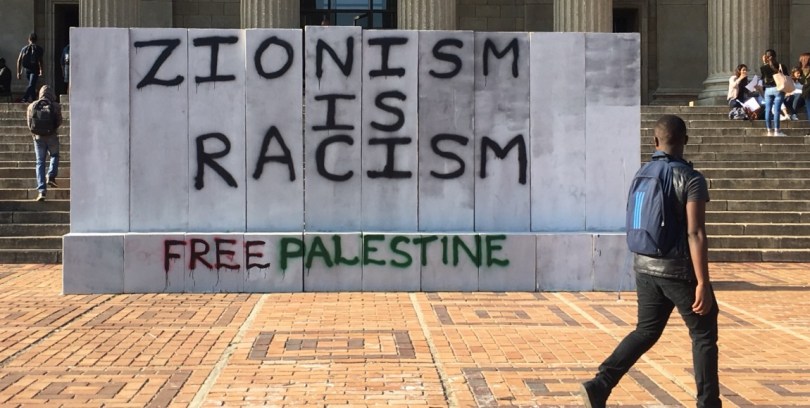
President Donald Trump’s executive order on antisemitism encourages the attorney general to use a federal law created to target the Klu Klux Klan, and will direct federal agencies to tell colleges and universities to “monitor” and “report activities” by foreign students, staff and faculty for activities related to terrorism, according to a draft of the order obtained by the Forward.

In addition, it says that the attorney general is “encouraged” to use the federal “conspiracy against rights” law “to combat antisemitism.” The measure was originally passed to combat KKK violence in the aftermath of the Civil War, and has since been used to prosecute civil rights violations related to elections. Trump himself was charged with violating the law in relation to his alleged attempt to subvert the results of the 2020 election.

The Anti-Defamation League has called for more aggressive action against students protesting Israel, including asking school presidents to investigate Students for Justice in Palestinechapters for providing material support to terrorist organizations. The Secure Community Network — the main organization providing security advice to synagogues and Jewish organizations in the United States — recently called for the country to “expel any non-citizen alien who supports terrorism,” including protesters.

Republicans have focused almost all of their attention on what they believe is antisemitism coming from left-wing activists and critics of Israel. The Heritage Foundation released a blueprint for the Trump administration to fight antisemitism called Project Esther that discussed how to dismantle a “Hamas Support Network” composed of progressive advocacy groups and foundations, while the author of that report said that he was not concerned with addressing the threat posed by white supremacists.

Trump antisemitism executive order invokes anti-KKK law and targets ‘leftist, anti-American’ universities

RAND and SeaLight Part 3b: Four Ways China Is Growing Its Media Influence in Southeast Asia

05-10-2022: Four Ways China Is Growing Its Media Influence in Southeast Asia

China’s most straightforward method of media outreach is directly broadcasting or publishing its state media content in target ASEAN countries. Xinhua, China’s official state media agency, has print bureaus in every Southeast Asian country. TV news channels CCTV-4 and the English-language CGTN likewise operate in nearly every country in the region, while China Radio International airs multilingual content in Vietnam, Laos, Cambodia, Thailand, and Myanmar. Xinhua is a ministry-level agency directly under the State Council, while the other media organizations all operate under the Chinese Communist Party Publicity Department. 

Read More »