
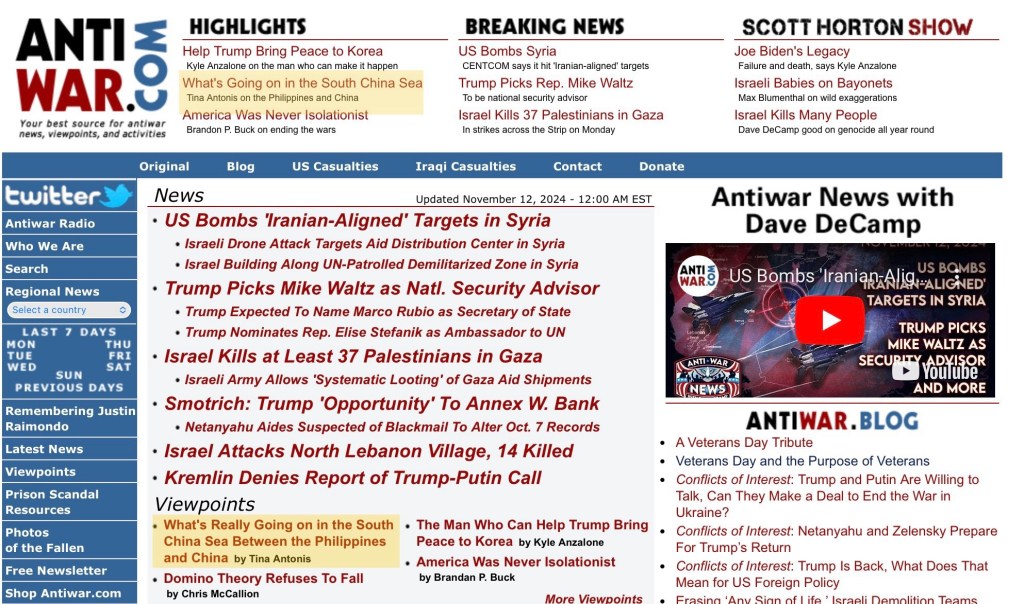
Read it at Antiwar.com or here with graphics. FYI, the “Ant” in Antonis is pronounced as 🐜.
Read it at Antiwar.com or here with graphics. FYI, the “Ant” in Antonis is pronounced as 🐜.
On an early spring day in 1959, Edward Hunter testified before a US Senate subcommittee investigating “the effect of Red China Communes on the United States.” It was the kind of opportunity he relished. A war correspondent who had spent considerable time in Asia, Hunter had achieved brief media stardom in 1951 after his book Brain-Washing in Red China introduced a new concept to the American public: a supposedly scientific system for changing people’s minds, even making them love things they once hated.
But Hunter wasn’t just a reporter, objectively chronicling conditions in China. As he told the assembled senators, he was also an anticommunist activist who served as a propagandist for the OSS, or Office of Strategic Services — something that was considered normal and patriotic at the time. His reporting blurred the line between fact and political mythology.
Related:
Read More »If war breaks out in Asia, the U.S. won’t send ground troops. Take note, Philippines!
MacArthur’s Last Stand Against a Winless War
Never get involved in a land war in Asia, MacArthur had told Kennedy, because if you do, you will be repeating the same mistake the Japanese made in World War II—deploying millions of soldiers in a futile attempt to win a conflict that cannot be won.
…
Kennedy appreciated MacArthur’s soothing judgment on Cuba (and would soon change the military’s top leadership—perhaps in keeping with MacArthur’s views), but then shifted the subject to Laos and Vietnam, where communist insurgencies were gaining strength. The Congress, he added, was pressuring him to deploy U.S. troops in response. MacArthur disagreed vehemently: “Anyone wanting to commit ground troops to Asia should have his head examined,” he said. That same day, Kennedy memorialized what MacArthur told him: “MacArthur believes it would be a mistake to fight in Laos,” he wrote in a memorandum of the meeting, adding, “He thinks our line should be Japan, Formosa, and the Philippines.” MacArthur’s warning about fighting in Asia impressed Kennedy, who repeated it in the months ahead and especially whenever military leaders urged him to take action. “Well now,” the young president would say in his lilting New England twang, “you gentlemen, you go back and convince General MacArthur, then I’ll be convinced.” So it is that MacArthur’s warning (which has come down to us as “never get involved in a land war in Asia”), entered American lore as a kind of Nicene Creed of military wisdom—unquestioned, repeated, fundamental.
Since publication of John Mearsheimer’s and Stephen Walt’s ‘The Israel Lobby’ in 2007, superior public relations has served as the main explanation for the outsized influence that the nation of Israel holds over American politicians. In that telling, AIPAC (American-Israel Public Affairs Committee) and other supporters of Israel built a sophisticated and far-reaching public relations machine that promotes US politicians who support Israel and punishes those who don’t.
The ‘Israel Lobby’ Works for the US Military Industrial Complex – by Rob Urie – 27 June 2024
H/T: xenagoguevicene
The United States is rife with paradoxes and this is one of them. On January 11, 2021, a few days away from ceasing to be president of the powerful nation -reluctantly and not without trying with his fanatics to reverse the electoral process won by Joseph Biden-, Donald Trump took a low blow and put the name of Cuba in a counterfactual list of countries sponsoring terrorism (SSOT). The incongruity lies not only in the fact that it is without a grain of truth, it is that in fact Cuba and the United States have in place a bilateral cooperation agreement on counterterrorism.
A List that Does not Match the Truth
The Primary Sources on Kissinger’s Controversial Legacy
Archive Obtained and Published Previously Secret Records on Kissinger’s Role in Secret Bombing Campaigns in Cambodia, Illegal Domestic Spying, Support for Dictators, and Dirty Wars Abroad
Henry Kissinger: The Declassified Obituary
Previously:
Twelve days ago, I was asked by the Opinion section of the New York Times to write an essay on the JFK assassination nearly 60 years later. This was a major breakthrough because the newspaper of record has always embraced the official version of the assassination, even as the Warren Report, based on the “magic bullet” and all that nonsense, has grown increasingly tattered over the years. In 2015, when The Devil’s Chessboard — my book about CIA spymaster Allen Dulles and the national security state’s war with President Kennedy — was published, the Times refused to review it. (Nonetheless, the book was a New York Times bestseller.)
At 60, We’re Winning – and Losing – the JFK Media War
H/T: Kim Iversen
Henry Kissinger, the toweringly influential former secretary of state who earned a reputation as a sagacious diplomat but drew international condemnation and accusations of war crimes for his key role in widening the American presence in Vietnam and the U.S. bombing of Cambodia, died Wednesday.
Henry Kissinger, world-shaping diplomat who was revered and reviled, dies at 100 🎉
Related:
Cultural Exchange and the Cold War: How the West Won (archived)
There are many theories of why Soviet communism collapsed and the Cold War ended. Here are a few of them to consider:
…
That is a claim also made by a former Hungarian ambassador to Washington, Andras Simonyi*, who led a rock band in Budapest during the Cold War. In a talk titled “How Rock Music Helped Bring Down the Iron Curtain,” delivered at the Rock ‘n Roll Hall of Fame in Cleveland, Simonyi said, ”Rock ‘n roll, culturally speaking, was a decisive element in loosening up communist societies and bring them closer to the world of freedom.”
Related:
He plays guitar in the rock band, The Coalition of the Willing (est.2003) with top rated U.S. guitarist Jeff “Skunk” Baxter (Steely Dan, Doobie Brothers) which has Secretary of State Tony Blinken (guitar, vocals) as a regular guest.
The 38-year-old called the social media app “digital fentanyl” days ago. Now he’s on the platform.
Vivek Ramaswamy flip-flops on TikTok
Related:
GOP 2024 hopeful Vivek Ramaswamy proposes raising the voting age to 25
Ramaswamy: Teens Would Choose TikTok Over Voting Rights
Vivek Ramaswamy would ban anyone under 16 from having social media accounts and believes members of Gen Z would choose TikTok over voting rights if forced to decide.
The 26th Amendment: “Old Enough to Fight, Old Enough to Vote”
 Ms. Cat’s Chronicles
You must be logged in to post a comment.