
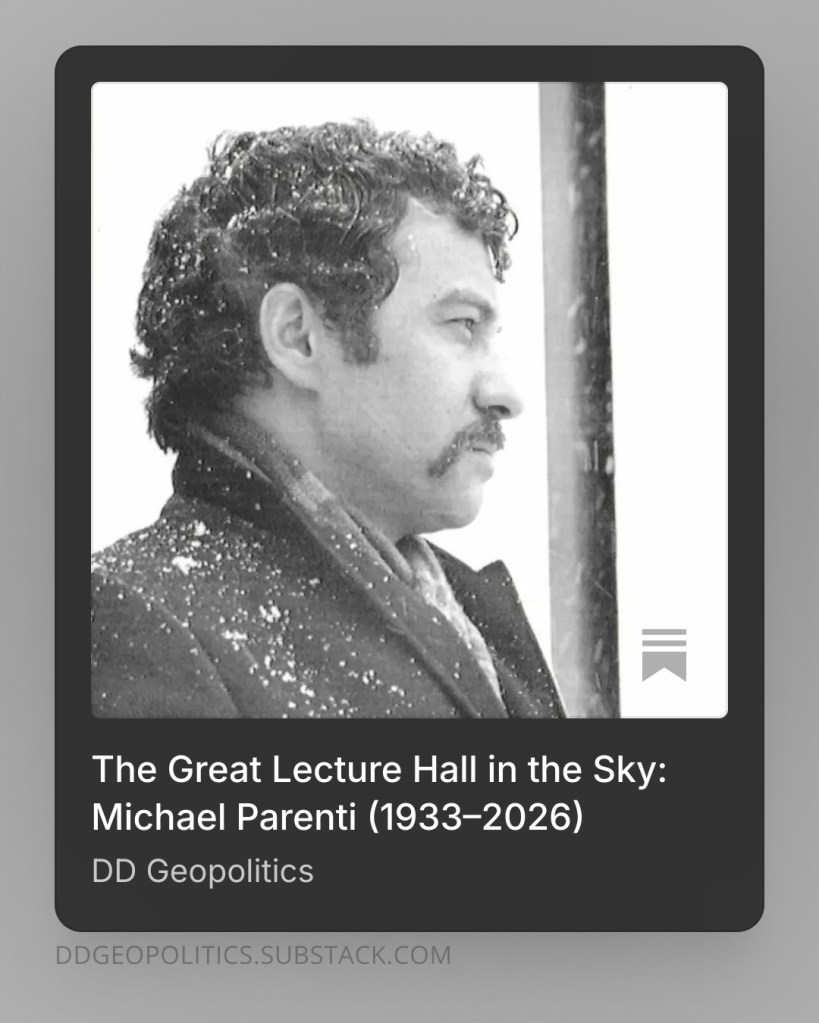
The Great Lecture Hall in the Sky: Michael Parenti (1933–2026)
Michael Parenti died today at 92, peacefully, surrounded by family.
The Great Lecture Hall in the Sky: Michael Parenti (1933–2026)
Michael Parenti died today at 92, peacefully, surrounded by family.

By Brian Berletic
While much of the world’s attention is currently focused on the economic fallout of the tariffs imposed by the United States on allies and designated adversaries alike, they are only one part of a much wider strategy aimed at what U.S. policymakers themselves claim is a bid to maintain the U.S. as “the world’s dominant superpower.”
The plan behind Washington’s violations of the One-China Principle
Hello Bolsonaristas who follow me here. Shall we try to learn? Soros is not a COMMUNIST. He financed the FALL of Communism in Europe, and is proud of it, read his text: George Soros and the Fall of Communism in Europe. He preaches the opposite of Communism: Global Governance to access all markets. capisce?
Read More »
Jimmy Carter, out of office, had the courage to call out the “abominable oppression and persecution” and “strict segregation” of Palestinians in the West Bank and Gaza in his 2006 book “Palestine: Peace Not Apartheid.” He dedicated himself to monitoring elections, including his controversial defense of the 2006 election of Hugo Chavez in Venezuela, and championed human rights around the globe. He lambasted the American political process as an “oligarchy” in which “unlimited political bribery” created “a complete subversion of our political system as a payoff to major contributors.”
The Soviet Union was asked by the Democratic Republic of Afghanistan to intervene to help fight against the Afghan mujahideen that the US was arming: Soviet-Afghan War
Carter, Charter 77, and Solidarność (Solidarity):
Read More »Congress Considers Neocon Lesson Plans to Keep Kids Off Communism
In the latest front in the culture war over school curricula, the House of Representatives is set to vote Friday on a bill that would give a congressional stamp of approval to the lesson plans of the Victims of Communism Memorial Foundation, a group closely linked to fervently hawkish corners of the foreign policy blob.
Read More »
“Ukraine and Slovakia will create an energy hub for Eastern Europe,” headlined Ukrainska Pravda on Monday , citing the words of Ukrainian Prime Minister Denis Shmyhal after his meeting with Prime Minister Robert Fico, who has recovered and returned to his post after the assassination attempt that put his life in danger. Although the Ukrainian media mainly focused on news about energy cooperation, the Slovak president did not hesitate to repeat to Shmyhal his position regarding Ukraine’s geopolitical position. As Politico stated on Monday, the Slovak president said on Sunday in an appearance in a Slovak media that “as long as I lead the government, I will direct the deputies under my control as chairman of the party [Smer] to never accept Ukraine’s accession.” According to Strana, Fico insisted on his “100%” support for Ukraine’s entry into the European Union, but not into NATO. This “no” attitude towards Ukraine’s entry into the military bloc is compounded by Fico’s intention to resume normal relations with Russia if the war ends during his term in office. However, as his meeting with the Ukrainian prime minister shows, this position is not in contradiction with cooperating with Kyiv on issues affecting both countries, including energy.
Read More »
Brian Berletic, September 24
Amid the ongoing conflict in Ukraine and growing tensions in the Asia-Pacific, Washington is moving toward an equally dangerous, regional war in the Middle East between its Israeli proxies and a growing list of neighboring states and organizations.
Washington Sets Trap for Iran, Will Iran Take the Bait? (archived)

 Ms. Cat’s Chronicles
You must be logged in to post a comment.