As Phyllis Chesler warned us in 1974, gender bias has accompanied psychiatric power throughout its history. Years later, in 2005, in the last annotated edition of Women and Madness , the author insisted on the persistence of this bias, which even today, 50 years later, seems to remain unchanged. Authors such as Ussher, Caplan, Margot Pujal and many others were situated in that same space. With their differences and nuances, they all converge on the same point: gender problems and discomforts produce deep suffering. This suffering leaves marks on our bodies and our behavior.
In our relentless pursuit to transcend the human suffering, we’ve stumbled into a dangerous oversimplification: an improved mental state reflects the absence or decrease in negative emotional states. This reductionist view has not only cheapened our understanding of the human emotional spectrum but has also paved the way for a troubling linguistic shift.
AS NEW HAMPSHIRE considers legalizing assisted suicide, also referred to as medical aid in dying (MAID), I would like to draw attention to the potential impacts this bill could have on disabled and other marginalized residents.
I was 19 years old the second time I attempted to die by suicide. I had just been diagnosed with a chronic but not life-threatening illness, I had rapidly lost about 70% of my hearing in the middle of completing a music degree, and I was struggling with untreated anorexia that was taking a serious toll on my health.
At my intake appointment with a new therapist a few days after my attempt, I explained my situation and the hopelessness I was feeling. She nodded along, then looked me in the eyes and said something I will never forget:
“I would probably kill myself if I were you.”
She wasn’t the first person to say this to me as I started becoming more noticeably disabled, but she was probably the last person I expected to do so. Now that I work in disability policy, nothing surprises me. I hear stories from other disabled people about doctors pressuring them to sign DNRs because they are assumed to have a low quality of life due to their disability. I get messages on social media from people asking me how to advocate for appropriate pain management when their doctors don’t believe the amount of pain they’re in. I pore over story after story of people like Michael Hickson and Tinslee Lewis having treatment withdrawn, withheld, or threatened because of the pervasive view that it’s better to be dead than disabled.
A group of 400 Israeli survivors of the October 7 Hamas attack, including civilians, released hostages, and soldiers, could be offered MDMA-assisted psychotherapy in a potentially trailblazing study to commence later this year.
…
“Our goal is to create a therapy model that can serve universally, with the intention and prayer to help people,” said Dr. Keren Tzarfaty, CEO and co-founder of MAPS Israel, which is already running trials evaluating MDMA-assisted therapy for the treatment of post-traumatic stress disorder, depression, and eating disorders. “We hope it will demonstrate high levels of safety and effectiveness and enable us to offer the program in other places over the region and the world, not only to treat PTSD, but to help people open their hearts and expand their minds.”
…
Dr. Rick Doblin, founding president of the U.S.-based MAPS and a longtime advocate for using psychedelic therapy in the Israeli–Palestinian conflict, said that the study would serve as a seminal piece of research into whether psychedelic-assisted therapy can help large groups of traumatized people.
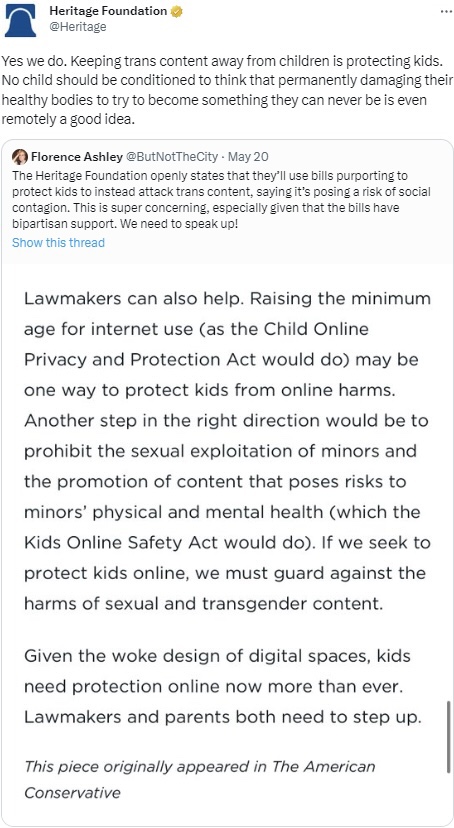
Wrote to Tammy Baldwin about how Republicans want to censor LGBT content with the KOSA bill that she is sponsoring! I included the following Techdirt article in my email! Not one word, about it, in her reply to me (which is just a form letter)! In fact, I didn’t bring up anything that she mentioned! As she is a LGBT person, I thought that she’d be concerned but I guess not?!
Meanwhile, Republicans are now freely admitting that they’re going to use KOSA to force websites to censor LGBTQ content. They’re literally proud of it. The Heritage Foundation, which at least used to have some principled stances before being taken over by culture warriors without any principles, is bragging about how it will use KOSA in this manner:
Congress has resurrected the Kids Online Safety Act (KOSA), a bill that would increase surveillance and restrict access to information in the name of protecting children online. KOSA was introduced in 2022 but failed to gain traction, and today its authors, Sens. Richard Blumenthal (D-CT) and Marsha Blackburn (R-TN), have reintroduced it with slight modifications. Though some of these changes were made in response to over 100 civil society organizations and LGBTQ+ rights groups’ criticisms of the bill, its latest version is still troubling. Today’s version of KOSA would still require surveillance of anyone sixteen and under. It would put the tools of censorship in the hands of state attorneys general, and would greatly endanger the rights, and safety, of young people online. And KOSA’s burdens will affect adults, too, who will likely face hurdles to accessing legal content online as a result of the bill.
Over the last week or so, I keep hearing about a big push among activists and lawmakers to try to get the Kids Online Safety Act (KOSA) into the year-end “must pass” omnibus bill. Earlier this week, one of the main parents pushing for the bill went on Jake Tapper’s show on CNN and stumped for it. And, the latest report from Axios confirms that lawmakers are looking to include it in the lameduck omnibus, or possibly the NDAA (despite it having absolutely nothing to do with defense spending).
The bill aims to curb people’s speech by targeting platforms By Didi Rankovic | Reclaim The Net | December 27, 2021
If a state senator got his way, the state of New York could soon get a new law aimed at regulating what content can appear on social media. The bill is designed to circumvent existing federal-level solutions in some instances and is reportedly inspired by internal documents leaked by former Facebook employee Frances Haugen.


 Ms. Cat’s Chronicles
You must be logged in to post a comment.