While much of the world’s attention is currently focused on the economic fallout of the tariffs imposed by the United States on allies and designated adversaries alike, they are only one part of a much wider strategy aimed at what U.S. policymakers themselves claim is a bid to maintain the U.S. as “the world’s dominant superpower.”
Three years ago, the most powerful political families in the Philippines joined hands to secure the nation’s biggest election victory in four decades. Now they are locked in a feud that threatens to derail one of Asia’s economic growth stars.
In dramatic events on Tuesday, Philippine President Ferdinand Marcos Jr.’s government arrested and deported his predecessor Rodrigo Duterte to face the International Criminal Court in The Hague. The move came just over a month after the impeachment of his daughter, Vice President Sara Duterte, by allies of Marcos. A Senate trial, which would determine whether she gets removed from office, is scheduled to begin in July.
Sara Duterte, left, with Ferdinand Marcos Jr. in 2022. Photographer: Ezra Acayan/Getty ImagesRead More »
THE West Philippine Sea “cognitive warfare” narrative has been playing since Sept. 2012 when then President Noynoy Aquino signed Administrative Order 29 “Naming the West Philippine Sea of the Republic of the Philippines, and for other purposes.”
…
This has already caused massive real economic damage to Filipinos, like the loss of 1.5-million Chinese tourist arrivals and $1.5-billion (P90-billion) tourism revenues for our six million tourism workers.
Even worse, it can give the US the basis for creating a false flag operation blaming China for a human disaster and precipitating a major conflict – which is clearly what the US warmongers intend as evidenced by the US military bases in the country.
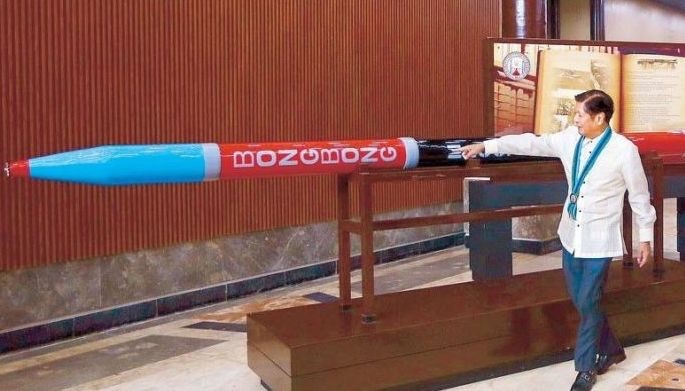
’A Failed Project?’ The only VALID reason I could think of for all these “secrecy” or lack of transparency is that the program itself was NOT successful, and there are a number of ways that it could have failed. For one, the FAILURE or SUCCESS RATE of the launches were never published, and it’s possible that there were just too many launch failures, like the rockets exploding or veering off course at their launch pad or after launch, or even rockets not taking off at all. And even if the launches were successful, there is the issue of how accurate the rocket was in terms of hitting its target. If it ends up several hundreds or thousands of meters from its intended target, then it’s not very useful. And just like the Launch Rate, the Accuracy of the rockets were also never published.
MANILA – President Ferdinand R. Marcos Jr. on Friday signed laws declaring the maritime zones under Philippine jurisdiction and designating sea lanes in the country for foreign vessels and aircraft.
The South China Sea Arbitration did not rule on sovereignty, and China does not recognize it because the Arbitral Tribunal lacked jurisdiction. “The Arbitral Tribunal violated the principle of state consent, exercised its jurisdiction ultra vires and rendered an award in disregard of the law. This is a grave violation of UNCLOS and general international law, Wang said.” The United Nations Convention on the Law of the Sea (UNCLOS) is an international treaty that establishes a legal framework for all marine and maritime activities. The Permanent Court of Arbitration is not an agency of the United Nations. The PCA rents space in the same building as the UN’s International Court of Justice. A Congressional Research Service report, dated August 2023, stated that the U.S. has not declared its position regarding sovereignty over any of the geographical elements that comprise the South China Sea.
THE PHILIPPINE Senate would put proposals to change the 1987 Constitution on the back burner and would instead focus on measures to boost the military amid growing tensions with China, according to the Senate president.
The chamber would also pass bills that seek to boost healthcare and jobs while easing hunger, Senate President Francis “Chiz” G. Escudero said in a speech as Congress resumed sessions on Monday.
…
At the weekend, he said they would tackle a proposal to amend the Electric Power Industry Reform Act (EPIRA) amid blackouts.
The Senate will also push changes to the Corporate Recovery and Tax Incentives for Enterprises (CREATE), particularly lower taxes on domestic and foreign companies.
Mr. Escudero said Congress should go beyond laws that only benefit big business, and find solutions to problems with healthcare, joblessness and poverty.
“We will take peaceful measures to defend our people’s right to sail in our seas and fish in our waters, as what our ancestors had done, and what our children and grandchildren shall do,” he added.
The Senate in December passed a bill that seeks to boost the country’s defense program through investments in local defense equipment manufacturing. The measure will give the Department of National Defense P1 billion in seed funding.
…
Also on Monday, Speaker and Leyte Rep. Ferdinand Martin G. Romualdez said the House of Representatives would also seek changes to EPIRA.
…
He said changes to EPIRA, which liberalized the power industry, would bring down electricity prices and ease inflation.
…
It would now fast-track changes to EPIRA and a bill that seeks to extend the lease period for foreign investors. Other pending measures include amendments to the Agrarian Reform law and another that will modernize national defense.
“We have to continue building roads, highways, ports, school buildings and climate change-proof structures to maintain and expand economic growth,” Mr. Romualdez said. “I emphasize our commitment to pass the remaining priority bills before the end of the third regular session.”
…
Jose Enrique “Sonny” A. Africa, executive director of think tank IBON Foundation, said it is wrong to equate economic progress with growth given the increasing number of poor Filipino families.
“Most Filipinos haven’t become better off because of this growth,” he told BusinessWorld. “The number of self-rated poor families has soared by 3.4 million since the start of the Marcos administration from 12.6 million in June 2022 to 16 million in June 2024.”
As the United States steps up its campaign to provoke China into war, the Philippines has lined up behind Washington, increasingly transforming the country into a lead attack dog in the region for American imperialism. Seeking to obscure the fact that the country has now been placed on the front lines of a catastrophic conflict, the Philippine ruling elite is demonizing China and people of Chinese ethnicity with absurd and lurid claims that Beijing is infiltrating spies into the country.
According to experts, Marcos’ tough words serve domestic political purposes when he needs to shift Filipinos’ discontent over his administration’s performance on livelihood and the economy, and are also a response to the “support” from countries outside the region, including the US.
…
“The US is the biggest external disturbance to peace and stability in the South China Sea,” Ding said, “without instigation from US, it is more likely that China and the Philippines would manage their differences through negotiation and consultation.”


 Ms. Cat’s Chronicles
You must be logged in to post a comment.