Frontier of global anti-imperialist struggle: China’s perceptions of the Palestinian struggle from 1955 to 1976 China is probably one of few states which flipped its diplomatic stance on the “Palestinian-Israeli conflict” in the most dramatic manner from the 1950s to 1970s. In only 20 years, the People’s Republic of China (PRC)’s official foreign policy dramatically changed from almost establishing diplomatic relations with Israel in 1950 to denying any legitimacy of the Israeli state in the 1960s to 1970s. As I aim to demonstrate in this article, the Maoist era, especially from 1955 to 1976, established the foundation of China’s diplomatic support for the Palestinian liberation movement, and this legacy is still one of the main factors guiding China’s official stance on Palestine today.
Now while investigating Chinese gun laws I came across this paper written by Huan Zhu at the University of Kansas. This is what she had dug up form her research:
“After the establishment of the People’s Republic of China, there have been three special laws or regulations issued on control of firearms, which are Temporary Measures of Control of Firearms (1952), Measures of the People’s Republic of China for the Control of Firearms (1981), and Law of the People’s Republic of China on Gun Control (1996) (hereinafter referred to as Law on Gun Control).”
In the second group on your list, you raise the question of “restricting alien parties”, that is, the question of the friction in various localities. Your concern over this matter is justified. There has been some improvement recently, but fundamentally the situation remains unchanged. Question: Has the Communist Party made its position on this question clear to the Central Government? Answer: We have protested. Question: In what way? Answer: Our Party representative, Comrade Chou En-lai, wrote a letter to Generalissimo Chiang Kai-shek as early as July. Then again on August 1, people from all walks of life in Yenan sent a telegram to the Generalissimo and the National Government, demanding the withdrawal of the “Measures for Restricting the Activities of Alien Parties”, which had been secretly circulated and which are at the very root of the “friction” in various places. Question: Has there been any reply from the Central Government? Answer: No. But it is said that there are also people in the Kuomintang who disapprove of these measures. As everybody knows, an army that participates in the common fight against Japan is a friendly army, not an “alien army”, and similarly, a political party that participates in the common fight against Japan is a friendly party, not an “alien party”. There are many parties and groups taking part in the War of Resistance and, while they vary in strength, they are fighting in the same cause; surely they must all unite and must in no circumstances “restrict” one another. Which party is an alien party? The party of the traitors headed by Wang Ching-wei, the running dog of Japan, because it has nothing in common politically with the anti-Japanese parties; that is the kind of party which should be restricted. Between the Kuomintang and the Communist Party there is common political ground, namely, resistance to Japanese aggression. Therefore, the problem is to concentrate all our strength on opposing and checking Japan and Wang Ching-wei, and not on opposing and checking the Communist Party. This is the only basis for formulating correct slogans. Wang Ching-wei has three slogans: “Oppose Chiang Kai-shek,” “Oppose the Communist Party”, and “Be friends with Japan”. Wang Ching-wei is the common enemy of the Kuomintang, the Communist Party and the entire people. But the Communist Party is not the enemy of the Kuomintang, nor is the Kuomintang the enemy of the Communist Party; they should unite and help each other rather than oppose or “restrict” each other. The slogans on our side must be different from Wang Ching-wei’s, they must be the opposite of his and never be confused with them. If he says, “Oppose Chiang Kai-shek”, everyone should support Chiang Kai-shek; if he says, “Oppose the Communist Party”, everyone should unite with the Communist Party; and if he says, “Be friends with Japan”, everyone should resist Japan. We should support whatever the enemy opposes and oppose whatever the enemy supports. In articles nowadays people often quote the saying, “Do not sadden your friends and gladden your enemies.” It comes from a letter which Chu Fou, a general under Liu Hsiu of the Eastern Han Dynasty, wrote to Peng Chung, the prefect of Yuyang. In context it reads, “Whatever you do, you must be sure that you do not sadden your friends and gladden your enemies.” Chu Pou’s words express a clear-cut political principle which we must never forget.
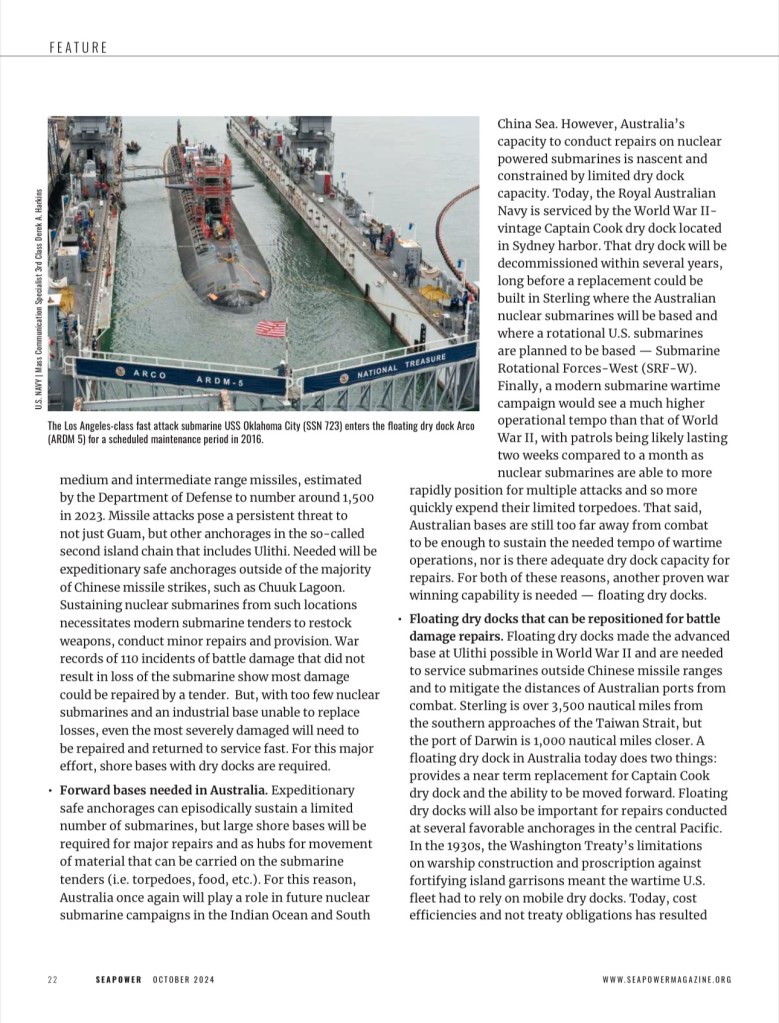
The Navy oiler – a tanker designed to refuel other ships while at sea – shuddered from the hit. Almost immediately, water began to flood into the engine room and at least one of the ship’s rudders was out of service. The damage and flow of water proved challenging for the crew. As the only US Navy fuel ship in the area capable of supporting a carrier strike group came to a stop, the vulnerability of the thin lifeline of American afloat logistics became apparent. How would an entire carrier strike group remain operational without fuel for its planes and escorts? With one stroke, the hitting power of a substantial portion of the U.S. Navy was reduced.
Never get involved in a land war in Asia, MacArthur had told Kennedy, because if you do, you will be repeating the same mistake the Japanese made in World War II—deploying millions of soldiers in a futile attempt to win a conflict that cannot be won.
…
Kennedy appreciated MacArthur’s soothing judgment on Cuba (and would soon change the military’s top leadership—perhaps in keeping with MacArthur’s views), but then shifted the subject to Laos and Vietnam, where communist insurgencies were gaining strength. The Congress, he added, was pressuring him to deploy U.S. troops in response. MacArthur disagreed vehemently: “Anyone wanting to commit ground troops to Asia should have his head examined,” he said. That same day, Kennedy memorialized what MacArthur told him: “MacArthur believes it would be a mistake to fight in Laos,” he wrote in a memorandum of the meeting, adding, “He thinks our line should be Japan, Formosa, and the Philippines.” MacArthur’s warning about fighting in Asia impressed Kennedy, who repeated it in the months ahead and especially whenever military leaders urged him to take action. “Well now,” the young president would say in his lilting New England twang, “you gentlemen, you go back and convince General MacArthur, then I’ll be convinced.” So it is that MacArthur’s warning (which has come down to us as “never get involved in a land war in Asia”), entered American lore as a kind of Nicene Creed of military wisdom—unquestioned, repeated, fundamental.
As the US celebrates $95.3 billion in military funding for Israel, Taiwan, Ukraine, and the US, we unpack the US Indo-Pacific strategy and what’s at stake.
MOSCOW, May 15 (Xinhua) — On the eve of his two-day state visit to China, which starts on Thursday, Russian President Vladimir Putin took a written interview with Xinhua.



 Ms. Cat’s Chronicles
You must be logged in to post a comment.