Despite the UN’s apparent disinterest in pursuing a broader inquiry, Russia claimed this week that it would continue to pursue an international effort. “We will do everything in our power to continue to insist and to initiate such an international investigation,” Kremlin spokesman Dmitry Peskov told reporters during a conference call.
*Russian use of nuclear weapons is a plausible contingency that Washington needs to account for and a hugely important factor in determining the future trajectory of the conflict
*Although a Russian decision to attack a NATO member state is by no means inevitable, the risk is elevated while the conflict in Ukraine is ongoing.
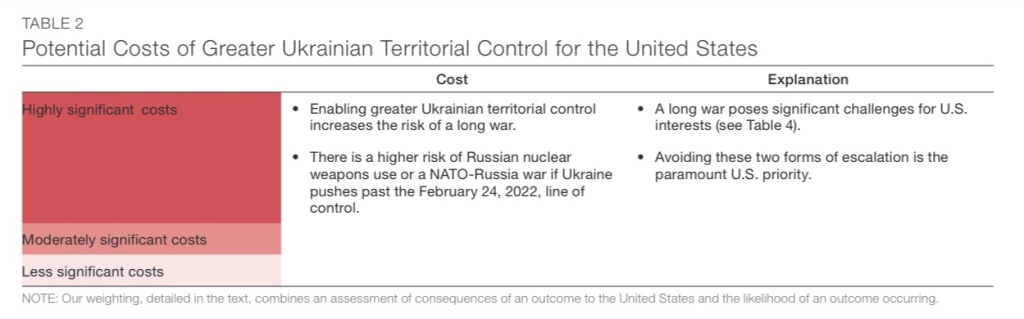
*Chairman of the Joint Chiefs of Staff Mark Milley reportedly kept a list of “U.S. interests and strategic objectives” in the crisis: “No. 1” was “Don’t have a kinetic conflict between the U.S. military and NATO with Russia.” The second, closely related, was “contain war inside the geographical boundaries of Ukraine.”
*It is clear why Milley listed avoiding a Russia-NATO war as the top U.S. priority: The U.S. military would immediately be involved in a hot war with a country that has the world’s largest nuclear arsenal. Keeping a Russia-NATO war below the nuclear threshold would be extremely difficult, particularly given the weakened state of Russia’s conventional military.
*Since neither side appears to have the intention or capabilities to achieve absolute victory, the war will most likely end with some sort of negotiated outcome.
*Since avoiding a long war is the highest priority after minimizing escalation risks, the United States should take steps that make an end to the conflict over the medium term more likely.
*A major source of uncertainty about the future course of the war is the relative lack of clarity about the future of U.S. and allied military assistance to Ukraine.
After two weeks of silence in detailing how it would react to the G7 oil price cap, overnight the Kremlin raised the stakes for the west when state-run Tass news service quoted Deputy Prime Minister Alexander Novak as sayingthat Russia may reduce output by 500,000 to 700,000 barrels a day in response to the cap.
The global energy crisis triggered by Russia’s invasion of Ukraine is causing profound and long-lasting changes that have the potential to hasten the transition to a more sustainable and secure energy system, according to the latest edition of the IEA’s World Energy Outlook.
The Biden administration intends to delay setting a price cap on Russian oil until after the November 8 midterms amid concerns that the fallout could weigh on Democrats’ standing in the upcoming vote, American media reported on Friday, citing sources.
Contingency planning, negotiations on price both within the administration and with allies, as well as the OPEC+ production cut have also contributed to the delay, the report said.
However, in a recent address to the press, the US president clarified that resuming oil exports from Venezuela was only one of several options. “There’s a lot of alternatives. We haven’t made up our mind yet,” he told reporters after calling the OPEC+ decision a “disappointment.” Washington has demanded that the Maduro government re-engages in talks with the opposition as a precondition for any changes to its sanctions policy.
The Biden administration wants to leverage U.S. companies with ties to Saudi Arabia but without sacrificing regional security efforts, according to the report.
…
The Biden administration will immediately begin scaling back its diplomatic and military activities in Saudi Arabia, at least until OPEC+’s next meeting on December 4, NBC reports, citing an unnamed senior administration official who said the meeting will “be a key test” of how OPEC+ will respond to European Union sanctions that ban Russian oil imports, effective December 5.
…
The OPEC+ conglomerate–a Saudi-led alliance of oil-producing countries, including Russia–plans to curb oil production by 2 million barrels a day beginning in November. The move, characterized by the Saudi government as an effort to stabilize energy markets, is expected to increase global oil prices and raise gas prices. The Biden administration has vowed “consequences” for Saudi Arabia over the announcement, and Democratic lawmakers have urged the president to halt arms sales to the kingdom, but the White House has yet to announce how, exactly, it will retaliate and is not expected to do so until Congress returns from recess after the November midterms.




 Ms. Cat’s Chronicles
You must be logged in to post a comment.