World Court orders Venezuela to refrain from action in border dispute with Guyana + More

World Court orders Venezuela to refrain from action in border dispute with Guyana

Friday’s ruling is the latest development in the larger border dispute. The ICJ said in April it had jurisdiction over the case, but a final ruling could be years away.

Interestingly, Judge Joan Donoghue used to work for the US State Department. 🤔

Related:

Essequibo and Other Border Issues: Venezuela’s Territorial Losses to Imperialist Powers Through the Centuries (Part 1)

Previous posts on Venezuela v Guyana

Opposition NGO warns Essequibo question might end up in war between Venezuela and Guyana + More

Control Ciudadano (Social Watch – CC) Chairwoman Rocío San Miguel said Guyanese President Irfaan Alí’s recent statements regarding the military support of several countries to defend the Essequibo amounted to a “very strong warning for Venezuela,” which will hold a referendum on the matter on Dec. 3.

NGO warns Essequibo question might end up in war between Venezuela and Guyana

Rocío San Miguel is Venezuelan Opposition.

Related:

US Defense officials to visit Guyana amid Venezuela row: Guyanese VP

Both nations claim the 160,000-square-kilometer (62,000-square-mile) region, in a dispute that has intensified since ExxonMobil discovered oil there in 2015.

Another major discovery in Essequibo in October added further to Guyana’s reserves, making them greater than those of Kuwait or the United Arab Emirates.

US Escalates Essequibo Dispute by Militarizing Guyana

Venezuela: Maduro Warns of ExxonMobil Interference Ahead of ‘Historical’ Essequibo Strip Vote

For historical context: The Secret Agenda Behind the Venezuela-Guyana Conflict

House Republicans Propose The Study Of An Oil Naval Blockade Of China

The House of Representatives is discussing a move that would effectively amount to an act of war if carried out: a naval blockade on China.

House Republicans Propose The Study Of An Oil Naval Blockade Of China

The following is outdated, especially considering the problems with the US Navy’s LCS ships, but I thought that the bold quote was interesting. I highly doubt that Russia would ever submit to the US!

Related:

[2013] Stranglehold: The Context, Conduct and Consequences of an American Naval Blockade of China

In short, Russia would not only be China’s best hope of overcoming an American blockade, but it would also be the United States’ key to closing China’s transit route through Central Asia and preventing China’s two neighboring oil producers from supplying it with petroleum. In an American blockade of China, Russia’s importance as a swing state cannot be overstated, as is borne out by the observation that “no blockade of China in history has succeeded without Russian acquiescence.”

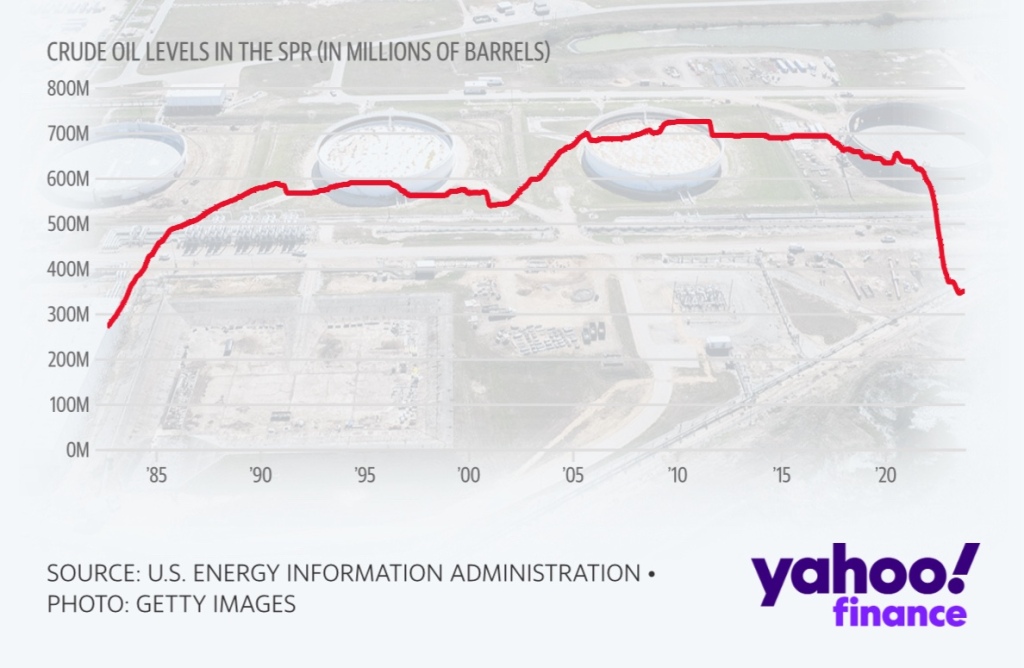
Is this why Biden isn’t refilling the Strategic Petroleum Reserve?!

[2017] Trump’s Budget Delivers Big Oil’s Wish: Reducing Strategic Petroleum Reserve

While most observers believe the budget will not pass through Congress in its current form, budgets depict an administration’s priorities and vision for the country. Some within the oil industry have lobbied for years to drain the SPR, created in the aftermath of the 1973 oil crisis.

Exxon, as well as the American Petroleum Institute (API) and the Independent Petroleum Association of America (IPAA), have long lobbied for a drawdown of SPR‘s supply, according to lobbying disclosure records reviewed by DeSmog. They supported two key bills, proposed but never passed by Congress: H.R. 4136 in 2012 and S. 1231 in 2015.

H.R. 4136, lobbied for by Exxon, API, and IPAA**, says that the Strategic Petroleum Reserve can only be tapped if more federally owned public lands and waters were leased to the oil and gas industry. S. 1231, the Strategic Petroleum Reserve Modernization Act of 2015, called for a Department of Energy study of the SPR “to determine options available for [its] continued operation,” to be completed 180 days after the bill’s passage.

“[T]he SPR is unnecessary in the first place. Private inventories and reserves are abundant, and open markets will respond more efficiently to supply shocks than federally controlled government stockpiles,” wrote Loris, who began his career as an associate for the Charles G. Koch Charitable Foundation. “Congress should authorize the Department of Energy to sell the entire inventory, using the revenues solely for deficit reduction.”