
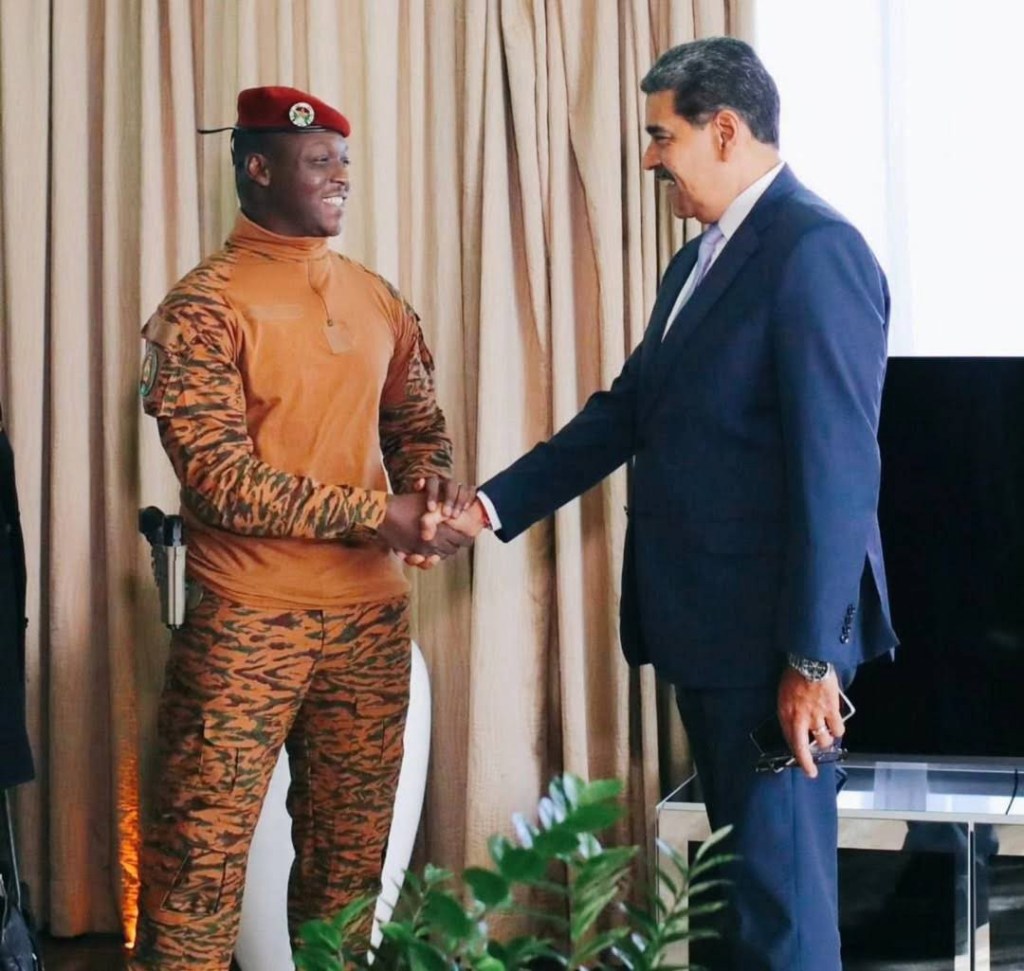
Venezuela and Burkina Faso Strengthen South-South Cooperation
Related:
Venezuela and Burkina Faso Strengthen South-South Cooperation
Related:
Syria, Yemen, and America’s Quest for Imperial Dominance
US interest in Yemen is certainly not rooted in altruism or a desire to promote democratic ideals. On the contrary, it is the application of a long-standing geopolitical strategy to control international trade through the Mandab Strait and Suez Canal, access to African raw materials, and most specifically, block the expansion of Chinese economic influence in both the Middle East and Africa. For these reasons, the United States has a keen interest in both Yemen and Somalia, desperate to maintain chaos in those countries so as to prevent stable, nationalist leaders from emerging. In so doing, Washington once again shows itself to be an imperialist aggressor, interested only in maintaining and expanding the empire.
Previously:
Trump extortion to choke off China’s maritime commerce
[2010] The Yemen Hidden Agenda: Behind the Al-Qaeda Scenarios, A Strategic Oil Transit Chokepoint
The Yemen Hidden Agenda: Behind the Al-Qaeda Scenarios, A Strategic Oil Transit Chokepoint
The Oil chokepoint and other oily affairs
The strategic significance of the region between Yemen and Somalia becomes the point of geopolitical interest. It is the site of Bab el-Mandab, one of what the US Government lists as seven strategic world oil shipping chokepoints. The US Government Energy Information Agency states that “closure of the Bab el-Mandab could keep tankers from the Persian Gulf from reaching the Suez Canal/Sumed pipeline complex, diverting them around the southern tip of Africa. The Strait of Bab el-Mandab is a chokepoint between the horn of Africa and the Middle East, and a strategic link between the Mediterranean Sea and Indian Ocean.” [9]
Read More »
How to DOGE USAID: The Wall Street Consensus under Trump
We often hear that the new Trump administration inaugurates the age of technofeudalism. Just look at Elon Musk, pontificating about so-called “Department of Government Efficiency” (DOGE) democracy from the Oval Office while undemocratically occupying the US Treasury payment system. But is the administration simply using bullying as a mode of power, as Adam Tooze recently diagnosed it, destroying institutions without measure or plan?
Read More »
Cuckold Europe, prop up dictators: Trump’s global plot laid bare
A month after Donald Trump’s second inauguration and the geopolitical global upheaval that may be unprecedented, one thing is clear: The president is an American sovereigntist, not an isolationist. Once this is understood, Trump’s seemingly wild upturning of the geopolitical order actually makes sense.
Sovereigntists are illiberal internationalists. They came of age after World War I, preventing the US from joining the League of Nations (the predecessor of the United Nations). At the time, American sovereigntists regarded the league as a stalking horse for global governance, anti-colonial independence movements, black internationalists, left-wing political movements and liberal Christians.
Today’s sovereigntists aim to weaken non-Western international associations that seek a more democratic international order. They make common cause with similar forces; Giorgia Meloni of Italy and Hungary’s Viktor Orban, for example. Their aim is an illiberal international geopolitical order where domestic political systems resemble “competitive authoritarianism” – multi-party elections embedded in a rigged legal and political environment. Under this model, the media and the machinery of government are used to attack opponents and co-opt critics.
Trump wants the US, not China, to write the technical standards of the global economy. Control over these standards creates lock-in effects in finance, telecommunications, space, robotics, bioengineering, nanotechnologies, and advanced materials and manufacturing methods. That means full-spectrum rivalry with China. If economic control is not possible, the plan B goal is global economic separation from China.
For Trump to achieve these goals, there are three key frontlines: Eastern Europe, the Middle East and Taiwan.
Most readers will know the news by now. DeepSeek, a Chinese AI company, released an AI model called R1 that is comparable in ability to the best models from companies such as OpenAI, Anthropic and Meta, but was trained at a radically lower cost and using less than state-of-the art GPU chips. DeepSeek also made public enough of the details of the model that others can run it on their own computers without charge.
Previously:
Interview with Deepseek Founder: We’re Done Following. It’s Time to Lead
Declaration Berlin (translated)
Posted by @nsanzo
“European leaders are scheduled to meet with Ukrainian President Volodymyr Zelensky and NATO chief Mark Rutte on Wednesday afternoon in Brussels to discuss peace plans and the possible deployment of peacekeeping forces in Ukraine,” Politico announced on Friday, confirming what was already known: NATO is leading the effort to coordinate what may happen in the coming months in the war in Ukraine, which on the ground will depend on European countries. “In addition to Rutte and Zelensky, invited participants include: German Chancellor Olaf Scholz, French President Emmanuel Macron, Polish President Andrzej Duda, European Council President António Costa, and European Commission President Ursula von der Leyen,” the outlet added, to show who the main actors are in preparing for the possibility of a significant reduction in the United States’ role in the day-to-day running of the war.
Read More »
This didn’t age well.
A review of RAND Corporation’s ‘War with China: Thinking Through the Unthinkable’
Read More »Philippine President Ferdinand Marcos Jr. said his nation won’t deploy Navy warships to the South China Sea in response to recent clashes with Beijing in disputed waters.
Marcos Says Philippines Won’t Send Warships After China Clashes
Previously:
Philippines to match China’s gray zone tactics in South China Sea
What’s Really Going On In the South China Sea Between the Philippines and China
Before anyone says that it isn’t possible, the U.S. government financially supported EDSA 1 and the 1988 Chilean Plebiscite through its front organizations.
Related:
Read More » Ms. Cat’s Chronicles
You must be logged in to post a comment.