What’s Really Going On In the South China Sea Between the Philippines and China

What’s Really Going On In the South China Sea Between the Philippines and China

by Tina Antonis

Maritime clashes between the Philippines and China had been mostly over the Philippines’ military outpost, BRP (BRP—Barko ng Republika ng Pilipinas, which translates to “Ship of the Republic of the Philippines”—the ship prefix for the Philippines) Sierra Madre, in the Spratly Islands, which is disputed by Brunei, China, Malaysia, the Philippines, Taiwan (a province of China, as recognized by the United Nations’ Resolution No. 2758), and Vietnam. The BRP Sierra Madre was intentionally run aground on a reef near the Second Thomas Shoal in the disputed Spratly Islands, in 1997, so that the Philippines could stake their territorial claim.

Read More »

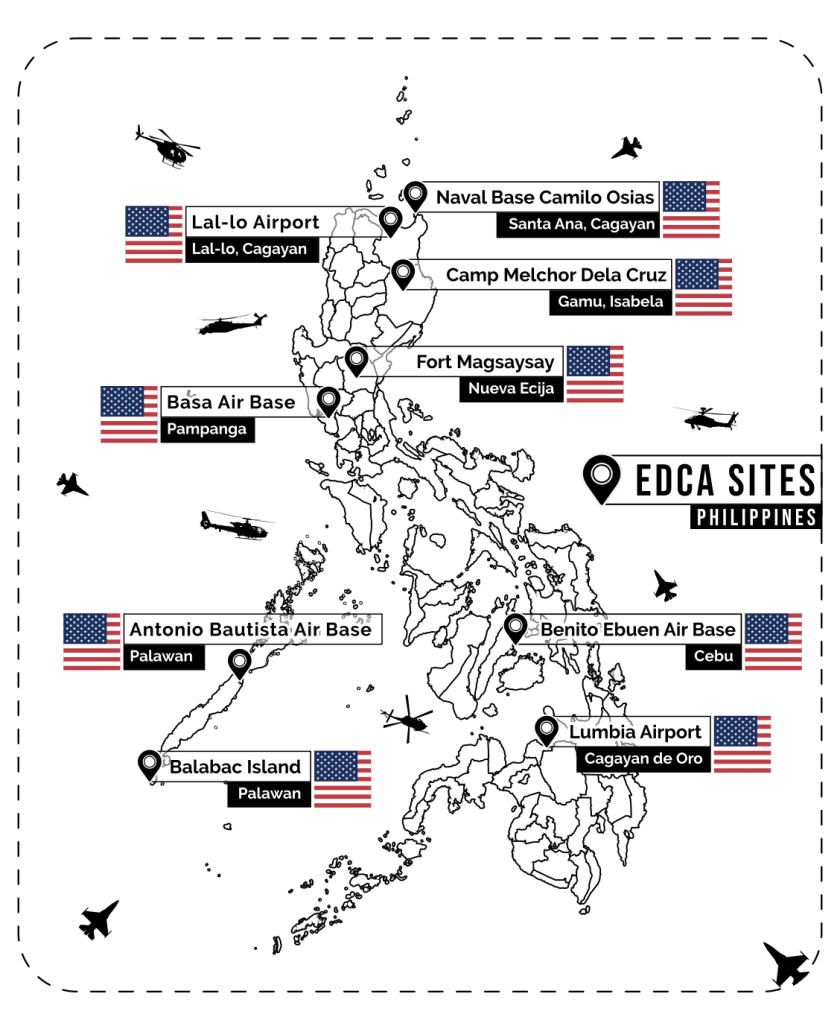
(Primer) A Decade of EDCA: US military bases and its expanding war games in the Philippines

The outright re-establishment of US military bases in the country and its relentless and escalating war games on land, sea, and air are flagrant manifestations of US imperialist domination of the Philippines. This further tightens the grip of US imperialism on the Philippine neocolonial state, especially on the puppet Armed Forces of the Philippines (AFP).

(Primer) A Decade of EDCA: US military bases and its expanding war games in the Philippines

South China Sea: US troop aid may reassure Philippines but will prod China, analysts say

Has anyone realized that by disclosing the existence of “US Task Force Ayungin,” Biden admin implicitly recognized Philippines’ sovereignty over a disputed SCS feature?

Washington has never taken a position on SCS territories(but it has in ECS). This is a clear signal to China.*

Derek J. Grossman, RAND

South China Sea: US troop aid may reassure Philippines but will prod China, analysts say (archived)

The Philippines has said the US task force only offered support – in the form of intelligence and surveillance – and did not directly take part in its resupply missions to BRP Sierra Madre, the retired warship, but analysts suggested that China’s leadership could see it in a different light.

Zheng said the revelation about the American task force meant the US was likely to be more engaged in the drawn-out maritime conflicts in the region, even suggesting that Washington would “be the first to take part in the command and planning of Philippine maritime activities”.

Ding Duo, deputy director of the Centre for Oceans Law and Policy at the National Institute for South China Sea Studies in Hainan, said the presence of a special task force showed that Washington and Manila had long cooperated on resupply operations to Second Thomas Shoal.

“Such support emboldens the Philippines and is not conducive to China and the Philippines managing their differences,” Ding said. “The US involvement has also squeezed the political space for internal coordination and decision-making within the Philippines.”

He said it was also possible that American troops could be on Philippine ships and involved in front-line action “using a covert or concealed identity to participate in Philippine maritime operations” in future.

He said the US could “only intervene [in South China Sea disputes] in a covert manner and so it took the form of a task force”.

Related:

Read More »

Philippines sides with Vietnam in South China Sea dispute, hoping it will ‘return the favour’

Analysts believe that while Vietnam appreciates the gesture, it is unlikely to influence Hanoi’s strategy in the disputed waters.

Philippines sides with Vietnam in South China Sea dispute, hoping it will ‘return the favour’

Related:

BowerGroupAsia: Dr. Prashanth Parameswaran

Prashanth is concurrently a fellow at the Wilson Center, a senior columnist at The Diplomat magazine and an instructor for institutions including the U.S. State Department. He is the founder of the twice-weekly ASEAN Wonk newsletter, which offers research insights and analysis on the geopolitics and geoeconomics of Southeast Asia and the Indo-Pacific region. 

Stratbase ADR Institute Non-Resident Fellow: Dr. Prashanth Parameswaran

Dr. Parameswaran has held various roles across think tanks, governments, media and companies, including the Center for Strategic and International Studies, Singapore’s Ministry of Trade and Industry and the Associated Press. In those capacities, he worked on various issues including geopolitical and geoeconomic statecraft, Southeast Asia foreign and security policy, regional institutions, major power engagement in the Indo-Pacific as well as alliances and partnerships.   

Dr. Parameswaran holds a Ph.D. and MA focused on international business, international relations, Asian affairs, and U.S. foreign policy from the Fletcher School of Law and Diplomacy at Tufts University. He earned a BA from the University of Virginia, where he studied foreign affairs and peace and conflict studies with a focus on Asia. He regularly advises groups and individuals seeking to advance conversations on Indo-Pacific affairs and serves on the board of several institutions.  

Global Times: China and Vietnam capable to handle law enforcement conflict in S.China Sea properly; Philippines’ intention to stigmatize China ‘won’t work’

SeaLight document

PH: America, Marcos and AFP can get us nuked

IF advocates of the United States’ access to bases of the Armed Forces of the Philippines (AFP) and US deployment of intermediate-range missiles prove the above headline unduly alarmist, this writer would be most thankful.

America, Marcos and AFP can get us nuked (archived)

Related:

Out-Competing China and Constraining Russia

Forget Hardened Bases, Pacific Conflict Requires Agile Combat Employment, Commander Says

The Plan to Defend Guam from Missile Threats Is Years from Completion: More Investment Is Needed Now

Ground-Based Intermediate-Range Missiles in the Indo-Pacific

The U.S. Alliance with the Philippines

How is the US Convincing the Philippines to Destroy Itself?

As China rises, Asia rises with it. The Southeast Asian state of the Philippines stood to rise alongside the rest of the region until relatively recently as the United States successfully convinces the Philippines to do otherwise. 

How is the US Convincing the Philippines to Destroy Itself? (archived)

Related:

PH’s PressONE is funded by several US front organizations:

The Philippine Fact-Checker Incubator was established with the financial backing of Facebook, in collaboration with VERA Files and Rappler. The incubated organizations include ABS-CBN News & Current Affairs, Manila Broadcasting Company, MindaNews, Philstar.com, PressONE.ph, and Probe Productions. They are accredited by the International Fact-Checking Network. – PFCIPoytner.

Poynter Institute has been funded by the Gates Foundation, the Koch Network, the National Endowment for Democracy, the Omidyar Network, and Open Society Foundations.  Other sponsors are CNN, the Scripps Howard Foundations, Craig Newmark Philanthropies, the Ethics and Excellence in Journalism Foundation, TEGNA Foundation, etc..

Front Organizations

Chinese and Philippine ships collide at Sabina Shoal, a new flash point + More

Source

The incident, the first time in decades that Beijing and Manila have clashed over the Sabina Shoal, may derail efforts to lower tensions in the South China Sea.

Chinese and Philippine ships collide at Sabina Shoal, a new flash point (archived)

Related:

CCG restricts repeated Philippine vessel intrusions near South China Sea reefs

Chen Xiangmiao, director of the World Navy Research Center at the National Institute for South China Sea Studies, told the Global Times on Monday that the Philippines sees Xianbin Jiao as a transfer station for its resupply missions to Ren’ai Jiao, as Xianbin Jiao is located between Ren’ai Jiao and the Philippines’ Palawan Province.

[08-16-24] Foreign Ministry Spokesperson’s Remarks on the Philippine Coast Guard Vessel’s Illegal Anchoring in the Lagoon of Xianbin Jiao

[08-14-24] Exclusive: Manila to deploy new vessel for ‘semi-permanent presence’ at China’s Xianbin Jiao, breaking its promise: source

Philippine media have hyped the China Coast Guard’s (CCG) presence in the Xianbin Jiao, but it is the Philippines that has sent the MRRV-9701 to the area in the first place. The Philippine ship anchored in the lagoon of the Xianbin Jiao in April, with a CCG ship arriving later in July.

Updated on 07-27-2024: SeaLight, formerly Project Myoushu

Powell’s storytelling:

Read More »