

The Woman Question: Selections from the Writings of Marx, Engels, Lenin, and Stalin
Tag: equality
The “Sexual Revolution:” An Unwitting Instrument of Capitalist Counterrevolution’s Devastating Public Health Legacy
The so-called “sexual revolution” that began in the 1960s and 1970s, hailed by bourgeois liberals and postmodern academics as a triumph of individual liberation and progressive reform, also became bound up with deeply reactionary phenomenon. From advancing the cause of human emancipation, it became a critical component of the broader social counterrevolution orchestrated by the ruling classes to undermine the potential of the working class. This pseudo-liberation, rooted to a notable extent in the decay of capitalist society, has contributed directly to profound negative impacts on public health, including the explosive proliferation of sexually transmitted infections (STIs), mental health crises, and the commodification of human relationships under the guise of “freedom.”
Related:
The Superorganism of Capitalism and Its Impact on Individuality | Karl Marx
Lenin: The Position of the Bund in the Party

Lenin: Answers To An American Journalist’s Questions
Answers To An American Journalist’s Questions
1. The governmental programme of the Soviet Government was not a reformist, but a revolutionary one. Reforms are concessions obtained from a ruling class that retains its rule. Revolution is the overthrow of the ruling class. Reformist programmes, therefore, usually consist of many items of partial significance. Our revolutionary programme consisted properly of one general item—removal of the yoke of the landowners arid capitalists, the overthrow of their power and the emancipation of the working people from those exploiters. This programme we have never changed. Some partial measures aimed at the realisation of the programme have often been subjected to change; their enumeration would require a whole volume. I will only mention that there is one other general point in our governmental programme which has, perhaps, given rise to the greatest number of changes of partial measures. That point is—the suppression of the exploiters’ resistance. After the Revolution of October 25 (November 7), 1917 we did not close down even the bourgeois newspapers and there was no mention of terror at all. We released not only many of Kerensky’s ministers, but even Krasnov who had made war onus. It was only after the exploiters, i.e., the capitalists, had begun developing their resistance that we began to crush that resistance systematically, applying even terror. This was the proletariat’s response to such actions of the bourgeoisie as the conspiracy with the capitalists of Germany, Britain, Japan, America and France to restore the rule of the exploiters in Russia, the bribery of the Czechoslovaks with Anglo-French money, the bribery of Mannerheirn, Denikin and others with German and French money, etc. One of the latest conspiracies leading to “a change”—to put it precisely, leading to increased terror against the bourgeoisie in Petrograd—was that of the bourgeoisie, acting jointly with the Mensheviks and Socialist-Revolutionaries; their conspiracy concerned the surrender of Petrograd, the seizure of Krasnaya Gorka by officer-conspirators, the bribing by British and French capitalists of employees of the Swiss Embassy and of many Russian employees, etc.
Read More »
Clara Zetkin: Only in Conjunction With the Proletarian Woman Will Socialism Be Victorious

Erasure’s A Little Respect: The Synthpop Classic That Defined A Generation
In 1988, Erasure gifted the world a song that would become a defining anthem of the late 80s and a timeless symbol of unity, love, and vulnerability. A Little Respect was not just a synthpop hit—it was a heartfelt plea for compassion, an enduring anthem that resonated across dance floors, living rooms, and hearts worldwide.
Erasure’s A Little Respect: The Synthpop Classic That Defined A Generation
Previously:
Smalltown Boy — Bronski Beat’s 1984 hit was a heartfelt cry for liberation
Bangladesh’s Constitution reform: Sweeping changes in the constitution
Constitution reform: Sweeping changes in constitution
Expanding the fundamental rights to include food, clothing, shelter, education, internet, and vote, the Constitution Reform Commission proposes replacing nationalism, socialism, and secularism with equality, human dignity, social justice and pluralism as fundamental principles of state policy.
…
Modifying, the much discussed article 70, the commission recommends that parliamentarians be allowed to vote against party line except finance bills.
…
The constitution commission recommends deletion of the constitutional provision that stipulates inclusion of Bangabandhu Sheikh Mujibur Rahman’s speech of March 7, 1971, his declaration of independence and the proclamation of independence, which are included in the 5th, 6th and 7th schedules respectively.
FYI, it was written by International IDEA, which is funded by USAID, Open Society Foundations, and several Western governments.
Related:
Leaked files expose covert US government plot to ‘destabilize Bangladesh’s politics’
Atlantic Council’s Ali Riaz to lead commission on constitutional reforms for Bangladesh
DeepSeek: What Would Lenin and Marx Say About Romantic Love
Vladimir Lenin, as a revolutionary and Marxist thinker, approached most topics through the lens of class struggle, materialism, and the broader social and economic systems. While he did not write or speak extensively about love as a personal or romantic concept, his views on human relationships were likely shaped by his Marxist perspective.
Here’s how Lenin might conceptualize love, based on his ideological framework:
Read More »
Alexandra Kollontai: Prostitution and ways of fighting it
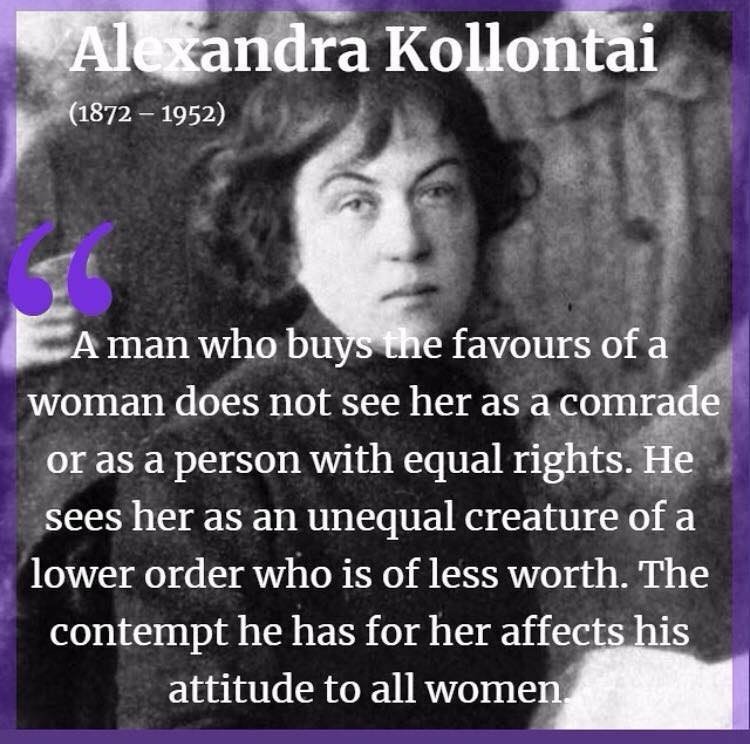
Alexandra Kollontai: Prostitution and ways of fighting it
What is the fundamental quality of the working class? What is its strongest moral weapon in the struggle? Solidarity and comradeship is the basis of communism. Unless this sense is strongly developed amongst working people, the building of a truly communist society is inconceivable. Politically conscious communists should therefore logically be encouraging the development of solidarity in every way and fighting against all that hinders its development – Prostitution destroys the equality, solidarity and comradeship of the two halves of the working class. A man who buys the favours of a woman does not see her as a comrade or as a person with equal rights. He sees the woman as dependent upon himself and as an unequal creature of a lower order who is of less worth to the workers’ state. The contempt he has for the prostitute, whose favours he has bought, affects his attitude to all women. The further development of prostitution, instead of allowing for the growth of comradely feeling and solidarity, strengthens the inequality of the relationships between the sexes.
 Ms. Cat’s Chronicles
You must be logged in to post a comment.