Network States: The New Frontier of Soft Power and Corporate Feudalism

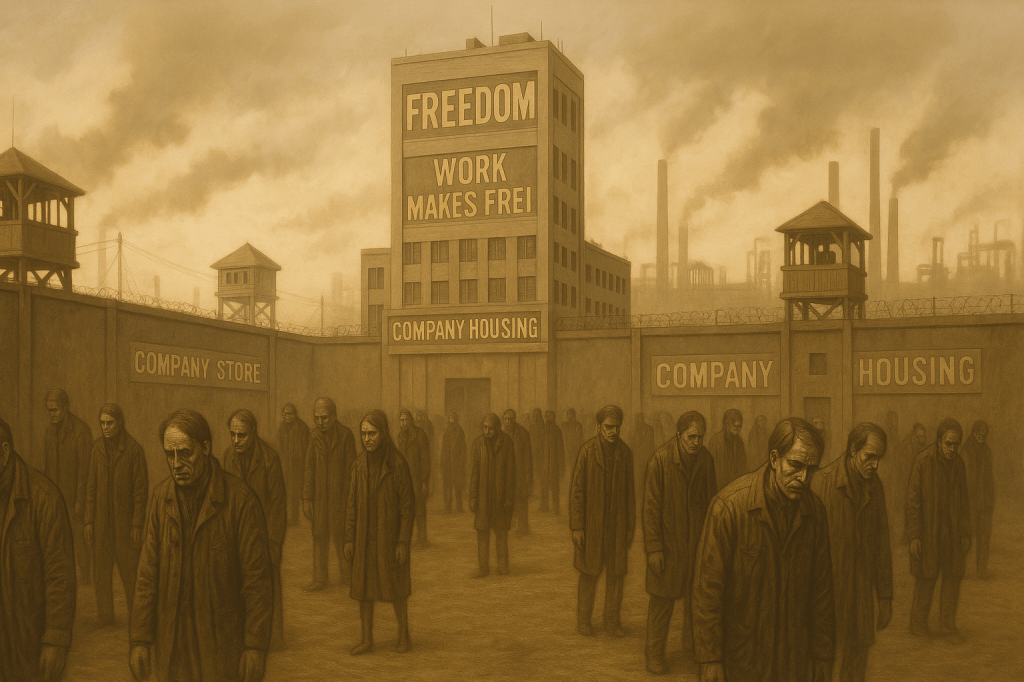
They sell the dream of autonomy—self-governing, tech-powered havens untethered from old institutions. But look closer, and you’ll see that Network States aren’t a rebellion against centralized power. They’re a rebrand, a more sophisticated, digitally optimized iteration of company towns, where the people inside serve the system without ever realizing they were locked in from the start.

Read More »

Lenin: May Day

Comrade workers! May Day is coming, the day when the workers of all lands celebrate Their awakening to a class- conscious life, their solidarity in the struggle against all coercion and oppression of man by man, the struggle to free the toiling millions from hunger, poverty, and humiliation. Two worlds stand facing each other in this great struggle: the world of capital and the world of labour, the world of exploitation and slavery and the world of brotherhood and freedom.

May Day

Tyranny & Tantrums: A Rant on America’s Collapse

America is to going to hell in a hand basket, and the cracks in its foundation are glaring. As Linkin Park’s Burn It Down echoes, “We’re building it up to break it back down,” the cycle of destruction and collapse feels all too familiar. Institutions meant to uphold democracy are being dismantled, only to be rebuilt on even shakier ground. Power is concentrated in the hands of a few, while the vulnerable are left to fend for themselves. Like the song’s imagery of betrayal and downfall, the current political landscape mirrors a system that prioritizes control and greed over people. The flames of collapse are fanned, and the question remains—what will rise from the ashes?

Read More »

“Dark Indonesia” and Astroturfed Subversion + More

21-04-2025: Since February, Indonesia has been beset by protests largely led by students, so-called civil society organisations, some labour unions and K-pop fans. Protests emerged in many cities throughout the Indonesian archipelago including Jakarta, Surabaya, Yogyakarta, Bandung, Solo, Semarang, Bali, Samarinda, Banjarmasin and South Sumatra. The protestors were reportedly delivering a “red report card” on the first 100 days of President Prabowo Subianto’s administration. They also condemned Prabowo’s “Ndasmu!” remark towards critics of the Free Nutritious Meal program.[1] “Ndasmu” is an impolite Javanese word meaning “your head”, which perhaps implies that the protestors’ actions were the result of something that existed in their heads only. The slogan “Dark Indonesia” under which the protests took place, is a stab at Prabowo’s election slogan of “Golden Indonesia” (Indonesia Emas), which aims to advance the Unitary State of the Republic of Indonesia (NKRI) to a sovereign, prosperous nation by 2045, the centennial of its independence won in 1945.[2]

“Dark Indonesia” and Astroturfed Subversion

Related:

Read More »

Lenin: Answers To An American Journalist’s Questions

Answers To An American Journalist’s Questions

1. The governmental programme of the Soviet Government was not a reformist, but a revolutionary one. Reforms are concessions obtained from a ruling class that retains its rule. Revolution is the overthrow of the ruling class. Reformist programmes, therefore, usually consist of many items of partial significance. Our revolutionary programme consisted properly of one general item—removal of the yoke of the landowners arid capitalists, the overthrow of their power and the emancipation of the working people from those exploiters. This programme we have never changed. Some partial measures aimed at the realisation of the programme have often been subjected to change; their enumeration would require a whole volume. I will only mention that there is one other general point in our governmental programme which has, perhaps, given rise to the greatest number of changes of partial measures. That point is—the suppression of the exploiters’ resistance. After the Revolution of October 25 (November 7), 1917 we did not close down even the bourgeois newspapers and there was no mention of terror at all. We released not only many of Kerensky’s ministers, but even Krasnov who had made war onus. It was only after the exploiters, i.e., the capitalists, had begun developing their resistance that we began to crush that resistance systematically, applying even terror. This was the proletariat’s response to such actions of the bourgeoisie as the conspiracy with the capitalists of Germany, Britain, Japan, America and France to restore the rule of the exploiters in Russia, the bribery of the Czechoslovaks with Anglo-French money, the bribery of Mannerheirn, Denikin and others with German and French money, etc. One of the latest conspiracies leading to “a change”—to put it precisely, leading to increased terror against the bourgeoisie in Petrograd—was that of the bourgeoisie, acting jointly with the Mensheviks and Socialist-Revolutionaries; their conspiracy concerned the surrender of Petrograd, the seizure of Krasnaya Gorka by officer-conspirators, the bribing by British and French capitalists of employees of the Swiss Embassy and of many Russian employees, etc.

Read More »

[03-08-1987] Thomas Sankara: The revolution cannot triumph without the emancipation of women

The revolution cannot triumph without the emancipation of women

The specific character of women’s oppression

Woman’s fate is bound up with that of the exploited male. This is a fact. However, this solidarity, arising from the exploitation that both men and women suffer and that binds them together historically, must not cause us to lose sight of the specific reality of the woman’s situation. The conditions of her life are determined by more than economic factors, and they show that she is a victim of a specific oppression. The specific character of this oppression cannot be explained away by setting up an equal sign or by falling into easy and childish simplifications.

Read More »

Vladimir Lenin on Economic Disparity, Private Property, and the Need for Systemic Change

The Second Congress of the Communist International

In the United States of America food prices have risen, on the average, by 120 per cent, whereas wages have increased only by 100 per cent. In Britain, food prices have gone up by 170 per cent, and wages 130 per cent; in France, food prices—300 per cent,. and wages 200 per cent; in Japan—food prices 130 per cent, and wages 60 per cent (I have analysed Comrade Braun’s figures in his pamphlet and those of the Supreme Economic Council as published in The Times of March 10, 1920). 

In such circumstances, the workers’ mounting resentment, the growth of a revolutionary temper and ideas, and the increase in spontaneous mass strikes are obviously inevitable, since the position of the workers is becoming intolerable. The workers’ own experience is convincing them that the capitalists have become prodigiously enriched by the war and are placing the burden of war costs and debts upon the workers’ shoulders. We recently learnt by cable that America wants to deport another 500 Communists to Russia so as to get rid of “dangerous agitators”.

Even if America deports to our country, not 500 but 500,000 Russian, American, Japanese and French “agitators” that will make no difference, because there will still be the disparity between prices and wages, which they can do nothing about. The reason why they can do nothing about it is because private property is most strictly safeguarded, is “sacred” there. That should not be forgotten, because it is only in Russia that the exploiters’ private property has been abolished. The capitalists can do nothing about the gap between prices and wages, and the workers cannot live on their previous wages. The old methods are useless against this calamity. Nothing can be achieved by isolated strikes, the parliamentary struggle, or the vote, because “private property is sacred”, and the capitalists have accumulated such debts that the whole world is in bondage to a handful of men. Meanwhile the workers’ living conditions are becoming more and more unbearable. There is no other way out but to abolish the exploiters’ “private property”.

The intersection of sex, capitalism, and militarism

The intersection of sex, capitalism, and militarism

The intersection of sex, capitalism, and militarism highlights how these systems often intertwine, with capitalism’s focus on commodification leading to the exploitation of sex work, while militarism frequently creates environments where women and vulnerable populations are particularly susceptible to sexual violence and trafficking, often due to the presence of military forces in a region, further perpetuating power imbalances and economic disparities. [12345678910]

Read More »