
Read More »
Tag: export controls
Stolen Valor & Frauds: Foreign Mercenaries in Ukraine
Stolen Valor: The U.S. Volunteers in Ukraine Who Lie, Waste and Bicker
Related:
U.S. Veteran Who Shared His Ukraine Experience Accused of Being Fraud
H/T: Judge Napolitano (Jack Posobiec didn’t give Gonzo Lira any credit).
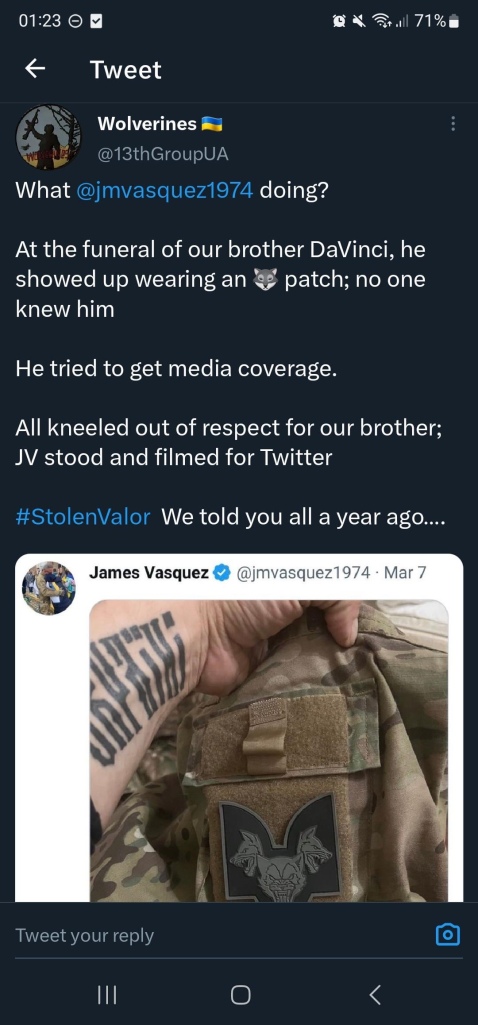
Sarah Ashton-Cirillo (Newsweek) says that James Vasquez is a fraud, but Malcom Nance (NYT) says that he isn’t (aren’t they all?!). Newsweek also says that Vasquez deleted his Twitter account but, as of now, it’s still active.
Biden Stunts Growth in China for Chipmakers Getting US Funds
The Biden administration unveiled tight restrictions on new operations in China by chipmakers that get federal funds to build in the US, potentially hampering efforts to expand in the world’s largest semiconductor arena.
Biden Stunts Growth in China for Chipmakers Getting US Funds
How much did Trump-era tariffs on China cost Americans? New US findings confirm ‘self-inflicted harm’

Import tariffs placed on more than US$300 billion worth of Chinese goods during the Trump administration increased US prices, according to a report from a bipartisan US trade commission, confirming a widely held view among analysts of trade and tariffs that they caused “self-inflicted harm”.
How much did Trump-era tariffs on China cost Americans? New US findings confirm ‘self-inflicted harm’
How America can win the Chip Wars
There is a 20% chance of military confrontation
How America can win the Chip Wars
To Be Updated: USAID is sponsoring YouTube channels
How Democracy Can Win: The Right Way to Counter Autocracy
The most important step the United States can take to counter foreign influence campaigns and disinformation is to help our partners promote media and digital literacy, communicate credibly with their publics, and engage in “pre-bunking”—that is, seeking to inoculate their societies against disinformation before it can spread. In Indonesia, for example, USAID has worked with local partners to develop sophisticated online courses and games that help new social media users identify disinformation and reduce the likelihood that they will share misleading posts and articles.
The United States has also helped Ukraine in its fight against the Kremlin’s propaganda and disinformation. For decades, USAID has worked to enhance the media environment in the country, encouraging reforms that allow greater access to public information and supporting the emergence of strong local media organizations, including the public broadcaster Suspilne. After Russia’s initial invasion of Ukraine in 2014, our work expanded to help the country’s local journalists produce Russian-language programming that could reach into Kremlin-occupied territories, such as Dialogues With Donbas, a YouTube channel that featured honest conversations with Ukrainians about life behind Russian lines. We also helped support the production of the online comedy show Newspalm, which regularly racks up tens of thousands of views as it skewers Putin’s lies. And even before Moscow’s full-scale invasion began in February 2022, we worked with the government of Ukraine to stand up the Center for Strategic Communications, which uses memes [memetic warfare], well-produced digital videos, and social media and Telegram posts to poke holes in Kremlin propaganda.
I still need to look into Newspalm. I’ll update if I find anything. As I don’t know Ukrainian, or Russian, I’m using Google translate for the following information. Note, this is all speculation!
Speculation:
Read More »The West Tried to Isolate Russia. It Didn’t Work.
After Russia invaded Ukraine, the West formed what looked like an overwhelming global coalition: 141 countries supported a United Nations measure demanding that Russia unconditionally withdraw.
The West Tried to Isolate Russia. It Didn’t Work.
Center for a New American Security & MICIMATT say, “Be Afraid, Very Afraid” Of China


By Richard Fontaine, the chief executive officer of the Center for a New American Security.
China’s Balloon Could Be America’s Awakening
Related:
Center for a New American Security (funding and employees):
Read More »Iran’s Su-35 Aircraft Procurement Is More Dangerous Than You Think
Iran’s Su-35 Aircraft Procurement Is More Dangerous Than You Think
Related:
The Difficulty of Disrupting Iranian Drones
Russia and Iran Are Building a Trade Route That Defies Sanctions
In all of this, some analysts see echoes of an idea that dates back more than a century and is reckoned to be the foundation of geopolitical thinking. It focused on the struggle between an oceangoing world power—the UK then, the US today—and the land giants of Eurasia. [Heartland Theory]
Oxfam: U.S., UK Fueling ‘Pattern of Violence’ Against Yemenis
Saudi-led coalition airstrikes using weapons supplied by the U.S. and UK were responsible for killing 87 civilians in Yemen in a 14-month period, a new report has found.
Oxfam: U.S., UK Fueling ‘Pattern of Violence’ Against Yemenis
 Ms. Cat’s Chronicles
You must be logged in to post a comment.