
Text: On the Question of the National Bourgeoisie and the Enlightened Gentry
Tag: Feudalism
Frederick Engels: On Anti-Semitism

Frederick Engels: On Anti-Semitism
…But whether you might not be doing more harm than good with your anti-Semitism is something I would ask you to consider. For anti-Semitism betokens a retarded culture, which is why it is found only in Prussia and Austria, and in Russia too. Anyone dabbling in anti-Semitism, either in England or in America, would simply be ridiculed, while in Paris the only impression created by M. Drumont’s writings – wittier by far than those of the German anti-Semites – was that of a somewhat ineffectual flash in the pan.
Read More »
A Caricature of Marxism and Imperialist Economism: 5. “Monism And Dualism”
A Caricature of Marxism and Imperialist Economism: 5. “Monism And Dualism”
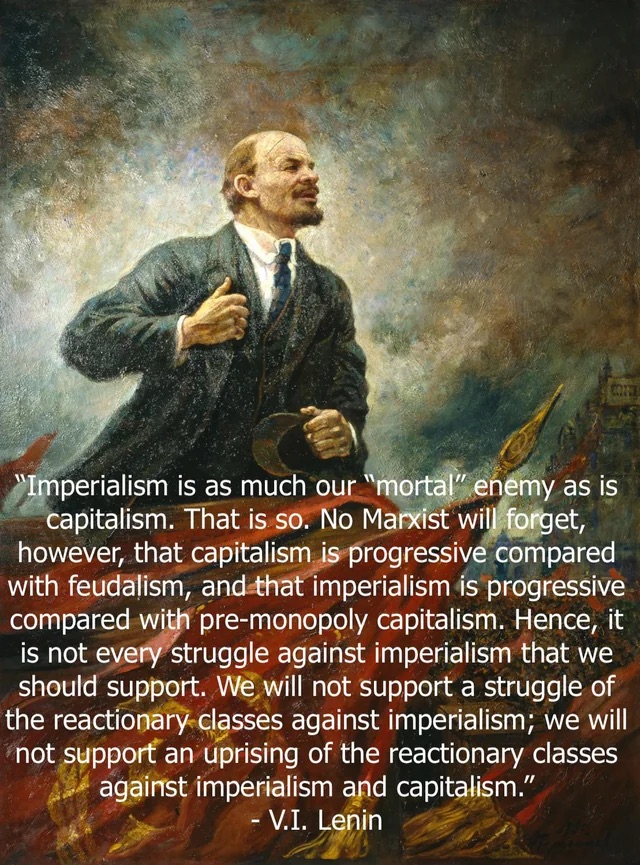
But this Kievsky argument is wrong. Imperialism is as much our “mortal” enemy as is capitalism. That is so. No Marxist will forget, however, that capitalism is progressive compared with feudalism, and that imperialism is progressive compared with pre-monopoly capitalism. Hence, it is not every struggle against imperialism that we should support. We will not support a struggle of the reactionary classes against imperialism; we will not support an uprising of the reactionary classes against imperialism and capitalism.
Sexual Relations and the Class Struggle
Among the many problems that demand the consideration and attention of contemporary mankind, sexual problems are undoubtedly some of the most crucial. There isn’t a country or a nation, apart from the legendary “islands”, where the question of sexual relationships isn’t becoming an urgent and burning issue. Mankind today is living through an acute sexual crisis which is far more unhealthy and harmful for being long and drawn-out. Throughout the long journey of human history, you probably won’t find a time when the problems of sex have occupied such a central place in the life of society; when the question of relationships between the sexes has been like a conjuror, attracting the attention of millions of troubled people; when sexual dramas have served as such a never-ending source of inspiration for every sort of art.
Mao: Tyrant or Great Leader?
Mao’s Legacy and Accomplishments
“Mao Tse‐tung, who began as an obscure peasant, died one of history’s great revolutionary figures. In Chinese terms, he ranked with the first Emperor who unified China in 200 B.C.
A Chinese patriot, a combative revolutionary, a fervent evangelist, a Marxist theorist, a soldier, a statesman and poet, above all Mao was a moralist who deeply believed, as have Chinese since Confucius, that man’s goodness must come ahead of his mere economic progress.
China achieved enormous economic progress under Mao. He transformed China into a modern, industrialized socialist state.”
Unlike many great leaders, Mao never exercised, or sought, absolute control over day‐to‐day affairs.”
Address of the Central Committee to the Communist League
Address of the Central Committee to the Communist League
Brothers!
In the two revolutionary years of 1848-49 the League proved itself in two ways. First, its members everywhere involved themselves energetically in the movement and stood in the front ranks of the only decisively revolutionary class, the proletariat, in the press, on the barricades and on the battlefields. The League further proved itself in that its understanding of the movement, as expressed in the circulars issued by the Congresses and the Central Committee of 1847 and in the Manifesto of the Communist Party, has been shown to be the only correct one, and the expectations expressed in these documents have been completely fulfilled. This previously only propagated by the League in secret, is now on everyone’s lips and is preached openly in the market place. At the same time, however, the formerly strong organization of the League has been considerably weakened. A large number of members who were directly involved in the movement thought that the time for secret societies was over and that public action alone was sufficient. The individual districts and communes allowed their connections with the Central Committee to weaken and gradually become dormant. So, while the democratic party, the party of the petty bourgeoisie, has become more and more organized in Germany, the workers’ party has lost its only firm foothold, remaining organized at best in individual localities for local purposes; within the general movement it has consequently come under the complete domination and leadership of the petty-bourgeois democrats. This situation cannot be allowed to continue; the independence of the workers must be restored. The Central Committee recognized this necessity and it therefore sent an emissary, Joseph Moll, to Germany in the winter of 1848-9 to reorganize the League. Moll’s mission, however, failed to produce any lasting effect, partly because the German workers at that time had not enough experience and partly because it was interrupted by the insurrection last May. Moll himself took up arms, joined the Baden-Palatinate army and fell on 29 June in the battle of the River Murg. The League lost in him one of the oldest, most active and most reliable members, who had been involved in all the Congresses and Central Committees and had earlier conducted a series of missions with great success. Since the defeat of the German and French revolutionary parties in July 1849, almost all the members of the Central Committee have reassembled in London: they have replenished their numbers with new revolutionary forces and set about reorganizing the League with renewed zeal
Dalai Lama: Excerpt from ‘Tibet or not Tibet’
Canadian MPs unanimously reject China’s sovereignty over Tibet
I wonder who gave them this idea? /s
Canadian parliamentarians have unanimously voted for a non-binding motion, put forward by Bloc Québécois MP Alexis Brunelle-Duceppe, that refers to Tibetans as “a people and a nation” who should get self-determination. This, having occurred on June 10, 2024, is a fundamental rejection of China’s sovereign control of the Tibet Autonomous Region, and an indisputable attack on China’s sovereignty.
Canadian MPs unanimously reject China’s sovereignty over Tibet
Previously:
US lawmakers pass Tibet policy bill that questions China’s claims over region
The Fascist Mimicry of Anti-Imperialism
A little more than a century ago the world’s superpower was the British Empire. Despite being a constitutional monarchy where the aristocracy and monarchy still retained significant power, the British Empire was arguably the birthplace of the industrial revolution and it played a significant role in spreading capitalism around the world through colonialism. From around the 19th century until the early 20th century, many saw the British Empire as quite possibly the most affluent and powerful capitalist-colonial empire in the world. The British Empire as the capitalist-colonial hegemon extracts resources from its colonies, transforms them into commodities, and sells them for a profit that would go into the pockets of capitalists and royal colonizers alike. There were other competing colonizers such as France, The Netherlands, Spain, Portugal, Germany, Japan, and the U.S., but none of them (except the U.S. in the late 20th century) could quite surpass the British Empire. The British Empire was the largest epicenter of world capitalist imperialism and being an anti-imperialist was almost (though not quite) synonymous with being against the British Empire. The geopolitical status of the British Empire is roughly or loosely analogous to the geopolitical status that the U.S. enjoyed since the late 20th century. Both the British Empire and the U.S. enjoy the status of being a hegemonic empire due to their overwhelmingly powerful military (especially their navy) and almost unparalleled economic power.
[1999] Philippines: The Great Left Divide
A SPECTER is haunting the revolutionary movement in the Philippines — the specter of seemingly interminable splits.
In the seven years since Armando Liwanag issued his “Reaffirm our Basic Principles and Rectify Errors” document, the Left — or more appropriately, the Left of the national democratic (ND) tradition — has gone through an unprecedented period of metastasis. The once monolithic movement that at its peak in the mid-1980s commanded 35,000 Party members, 60 guerrilla fronts, two battalions and 37 company formations, and foisted ideological and organizational hegemony in the progressive politics during the Marcos dictatorship is now history. Out of it have emerged fragments of disparate groups — eight at least — that continue to wage “revolution” in similarly disparate forms.
The Great Left Divide
Related:
 Ms. Cat’s Chronicles
You must be logged in to post a comment.