Jesalyn Harper, the only full-time code enforcement officer for the small, agricultural city of Reedley in California’s Central Valley, was responding to a complaint about vehicles parked in the loading dock of a cold-storage warehouse when she noticed a foul smell and saw a garden hose snaking into the old building.
A World Health Organization’ agency will list the widely used artificial sweetener aspartame as “possibly carcinogenic to humans” July 14, Reuters reported, citing two sources familiar with the situation.
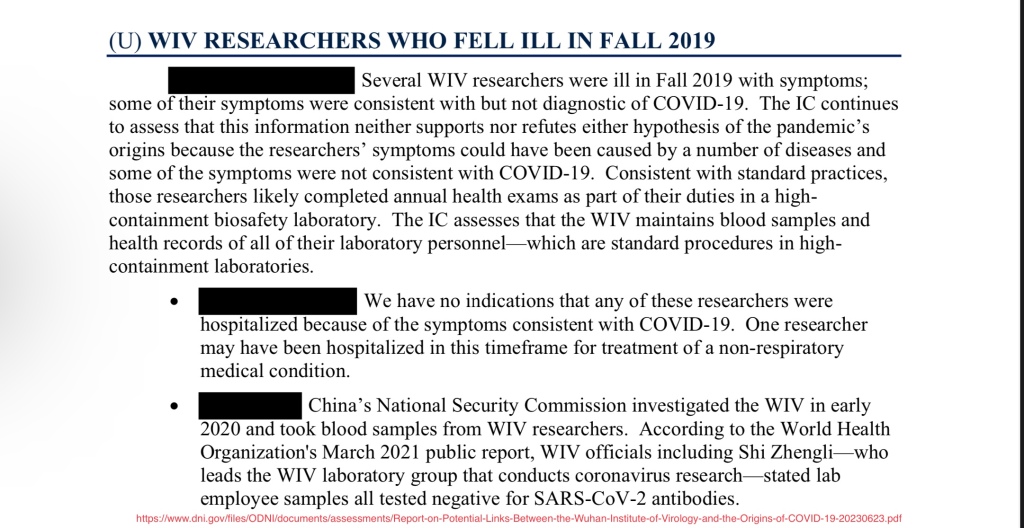
Cleared by Congress, legislation later signed by US President Joe Biden in March ordered the Director of National Intelligence (DNI) to declassify information regarding the potential origins of SARS-CoV-2, the virus that causes COVID-19. The measure forced the DNI to declassify its report within 90 days.
Hu and two of his WIV colleagues were thrown into the furious COVID-19 origin debate on 13 June when an online newsletter called Public said the three scientists developed COVID-19 in November 2019. That was prior to the outbreak becoming public when a cluster of cases at the end of December 2019 surfaced in people linked to a Wuhan marketplace. Public’s report was quickly embraced by a camp that argues COVID-19 came from a virus stored, and possibly manipulated, at WIV, rather than from infected animal hosts, perhaps being sold at the Wuhan market. A Wall Street Journal (WSJ) article on 20 June that said it had “confirmed” the allegations against the three, without referring to any public evidence or named sources with direct knowledge, fueled the flames even more. Social media and other publications spread the charges—and the scientists’ names.
Elon Musk, the genius behind SpaceX and Tesla Inc., has declared that humanity must embrace the merging of man and machine if we hope to survive in a world dominated by artificial intelligence (AI).
This is why fentanyl is used in black-market opioids in the first place. Users did not demand a substance that is 40 times more potent than heroin for recreational use; prohibitionist policies made it more challenging to procure pain medication, leading pain patients to seek out heroin. Heroin, however, is a crop drug, which makes it expensive to produce, ship, and buy. Fentanyl is synthetic, making it cheaper to produce, ship, and buy. When the law makes it harder to get legal pain pills, everybody adapts, and you get illegal fentanyl with no quality control.
Patients and doctors expect drug regulators to provide an unbiased, rigorous assessment of investigational medicines before they hit the market. But do they have sufficient independence from the companies they are meant to regulate? Maryanne Demasi investigates
In July, the medical community was rocked by a disappointing reminder of science’s weakest link: the humans doing the work. The journal Science had shared that its six-month investigation supported the findings of whistleblower Matthew Schrag, who first noted altered images in a high-impact paper on Alzheimer’s, published in Nature in 2006. That paper is still flagged on Natureas under review, but the damage has already been done. Alzheimer’s drugs for the last decade and a half have been developed around claims without as much evidence as initially believed—which might also explain why they haven’t been working, leading people to pour false hope into useless and often expensive treatment plans for declining loved ones.
Most remarkably, it didn’t seem to matter to the CDC that 75.2 percent of children under age 11 already have natural immunity, according to a CDC study that concluded in February. Natural immunity is certainly much more prevalent today, given the ubiquity of the Omicron variant since February. CDC data from New York and California demonstrated that natural immunity was 2.8 times more effective in preventing hospitalization and 3.3 to 4.7 times more effective in preventing COVID infection compared to vaccination during the Delta wave. These findings are consistent with dozens of other clinical studies. Yet natural immunity has consistently and inexplicably been dismissed by the medical establishment.
…
Public health officials are expected to recommend COVID vaccines for children under 5 as soon as June 21st, despite the fact that the vast majority of children already have natural immunity. In a recent Kaiser survey, only 18 percent of parents said they were eager to vaccinate their child in that age group.



 Ms. Cat’s Chronicles
You must be logged in to post a comment.