
There has never been a US presidential visit to the Middle East like this one.
This week, success will be measured not in conventional diplomacy, peace deals, or arms sales, although Donald Trump did make some news by lifting sanctions on the Syrian leadership, urging Saudi Crown Prince Mohammed bin Salman to join the Abraham Accords by normalizing relations with Israel, and agreeing to a $142 billion weapons package for Riyadh.
Trump’s remarkable Middle East tour is all about striking megadeals and outfoxing China
Tag: foreign direct investments
US Seizing Panama & Greenland Aimed at China
Despite the temporary window of false hope some perceived the recent US presidential election as, US foreign policy has once again continued onward toward the pursuit of primacy.
Previously:
US Greenland-Panama Ambitions Aimed at War with Russia-China
PH: Stratbase, CIPE (NED), and the Belt and Road Initiative
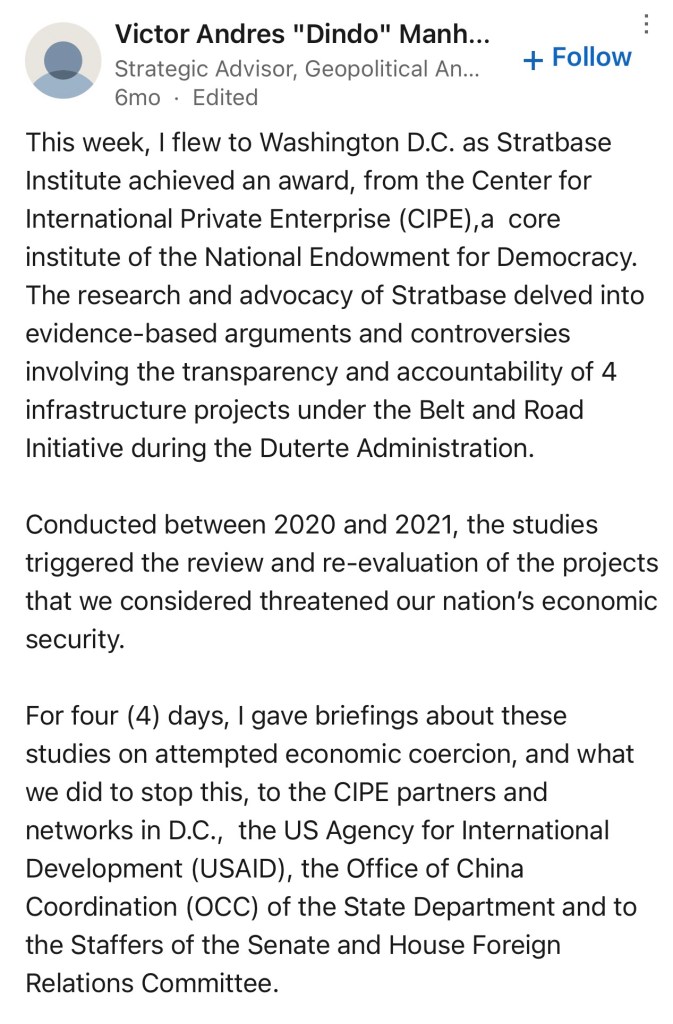
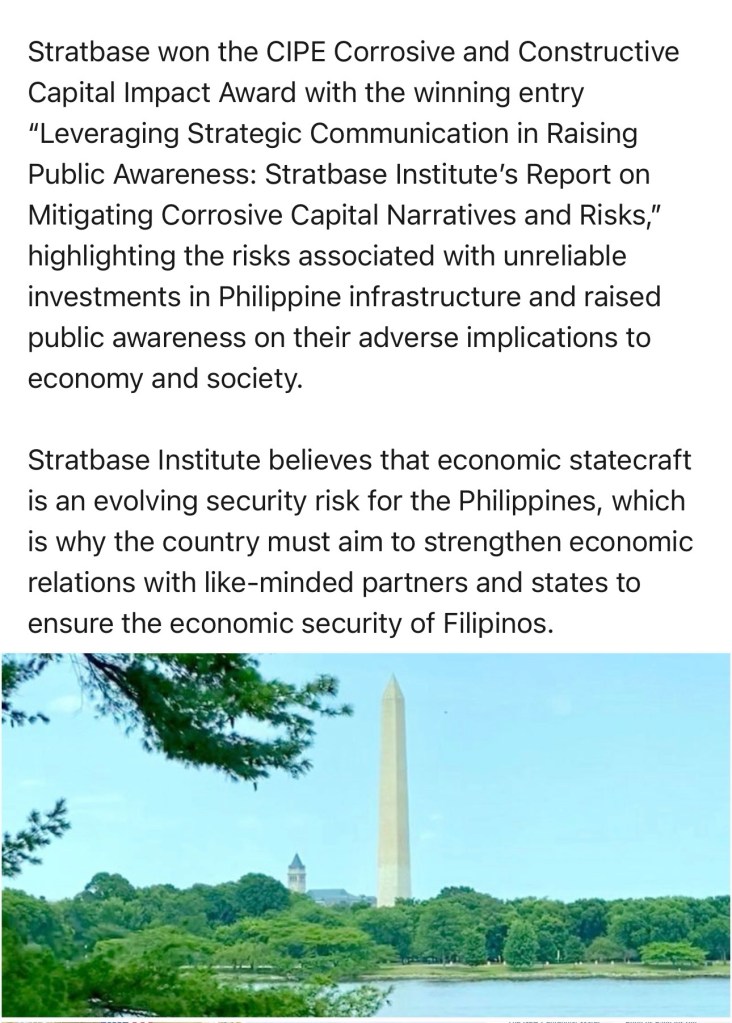

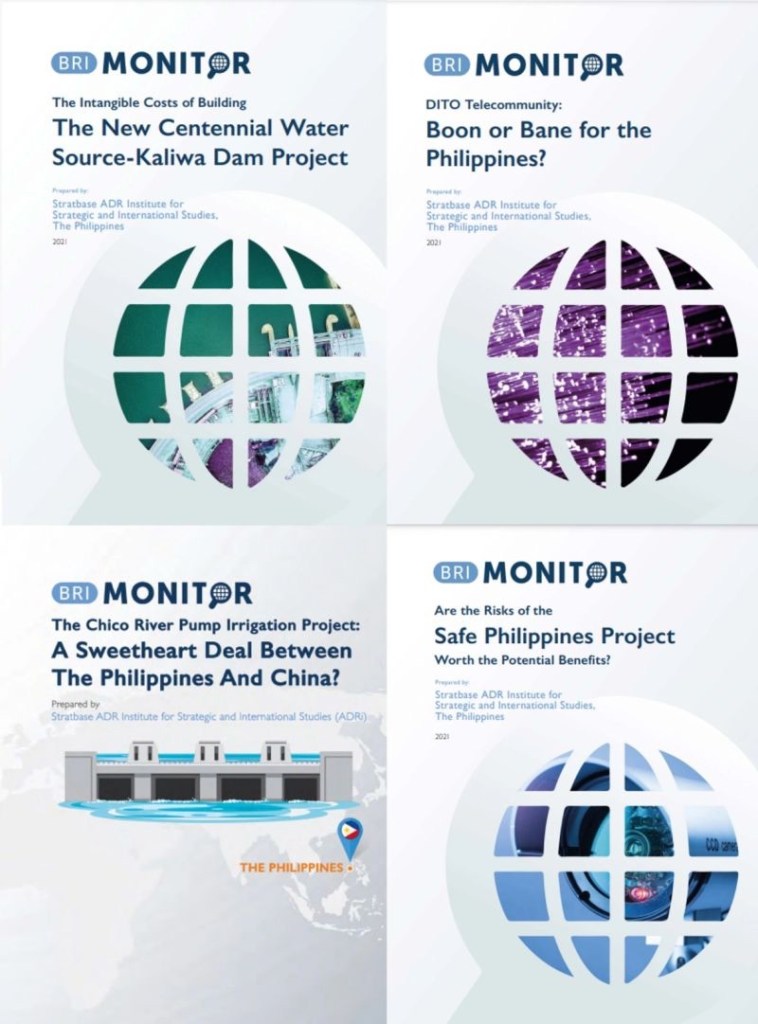
07-31-2024: If it’s bad business, it’s bad for the Philippines (archived)
Our organization, the Stratbase ADR Institute, received an award from the prestigious Center for International Private Enterprise (CIPE), one of the four core institutes of the National Endowment for Democracy in Washington, DC. We were recognized for our research, advocacy, and strategic communication on four infrastructure projects entered into by the Philippines, during the administration of former President Rodrigo Duterte, under the Belt and Road Initiative of China.
…
The Philippines has currently withdrawn from the Belt and Road Initiative and the current administration has been careful to consider other partners aside from China.
…
Victor Andres “Dindo” C. Manhit is the president of the Stratbase ADR Institute.
Just like the National Endowment for Democracy, CIPE has been scrubbing their website. Search for the Philippines and click on the results. Most of the links are missing.
Related:
Read More »India is losing Bangladesh to China and Pakistan, and it could get worse
India is losing Bangladesh to China and Pakistan, and it could get worse
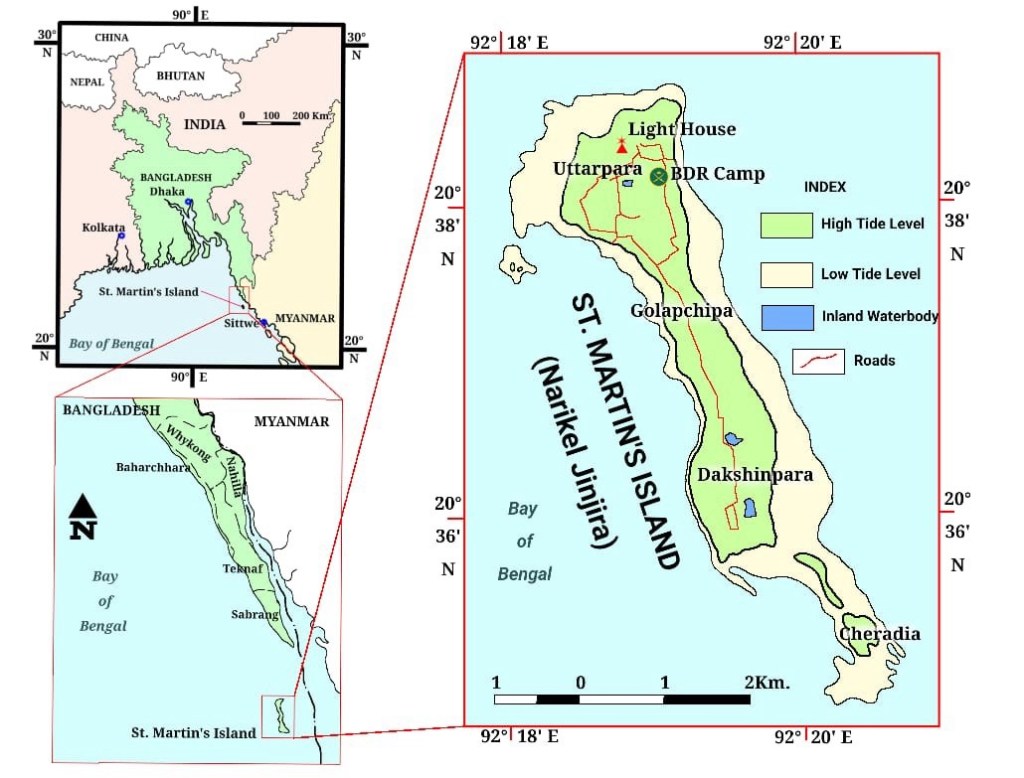
by Derek J Grossman, RAND
Beijing has further sought to develop numerous Bangladeshi ports, including Chittagong, Mongla, and Sonadia ports, to achieve a maritime presence in the Bay of Bengal. Enhanced access to any or all of these ports could substantially add to Beijing’s “string of pearls” strategy to hem in India in the Indian Ocean.
Read More »
PH: Net FDI hits over 4-year low of $368M in Sept, BSP reports
NET foreign direct investments (FDI) remained positive in September but were markedly lower compared to a year ago, the Bangko Sentral ng Pilipinas (BSP) reported on Tuesday.
…
“Investors often prefer safe-haven assets in advanced economies under these conditions,” he explained, adding that heightened geopolitical tensions and economic uncertainties may have also further dampened investor confidence globally.
China Forges Ahead Amid Challenges and Shifting Global Dynamics
This article presents a critical analysis of navigating headwinds and seizing opportunities in China’s economic crossroads, based on Yaroslav Lissovolik’s blog.
China Forges Ahead Amid Challenges and Shifting Global Dynamics
SECNAV Del Toro Meets with Wisconsin Governor, Michigan Cabinet, and Leadership of Fincantieri Marinette Marine
April 17, 2024
Secretary of the Navy Carlos Del Toro and senior members of his staff met with Wisconsin Governor Tony Evers, members of Michigan Governor Gretchen Whitmer’s cabinet, and the leadership of Fincantieri Marinette Marine to coalesce federal, state, and local initiatives to ensure timely completion and delivery of the Constellation-class frigate.
SECNAV Del Toro Meets with Wisconsin Governor, Michigan Cabinet, and Leadership of Fincantieri Marinette Marine
Previously:
Philippines’ ‘assertive transparency’ strategy is causing them to miss out economically
The Philippines is going all in with the United States and bracing itself against lost Chinese largesse. President Ferdinand Marcos Jnr will fly to Washington next month to attend the US-Japan-Philippines trilateral leaders’ summit. It will be his fourth visit to the US since taking office as president less than two years ago.
South China Sea: Philippines must softly manage disputes or miss out economically
Previously:
PH: Compared To China, US Trade, Investment Offers Laughable + More
‘Desperate’ US Seeks Japan’s & South Korea’s Help To Restart Its Defunct Shipyards; Keep Pace With China
The US approach focuses on tapping Asian funding, engineering know-how, and shipbuilding experience to expand its shipbuilding capacity, Nikkeia Asia reported.
…
Emanuel said, “There’s a closed plant in Philadelphia. There’s a closed Navy shipyard in Long Beach. And there are a couple of others…We wanted to see if Mitsubishi and other Japanese companies would be interested in potentially investing and reopening one of those shipyards and being part of building Navy, commercial, and Coast Guard ships.”
…
Emanuel had also hinted in January this year that for US Navy warships to remain in Asian waters and be prepared for any future confrontation, the United States and Japan are attempting to reach an agreement enabling Japanese shipyards to do routine maintenance and overhauls.
Over the past 40 years, China has developed a remarkable commercial shipbuilding industry, cautioned Del Toro at an event. “We’ve lost that capability from about the 1980s when we left it open to market forces.”
…
The US has seen a very significant dip in its shipbuilding capacity. Nine of the 13 public naval shipyards the United States formerly had are closed. Several closed shipyards are now national parks, naval air stations, or container terminals. However, a few could be brought back for ship repair or construction.
The urgency to resuscitate these redundant shipyards stems from the threat posed by China’s massive shipbuilding industry, producing many naval vessels that could be used to project dominance in far seas and deployed against the US and its Indo-Pacific allies in the event of a conflict.
…
According to the latest Pentagon’s annual report to Congress on Chinese military and security developments, the Chinese Navy possesses an estimated 350 vessels, while the US Navy battle force has 293 warships.
The yawning gap of 60 hulls between the two navies is expected to grow every five years until 2035, when China will have an estimated 475 naval ships compared to 305-317 US warships. Notably, China has inducted as many as 150 warships in the last ten years.
H/T: Johnsonwkchoi
Related:
U.S. seeks to revive idled shipyards with help of Japan, South Korea – Nikkei Asia
But while quick repairs on damages suffered through deployment are allowed, like the Big Horn at Mitsubishi, U.S. law prohibits U.S.-based ships to undergo full-scale overhaul, repair or maintenance at a shipyard outside the U.S. or Guam. Changing such a law — put in place to protect U.S. jobs — may face headwinds, especially in an election year.
…
Both tours were led by the companies’ respective CEOs. The shipbuilders expressed “strong interest” in establishing U.S. subsidiaries and investing in shipyards in the U.S., the Navy said in a press release.
…
U.S. Navy ships are currently built by seven private shipbuilders, including two non-American players: Italy’s Fincantieri Marinette Marine in Wisconsin and Australia’s Austal USA in Alabama. The involvement of two international shipbuilders serves as a precedent as the Asian players contemplate entry.
Maintenance of the most sensitive nuclear-powered aircraft carriers and submarines are conducted exclusively at four public naval shipyards — in Virginia, Maine, Washington and Hawaii.
…
Emanuel said that when he started working for former President Bill Clinton in the early 1990s, there were 10 to 11 shipyards that built naval ships. “We’re down to seven and our work is growing. You’re not going to get the same volume out of seven that you got out of 11. You need to get back to 11 or 10.”
Is the Philippines becoming a US ‘proxy’ against Beijing in the South China Sea?
Is the Philippines becoming a US ‘proxy’ against Beijing in the South China Sea?
‘The ants that get trampled on’
Not everyone agrees with drawing closer to the US, however, and they warn about the Philippines turning into a “proxy” for American interests. The president’s own sister Imee, a senator, told ANC Digital earlier this month that “China will always be our neighbour, we have no fight with them, let’s not get dragged into a fight that’s not our own.”
Anna Rosario Malindog-Uy, director of the pro-China Asian Century Philippines Strategic Studies Institute, wrote in the Manila Times on February 10 that “agreements such as the EDCA, the VFA and the Mutual Defence Treaty have not only cemented the US military presence and influence in the Philippines but also, most importantly, exemplified the Philippines’ dependence on the US in the military and defence sector.”
Teresita Ang See, former president of the Philippine Association for Chinese Studies and currently part of its advisory council, told This Week in Asia: “Filipinos in general condemn China’s action. But many also understand that China’s assertiveness is in response to US, Japanese and Australian provocations and increasing military presence in the Philippines.”
She warned that “we are fighting a proxy war between the US and China and in the end we will be the ants that get trampled upon”.
H/T: Johnsonwkchoi
Related:
Responding to the Catholic Bishops
Philippines counts the cost of tough South China Sea stance against Beijing
 Ms. Cat’s Chronicles
You must be logged in to post a comment.