
‘Responsible Statecraft’, a publication of analysis, opinion, and news that seeks to promote a positive vision of U.S. foreign policy based on humility, diplomatic engagement, and military restraint, asked some experts to gauge the short and long term effects of Kyiv’s bold invasion on the war.
‘Responsible Statecraft’: What does Ukraine’s incursion into Russia really mean?
Tag: Foreign Policy
President Maduro Responds to Lula and Petro’s ‘Proposals
Venezuelan President Nicolás Maduro responded to his Brazilian and Colombian counterparts’ interventionist statements regarding Venezuela’s presidential elections.
Related:
For more about Mark Feierstein, author of ‘How to Stop a Coup’, see ‘Coups, Massacres And Contras: The Legacy Of Washington’s New Point Man In Latin America’
María Corina Machado is the female Javier Milei (aka US Puppet)
US Military Sex Assault Cases Much Higher Than Official Estimates, Study Finds
The number of sexual assaults in the U.S. military is likely significantly higher than official government estimates, according to a new study released on Wednesday.
US Military Sex Assault Cases Much Higher Than Official Estimates, Study Finds
Related:
DESERTED: THE U.S. MILITARY’S SEXUAL ASSAULT CRISIS AS A COST OF WAR
Reading update 08-14-2024: Finished with Colby’s book

Thank goodness! I don’t know if I’ll read Pottinger’s book, The Boiling Moat, or not. It’s not available on Audible.
On another note, I hate having dyscalculia! It’s August, not September. I had to go back and change the dates on some of my posts. It’s a good thing that I don’t write checks!
08-11 Reading Update: Elbridge Colby

Reading Update: Elbridge Colby
So-called realists are just cleverly disguised China Hawks. They seem to believe that China will mimic the U.S. government’s foreign policy. They’re afraid of China’s rise. I call it the fear of retribution.
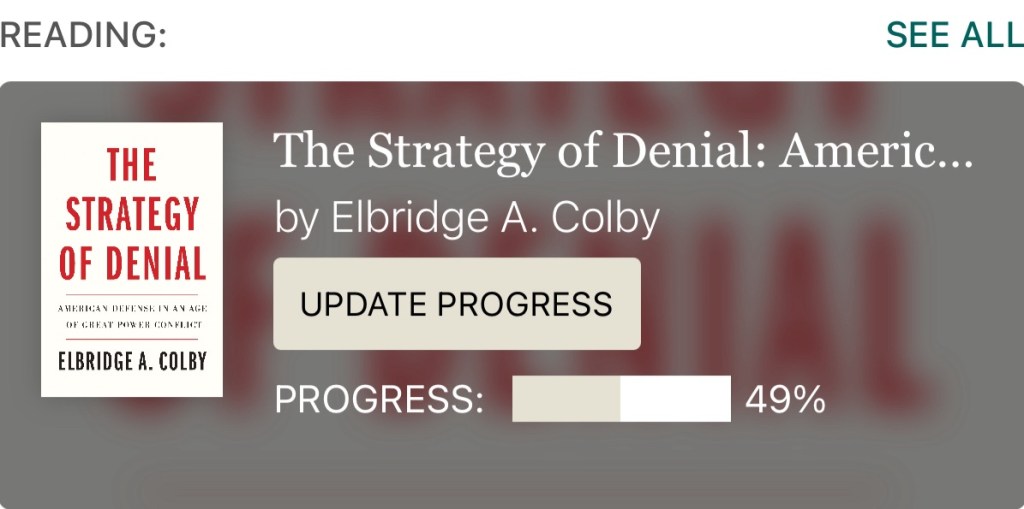
The next four hours and 23 minutes will be painful. I’ll probably finish it up tomorrow or Monday.

MacArthur’s Last Stand Against a Winless War
If war breaks out in Asia, the U.S. won’t send ground troops. Take note, Philippines!
MacArthur’s Last Stand Against a Winless War
Never get involved in a land war in Asia, MacArthur had told Kennedy, because if you do, you will be repeating the same mistake the Japanese made in World War II—deploying millions of soldiers in a futile attempt to win a conflict that cannot be won.
…
Kennedy appreciated MacArthur’s soothing judgment on Cuba (and would soon change the military’s top leadership—perhaps in keeping with MacArthur’s views), but then shifted the subject to Laos and Vietnam, where communist insurgencies were gaining strength. The Congress, he added, was pressuring him to deploy U.S. troops in response. MacArthur disagreed vehemently: “Anyone wanting to commit ground troops to Asia should have his head examined,” he said. That same day, Kennedy memorialized what MacArthur told him: “MacArthur believes it would be a mistake to fight in Laos,” he wrote in a memorandum of the meeting, adding, “He thinks our line should be Japan, Formosa, and the Philippines.” MacArthur’s warning about fighting in Asia impressed Kennedy, who repeated it in the months ahead and especially whenever military leaders urged him to take action. “Well now,” the young president would say in his lilting New England twang, “you gentlemen, you go back and convince General MacArthur, then I’ll be convinced.” So it is that MacArthur’s warning (which has come down to us as “never get involved in a land war in Asia”), entered American lore as a kind of Nicene Creed of military wisdom—unquestioned, repeated, fundamental.
Who Really Controls US Foreign Policy?
From the ongoing US involvement in Ukraine, to an enduring US military presence in the Middle East, and growing US-Chinese tensions in the Asia-Pacific region, regardless of who controls the US Congress and regardless of who sits in the White House, these conflicts continue forward – often with a Democratic president setting the stage for his Republican successor, and vice versa.
Retro Israel Panel Defies ‘America First’ Foreign Policy
The future is knocking but at the National Conservatism Conference, old school remnants still dominate
Related:
Aides in Congress Create Dissent Channel to Protest Support for Israel
An anonymous group of junior staff members has modeled its effort on an internal State Department messaging system, hoping to create an outlet for calls for a cease-fire in the war in Gaza.
Aides in Congress Create Dissent Channel to Protest Support for Israel
Related:
 Ms. Cat’s Chronicles
You must be logged in to post a comment.