
Marx’s insight—”The ruling ideas of each age have ever been the ideas of its ruling class”—perfectly captures the hypocrisy of free speech under the Trump administration. While they denounced censorship when the Biden administration silenced voices questioning pandemic policies, they now weaponize state power against those protesting the war in Gaza. This contradiction reveals that their defense of free speech is not based on principle but on political utility—protecting narratives that serve their interests while suppressing dissent that threatens their agenda. By framing pandemic skepticism as truth-seeking while branding anti-war activism as dangerous, they manipulate public discourse to maintain control rather than uphold genuine democratic values. This selective enforcement isn’t new; it’s a recurring pattern in power structures, where the ruling class dictates which ideas are legitimate and which must be silenced.
Tag: Friedrich Engels
Reflections of a young man on the choice of a profession – Karl Marx

The State: A Product of the Irreconcilability of Class Antagonisms
The State: A Product of the Irreconcilability of Class Antagonisms
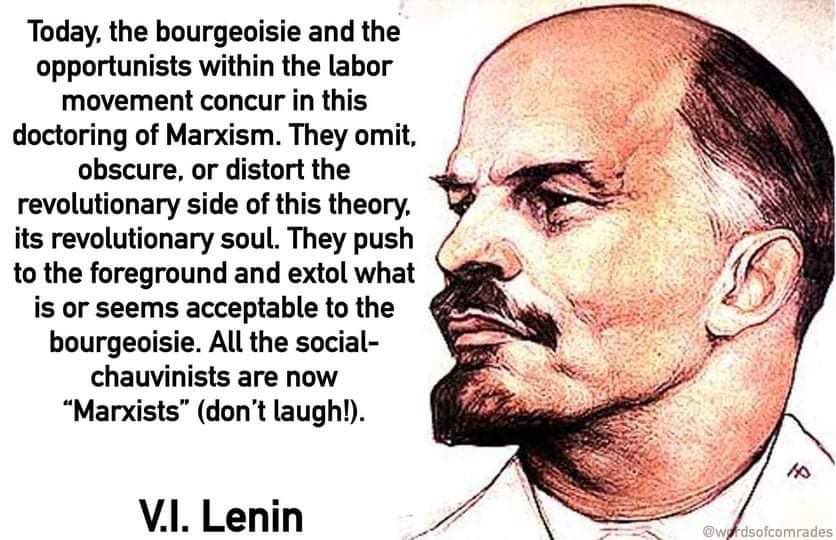
What is now happening to Marx’s theory has, in the course of history, happened repeatedly to the theories of revolutionary thinkers and leaders of oppressed classes fighting for emancipation. During the lifetime of great revolutionaries, the oppressing classes constantly hounded them, received their theories with the most savage malice, the most furious hatred and the most unscrupulous campaigns of lies and slander. After their death, attempts are made to convert them into harmless icons, to canonize them, so to say, and to hallow their names to a certain extent for the “consolation” of the oppressed classes and with the object of duping the latter, while at the same time robbing the revolutionary theory of its substance, blunting its revolutionary edge and vulgarizing it. Today, the bourgeoisie and the opportunists within the labor movement concur in this doctoring of Marxism. They omit, obscure, or distort the revolutionary side of this theory, its revolutionary soul. They push to the foreground and extol what is or seems acceptable to the bourgeoisie. All the social-chauvinists are now “Marxists” (don’t laugh!). And more and more frequently German bourgeois scholars, only yesterday specialists in the annihilation of Marxism, are speaking of the “national-German” Marx, who, they claim, educated the labor unions which are so splendidly organized for the purpose of waging a predatory war!
DeepSeek: What Would Lenin and Marx Say About Romantic Love
Vladimir Lenin, as a revolutionary and Marxist thinker, approached most topics through the lens of class struggle, materialism, and the broader social and economic systems. While he did not write or speak extensively about love as a personal or romantic concept, his views on human relationships were likely shaped by his Marxist perspective.
Here’s how Lenin might conceptualize love, based on his ideological framework:
Read More »
This Valentine’s Day, Let’s Look to Marxists to Reimagine Love, Romance and Sex

This Valentine’s Day, Let’s Look to Marxists to Reimagine Love, Romance and Sex
It’s certainly fitting to think of what Gramsci was writing from a fascist prison in today’s political climate. But it’s also true that we’re in another sort of interregnum, one of romance, sexuality and gender itself. And this one comes with its very own set of morbid symptoms, as anyone who’s tried dating lately can attest. Dating apps are a plague, every week there seems to be a new term for bad behavior (“ghosting,” “breadcrumbing,” whatever), work demands more and more of our time, leaving less and less for love, and a constantly destabilized economy leaves us anxious and stressed even if we do happen to have stable work. Abortion is now illegal in a huge chunk of the country, and homophobic and transphobic violence — not to mention actual bans on trans healthcare and drag — are on the rise. And even if you do make it to coupledom and want to have children, our country still has precisely no support for working parents. The material basis on which you might have thought you’d be able to build a life is crumbling.
Read More »
The Three Sources and Three Component Parts of Marxism

The Three Sources and Three Component Parts of Marxism
People always have been the foolish victims of deception and self-deception in politics, and they always will be until they have learnt to seek out the interests of some class or other behind all moral, religious, political and social phrases, declarations and promises. Champions of reforms and improvements will always be fooled by the defenders of the old order until they realise that every old institution, how ever barbarous and rotten it may appear to be, is kept going by the forces of certain ruling classes. And there is only one way of smashing the resistance of those classes, and that is to find, in the very society which surrounds us, the forces which can—and, owing to their social position, must—constitute the power capable of sweeping away the old and creating the new, and to enlighten and organise those forces for the struggle.
A Socialist, Feminist, and Transgender Analysis of “Sex Work” (2020)
The question of women’s liberation is central to any revolutionary project, and thus so is the question of “sex work.” Esperanza Fonseca’s contribution, although coming from a Maoist political orientation with which we often have differences, [1] makes the stakes of this debate crystal clear, as she combines personal experience, public policy research, and historical materialism to argue that Marxists cannot uphold what she calls “sex-trade-expansionary feminism.”
Content Warning: Descriptions of rape.
…
The right of the subordinated classes of men to buy access to women’s bodies has been used historically to break class solidarity in order to maintain the dominant social relations of the time. This was true in feudal Europe and remains true today: when proletarian and petit bourgeois men get to buy women too, they develop a false consciousness and build solidarity with bourgeois men of their own gender rather than aligning with women of their own class. And because the overthrow of capitalism is only possible by the overthrowing of the bourgeoisie, prostitution serves two great purposes: (1) allows bourgeois men access to a reserve army of women for their pleasure, and (2) prevent class consciousness and thus helps stop the proletariat from organizing as a class.
A Socialist, Feminist, and Transgender Analysis of “Sex Work” (2020)
Cats Studying Marxism
Karl Marx in New-York Tribune 1859: From Population, Crime and Pauperism
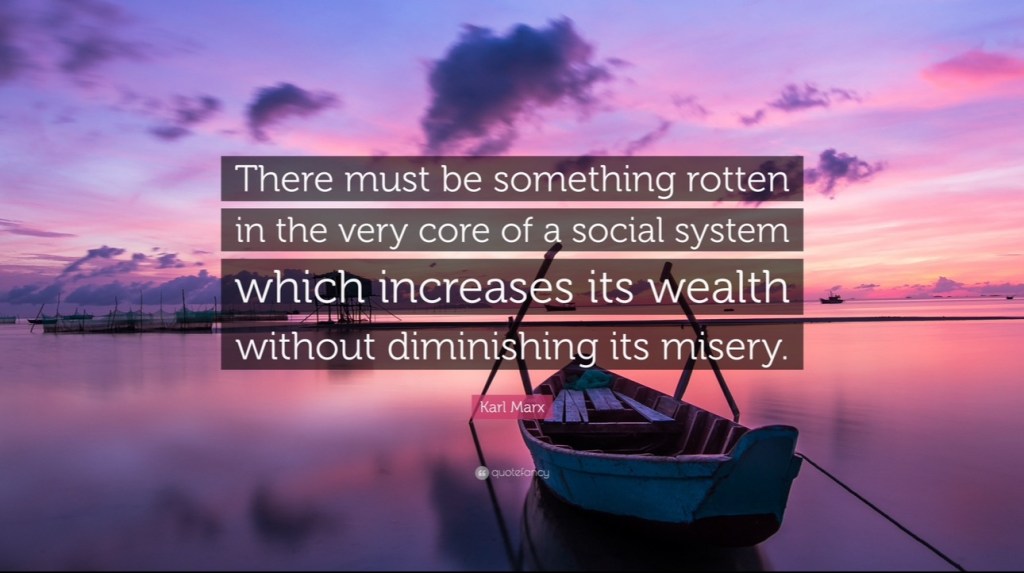
Karl Marx in New-York Tribune 1859: From Population, Crime and Pauperism
There must be something rotten in the very core of a social system which increases its wealth without diminishing its misery, and increases in crimes even more rapidly than in numbers.
Related:
Marx/Engels: On the Question of Free Trade

Karl Marx, On the Question of Free Trade
To him, Free Trade is the normal condition of modern capitalist production. Only under Free Trade can the immense productive powers of steam, of electricity, of machinery, be full developed; and the quicker the pace of this development, the sooner and the more fully will be realized its inevitable results; society splits up into two classes, capitalists here, wage-laborers there; hereditary wealth on one side, hereditary poverty on the other; supply outstripping demand, the markets being unable to absorb the ever growing mass of the production of industry; an ever recurring cycle of prosperity, glut, crisis, panic, chronic depression, and gradual revival of trade, the harbinger not of permanent improvement but of renewed overproduction and crisis; in short, productive forces expanding to such a degree that they rebel, as against unbearable fetters, against the social institutions under which they are put in motion; the only possible solution: a social revolution, freeing the social productive forces from the fetters of an antiquated social order, and the actual producers, the great mass of the people, from wage slavery. And because Free Trade is the natural, the normal atmosphere for this historical evolution, the economic medium in which the conditions for the inevitable social revolution will be the soonest created – for this reason, and for this alone, did Marx declare in favor of Free Trade.
Read More »
 Ms. Cat’s Chronicles
You must be logged in to post a comment.