
The Present Situation And The Unity Congress Of The Workers’ Party
Read More »Tag: Friedrich Engels
A Caricature of Marxism and Imperialist Economism: 5. “Monism And Dualism”
A Caricature of Marxism and Imperialist Economism: 5. “Monism And Dualism”
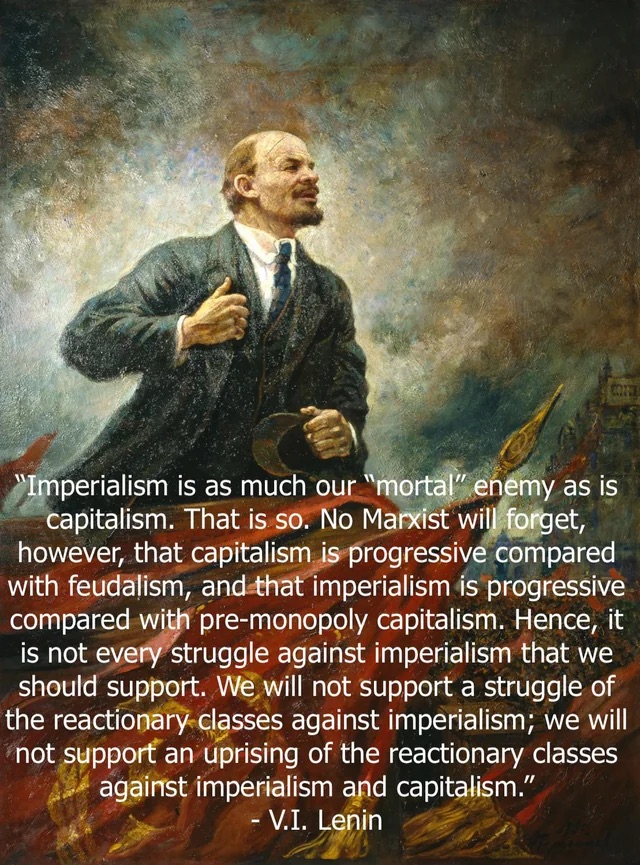
But this Kievsky argument is wrong. Imperialism is as much our “mortal” enemy as is capitalism. That is so. No Marxist will forget, however, that capitalism is progressive compared with feudalism, and that imperialism is progressive compared with pre-monopoly capitalism. Hence, it is not every struggle against imperialism that we should support. We will not support a struggle of the reactionary classes against imperialism; we will not support an uprising of the reactionary classes against imperialism and capitalism.
Condition of the Working Class in England, by Engels, 1845 Results
Condition of the Working Class in England, by Engels, 1845 Results
When one individual inflicts bodily injury upon another such that death results, we call the deed manslaughter; when the assailant knew in advance that the injury would be fatal, we call his deed murder. But when society places hundreds of proletarians in such a position that they inevitably meet a too early and an unnatural death, one which is quite as much a death by violence as that by the sword or bullet; when it deprives thousands of the necessaries of life, places them under conditions in which they cannot live – forces them, through the strong arm of the law, to remain in such conditions until that death ensues which is the inevitable consequence – knows that these thousands of victims must perish, and yet permits these conditions to remain, its deed is murder just as surely as the deed of the single individual; disguised, malicious murder, murder against which none can defend himself, which does not seem what it is, because no man sees the murderer, because the death of the victim seems a natural one, since the offence is more one of omission than of commission. But murder it remains.
Preface to A Contribution to the Critique of Political Economy

Preface to A Contribution to the Critique of Political Economy
In the social production of their existence, men inevitably enter into definite relations, which are independent of their will, namely relations of production appropriate to a given stage in the development of their material forces of production. The totality of these relations of production constitutes the economic structure of society, the real foundation, on which arises a legal and political superstructure and to which correspond definite forms of social consciousness. The mode of production of material life conditions the general process of social, political and intellectual life. It is not the consciousness of men that determines their existence, but their social existence that determines their consciousness. At a certain stage of development, the material productive forces of society come into conflict with the existing relations of production or – this merely expresses the same thing in legal terms – with the property relations within the framework of which they have operated hitherto. From forms of development of the productive forces these relations turn into their fetters. Then begins an era of social revolution. The changes in the economic foundation lead sooner or later to the transformation of the whole immense superstructure.
Related:
Marx-Engels Correspondence 1893: Engels to Franz Mehring
Marx-Engels Correspondence 1893: Engels to Franz Mehring
Ideology is a process accomplished by the so-called thinker consciously, indeed, but with a false consciousness. The real motives impelling him remain unknown to him, otherwise it would not be an ideological process at all. Hence he imagines false or apparent motives. Because it is a process of thought he derives both its form and its content from pure thought, either his own or that of his predecessors. He works with mere thought material which he accepts without examination as the product of thought, he does not investigate further for a more remote process independent of thought; indeed its origin seems obvious to him, because as all action is produced through the medium of thought it also appears to him to be ultimately based upon thought. The ideologist who deals with history (history is here simply meant to comprise all the spheres – political, juridical, philosophical, theological – belonging to society and not only to nature), the ideologist dealing with history then, possesses in every sphere of science material which has formed itself independently out of the thought of previous generations and has gone through an independent series of developments in the brains of these successive generations. True, external facts belonging to its own or other spheres may have exercised a co-determining influence on this development, but the tacit pre-supposition is that these facts themselves are also only the fruits of a process of thought, and so we still remain within that realm of pure thought which has successfully digested the hardest facts.
Related:
Ministry of Law, Justice and Parliamentary Affairs of the People’s Republic of Bangladesh: Marx/Engels Letters (PDF)
Karl Marx, Jenny von Westphalen and Engels On Love and Marriage

Karl Marx, Jenny von Westphalen and Engels
On Love and Marriage
From Jenny von Westphalen in Trier to Karl Marx in Paris, 18 August 1844.
The direct, natural, and necessary relation of person to person is the relation of man to woman. The relation of man to woman is the most genuine relation of human being to human being. It therefore reveals the extent to which man’s natural behaviour has become human, or the extent to which the human essence in him has become his natural essence. The relationship also reveals the extent to which man’s need has become a human need: the extent to which, therefore, the other person as a person has become for him a need.
… If you love without evoking love in return – if through the vital expression of yourself as a loving person you fail to become a loved person, then your love is impotent, it is a misfortune.
Private Property and Communism, Economic and Philosophic Manuscripts of 1844
If you love without evoking love in return – that is, if your loving as loving does not produce reciprocal love; if through a living expression of yourself as a loving person you do not make yourself a beloved one, then your love is impotent – a misfortune.
Eva Illouz quotes


Ho-Chunk launches casino construction in Beloit + More
Ho-Chunk launches casino construction in Beloit (archived)
More than 200 people came to Willowbrook Road Friday morning for the official beginning of construction of a Ho-Chunk casino, convention center, and 312-room, 18-story hotel.
…
The Ho-Chunk casino and hotel project is estimated to cost $405 million. When complete it will employ an estimated 1,500 people, Ho-Chunk officials have said.
Related:
Indian Casinos: Who Gets The Money?
Indian Casinos: Playing The Political Slots
Read More »Protected: Personal: What was that?
Clausewitz or Engels?
Once technological advances can be used for military purposes and have been used for military purposes, they will immediately almost forcefully, and often against the commander’s will, cause changes or even revolutions in warfare.
Who said it? Carl von Clausewitz or Friedrich Engels? I saw it quoted in a paper by the China Aerospace Studies Institute (attributed to Engels). Considering that it’s the “think tank” of the Department of the Air Force, I’m not taking the contents of the paper at face value (same with the papers that I posted below). I’m more interested in who said it, anyway. FYI, I only have Volume 1 of “On War” and apparently it’s the “wrong” translation. I’m too busy reading Mao to read Clausewitz. I find it interesting what I find when researching stuff, though.
Engels’s Second Theory: Technology, Warfare and the Growth of the State
Thesis Title: “The First Red Clausewitz”: Friedrich Engels and Early Socialist Military Theory, 1848-1870 by Michael A. Boden (United States Army Command and General Staff College)
 Ms. Cat’s Chronicles
You must be logged in to post a comment.