NEP has relied on the Associated Press to perform vote tabulations and has contracted with Edison Media Research and Mitofsky International to “make projections and provide exit poll analysis.”[1]
…
The US has funded exit polls abroad because, state dept. officials testified, it is one of the few ways to expose and ascertain the extent of large-scale fraud.[4] Indeed, discrepancies between exit polls and the official results have been used to successfully overturn election results in Serbia, Peru, the Republic of Georgia and, in November 2004, Ukraine.[5]
15-07-2024: The East African nation of Kenya was rocked by deadly protests mainly composed of youth during June, ostensibly in response to the Kenyan parliament’s Finance Bill 2024. By the end of the month around 30 protestors had lost their lives, despite forcing the government to withdraw the Bill, which contained some $2.7 billion in tax hikes.[1] The protests were mainly composed of “Gen Z” youth (those born during the late 90s and early 2000s) which gives the impression of young people fighting for their future. Kenya has a population of some 50 million, with 5 million inhabiting the capital Nairobi, and 4 million in the city of Mombasa on the shores of the Indian Ocean. Those aged between 15 and 29 make up roughly 30% of the population,[2] meaning such protests can draw in larger number than is generally the case in the ageing populations of the West. In the wake of the violence, Uasin Gishu Governor Jonathan Bii urged the Gen Z protestors to give dialogue with President William Ruto a chance. Despite goons and looters infiltrating the protests and causing mayhem, Bii conceded that the protestors have genuine issues that need to be addressed.[3]
July 1st marked the 10th anniversary of a brutal resumption of hostilities in the Donbass civil war. Perhaps unsurprisingly, it passed without comment in the Western media. On June 20th 2014, far-right Ukrainian President Petro Poroshenko called a ceasefire in Kiev’s “anti-terrorist operation”. Launched two months prior following vast protests, and violent clashes between Russian-speaking pro-federal activists and authorities throughout eastern Ukraine, the intended lightning strike routing of internal opposition to the Maidan government quickly became an unwinnable quagmire.
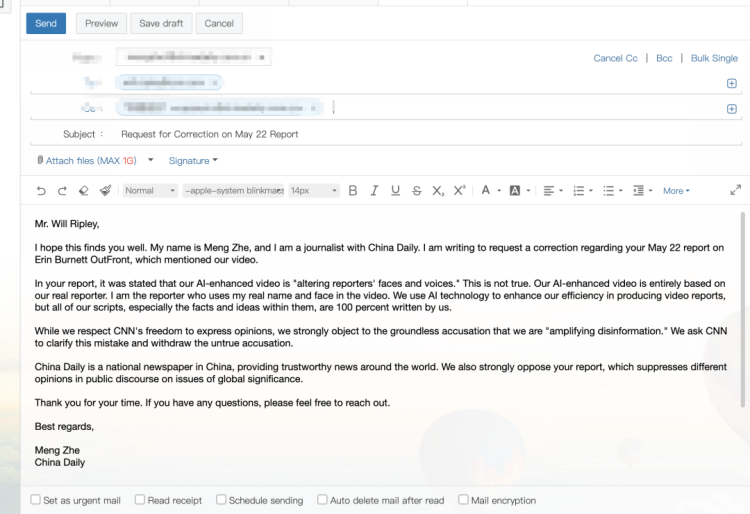
“RIPLEY (voice-over): Chinese state media is using A.I.-enhanced videos on TikTok, altering the reporter’s voice and face. A disclosure on screen for just a few seconds, easy to miss.
[01:39:52]
UNIDENTIFIED FEMALE: Under China’s jurisdiction.
RIPLEY: The video is pushing Beijing’s narrative on the South China Sea.
Is this a threat to democracy?
FELIPE SALVOSA II, JOURNALISM PROFESSOR, UNIVERSITY OF SANTO TOMAS: Most definitely. I think China has found a more cost-effective way to get its message across.
RIPLEY: Turning today’s digital landscape into a battleground for truth, where seeing is no longer believing.
Every time I do a story about these deepfake videos, what strikes me is the quality keeps improving. Our researcher (INAUDIBLE) spent hours putting these through algorithms to determine with 99 percent accuracy whether these videos are real, whether they’re fake, whether the voice has been altered, the face has been altered. Who on social media has time for that and a lot of people don’t take the time which experts say is dangerous, particularly in democracies when people are watching these videos and then potentially using the information they hear to make decisions about how to vote.
As Congress debates major new funding to support the Ukrainian war effort, U.S. taxpayer dollars are already flowing to outlets such as the New Voice of Ukraine, VoxUkraine, Detector Media, the Institute of Mass Information, the Public Broadcasting Company of Ukraine and many others. Some of this money has come from the $44.1 billion in civilian-needs foreign aid committed to Ukraine. While the funding is officially billed as an ambitious program to develop high-quality independent news programs; counter malign Russian influence; and modernize Ukraine’s archaic media laws, the new sites in many cases have promoted aggressive messages that stray from traditional journalistic practices to promote the Ukrainian government’s official positions and delegitimize its critics.


 Ms. Cat’s Chronicles
You must be logged in to post a comment.