We type these words travelling through the Swiss Alps on high-speed rail. As the world becomes smaller, we at The Radio Research Group have witnessed firsthand how nearly everything we knew about modern conflict is changing, under the shadow of Fifth Generation Warfare. The incredible, exponential, accelerating pace of technology has overturned centuries of standard operating procedure. Diplomats and military leaders alike have been thrust into uncharted domains, disrupted by an invisible enemy that makes us question our reality.
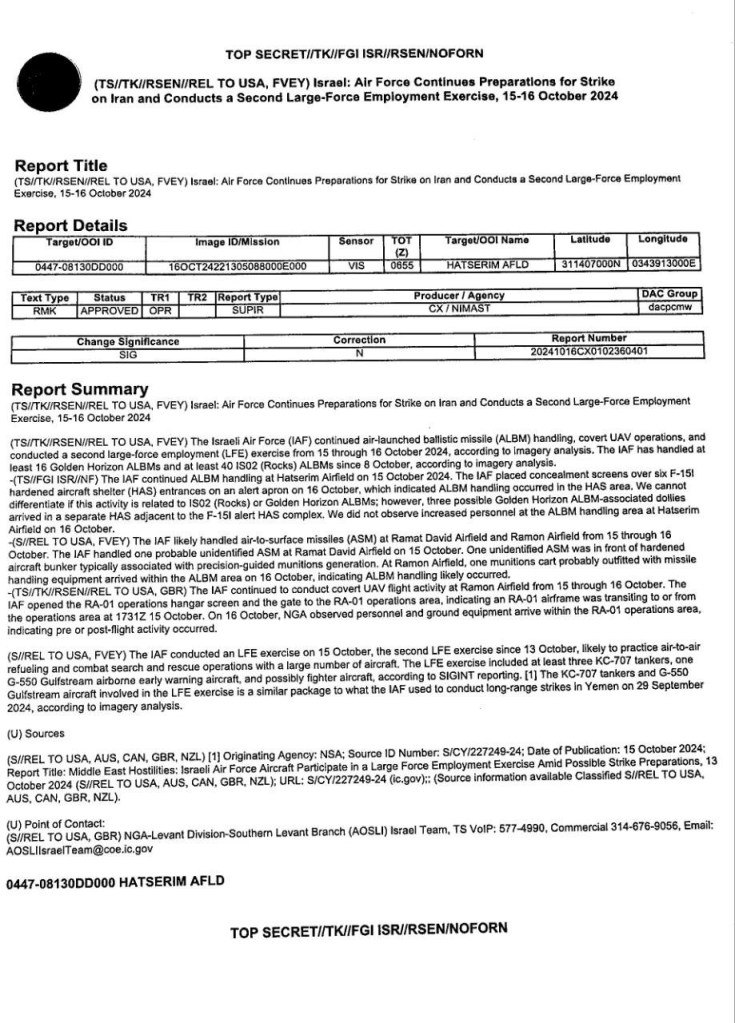
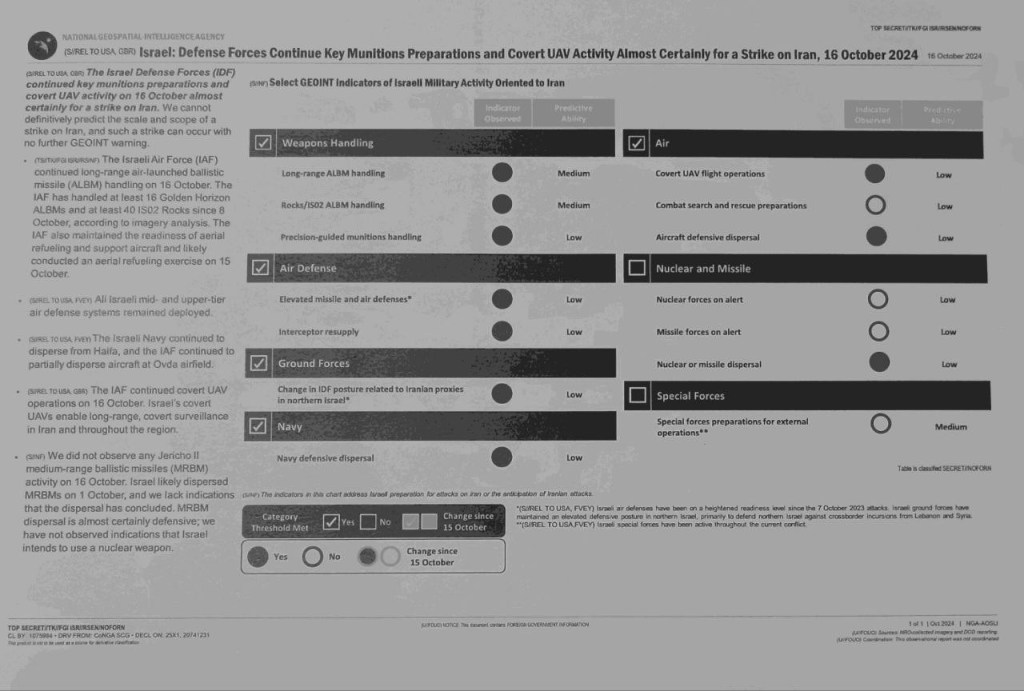
American officials are trying to determine the source of the leak, which describes military drills and weapons placement, and how damaging it might be.
Case in point: a data broker by the name of SafeGraph was busted in 2022 selling the app-gleaned location data of users who had visited abortion clinics. Journalists found that the company was selling a week of granular location data of clinic visitors for as little as $160, documenting not just which clinic they visited and how long they stayed, but where they went before and after.
…
At the same time, SafeGraph contracts with government agencies like the CDC to help do things like track the effectiveness of pandemic lockdowns. And there’s ongoing, emerging data indicating that the company has a fairly robust relationship with the U.S. Air Force that involves providing data for, among other things, “targeting cycle and decisions” in “contested geographies.”:
“Geospatial Data to Navigate Contested Geographies,” the documents and public procurement records, dated May 2023, read. “Improving AFCENT and 9AF Targeting Cycle and Decisions.” 9AF, or Ninth Air Force, is responsible for missions with partner nations in Southwest Asia.”
TARGETING INTELLIGENCE — THE information used to conduct airstrikes and fire long-range artillery weapons — has played a central role in Israel’s siege of Gaza. A document obtained through the Freedom of Information Act suggests that the U.S. Air Force sent officers specializing in this exact form of intelligence to Israel in late November.
The Taliban government of Afghanistan has carried out “truly unprecedented reductions in poppy cultivation” in 2023, according to a new analysis published by Alcis, a UK-based geographic information services firm specializing in geospatial data collection, statistical analysis and visualization.
WASHINGTON: The NATO alliance is open to more engagement should India seek it, but the organisation is not seeking new members in the region, the US envoy to NATO said.
Aside from armor-penetrating tank rounds, the US uses DU ammunition for its 30mm GAU-8 Avenger Gatling gun on the A-10 Warthog ground attack jet fighter. The A-10s figured prominently in the Iraq wars and in Afghanistan.
Ukraine last winter requested 100 A-10 jets from the United States and have been secretly training to use the aircraft in combat. If a Crimea offensive takes place, the A-10 may be moved into Ukraine and flown by a combination of Ukrainian pilots and possibly by volunteer former US Air Force pilots.
…
How will Russia answer these latest developments? Putin has already sent a warning to Britain about DU ammunition, although what he actually has in mind is not clear. If Russia is watching US activity in rushing the Abrams tanks to the battlefield, including the possibility of the A-10, the situation will get more heated.
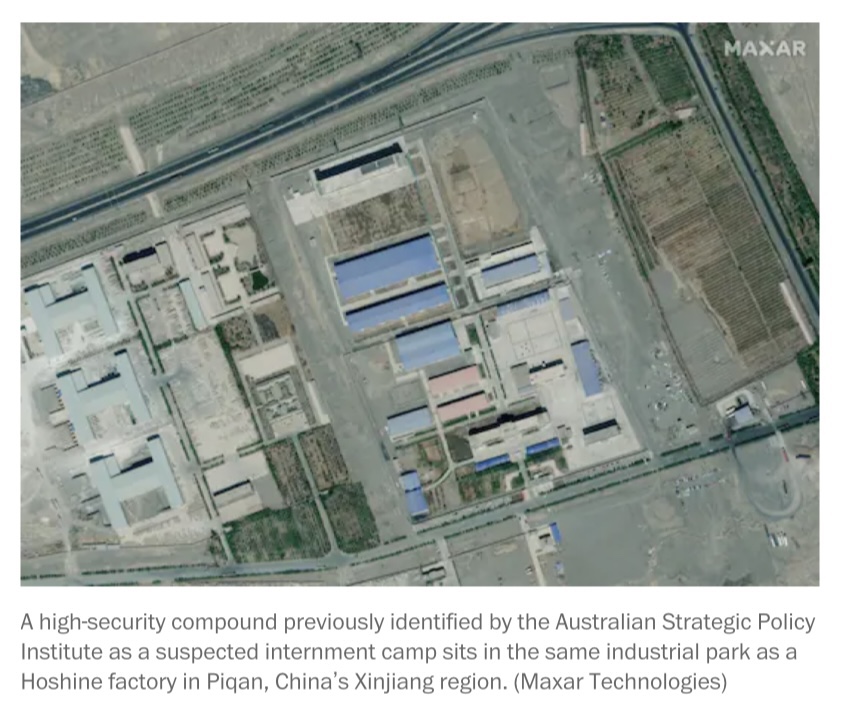
Maxar provides 90% of the foundational geospatial intelligence used by the United States Government for national security and keeping troops safe on the ground.
From its headquarters in Westminster, Maxar is keeping the federal government informed about ground conditions in Ukraine. For the past two decades, the company has worked with the National Reconnaissance Office’s EnhancedView program, which allows the NRO — which manages America’s spy satellites — to gain additional imagery from private outfits.
…
Along with the U.S. government, Maxar has partnered with private businesses and overseas allies including Ukraine to provide up-to-date images throughout the conflict. All of the imagery is unclassified.
The NRO pays Maxar $300 million a year to provide imaging along with other data-related services. “Maxar is one of three electro-optical commercial imagery providers on contract with the NRO and provides commercial imagery in support of NRO’s mission in providing data to more than 500,000 government users in the Intelligence Community, the Department of Defense, dozens of federal civil government agencies, allies, and mission partners,” says the NRO spokesperson.
…
Dan Jablonsky, CEO of Maxar, says one of the important parts of the company’s work is providing news organizations imagery that promotes transparency, helps reduce the spread of misinformation, and shows the realities on the ground in Ukraine.
One of these companies is Maxar, headquartered in Colorado, USA. Maxar traces its history back to the 1960s on its website though its current incarnation’s roots lie in Worldview Imaging Corporation, aka DigitalGlobe…
During the late 1990s and early 2000s, DigitalGlobe forged close links with the US government, being licensed to launch commercial image-gathering satellites – technology that had previously been dominated by the world’s militaries. Contracts in the hundreds of millions or even billions of dollars reportedly followed.
…
The company’s close links to the US government persist. In 2019, NASA awarded it the contract for building a Moon-landing module, while this year Northrop Grumman won a $935m habitation module contract that required integration with a propulsion module being built by Maxar. Three years ago it reportedly sold its space robotics arm MDA for $765m.
The NRO [National Reconnaissance Office] is the U.S. intelligence agency responsible for developing, launching and operating the nation’s spy satellites. It is also the primary acquirer of commercial imagery for the federal government.
…
Maxar Technologies is the NRO’s sole supplier of commercial high-resolution satellite imagery under the EnhancedView contract, a deal that dates back to 2010 when NGA [National Geospatial Intelligence Agency] selected two imagery providers — DigitalGlobe and GeoEye. By 2012, government spending cuts forced NGA to slash its imagery budget by half. EnhancedView subsequently was reduced from more than $7 billion to about $3.5 billion, which led to the merger of the two companies under DigitalGlobe.
The NRO pays Maxar $300 million a year for access to the former Digital Globe’s WorldView-1, WorldView-2, WorldView-3 and GeoEye-1 satellites, as well as the company’s image archive. EnhancedView was a 10-year deal set to expire in 2020 but when the NRO took over the management of the contract, it added three one-year options worth about $300 million each. The agency so far has exercised two one-year options, extending the contract through August 2022.
…
[Chris] Quilty said Maxar is expected to remain the largest supplier of imagery to the U.S. government but it is almost certain that Planet and BlackSky will get some share of the EOCL contracts.



 Ms. Cat’s Chronicles
You must be logged in to post a comment.