
Philippines Could Receive $2.5 Billion in Security Aid from U.S. Defense Bill
Read More »Tag: Gilbert Teodoro
Capes, Cameras, and the Cult of Visibility
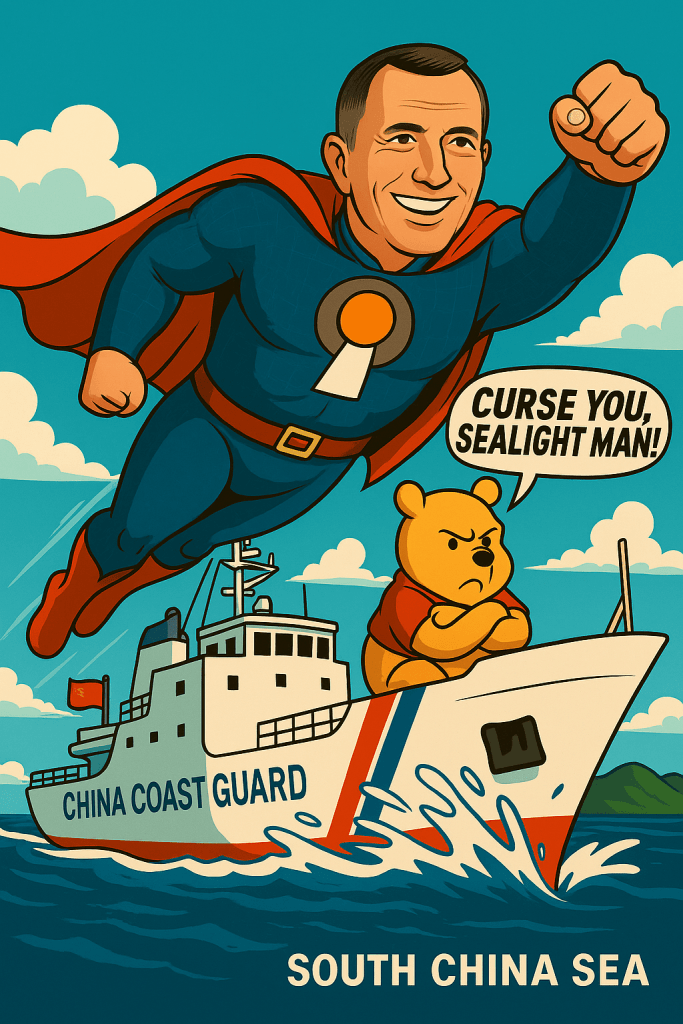
Capes, Cameras, and the Cult of Visibility: The SeaLight Crusade as White Savior Theater
By Tina Antonis
The South China Sea is more than a maritime dispute—it’s a theater of narrative warfare. While headlines focus on Chinese aggression and Philippine resistance, a quieter campaign unfolds in the background: one of satellite feeds, curated imagery, and Pentagon-backed storytelling. At the center of this effort is SeaLight, a project that claims to illuminate truth but often casts shadows of its own.
As explored in my article at Antiwar.com, SeaLight doesn’t just document—it performs. It reframes geopolitical tension through moral spectacle, positioning its creators as heroic arbiters of transparency. But when the messenger wears a cape and the funding flows from defense budgets, we must ask: is this clarity, or choreography?
Stage Left: The White Savior Enters
In the comic-strip cosmology of Ray Powell’s SeaLight project, transparency wears a cape. Clad in heroic postures and backed by satellite imagery, Powell casts himself as the guardian of maritime morality—unarmed, except with satellite feeds, theatrical flair, and strategic messaging.
Yet beneath the cartoon and Pentagon-funded optics lies a familiar archetype: the white savior, rebranded for the South China Sea.
China Is Imperialist? Says Who?
Calling China a “maritime occupier,” Powell positions himself as a bulwark against aggression. But that moral pose collapses under scrutiny. He speaks for a country with over 800 foreign military installations and a documented history of over 250 military interventions since 1991—wars in Iraq, Afghanistan, Libya, Syria, Somalia, and dozens more, all under the banner of peace, freedom, or preemption.
By comparison, China’s post–Cold War footprint includes no sustained foreign occupations and only scattered border conflicts and peacekeeping missions. The imbalance is staggering. And Powell’s framing doesn’t just ignore it—it performs around it.
As David Vine argues in The United States of War, this vast base empire is not a passive network—it’s an architecture of perpetual war. These outposts make military engagement not an exception but a structural habit, cloaked in strategic necessity and sold as global stewardship.
Powell’s cartoon rhetoric—calling China an occupier—obscures the scale of U.S. militarism. The term “occupation” is deployed not to analyze, but to project. When adversaries hold territory, it’s a crisis; when the U.S. spans the globe with armed installations, it’s policy.
Framing Conflict: The Optics of Consent
This isn’t irony. It’s performance. Powell’s language manufactures a moral frame for confrontation—costumed in transparency, but driven by escalation. The cape is literal. The conditioning is deliberate. And the stage is set for war.
SeaLight’s mission is not just visual documentation—it’s narrative warfare. As the Japan Times openly notes, its “chief weapon is photography, applied purposefully, generously and consistently over time.” These images—enhanced, curated, and distributed across media—are not neutral. They’re constructed to shape public perception, sway international opinion, and ultimately manufacture consent for confrontation.
Assertive transparency becomes a kind of ideological scaffolding—a stage on which geopolitical tension is dramatized, simplified, and morally polarized. The goal isn’t simply to reveal conflict; it’s to condition audiences for escalation.
And when the messenger dons a superhero’s cape, the spectacle transforms into something deeper: a story of rescue, of virtue, of intervention. This is not analysis—it’s soft propaganda dressed in heroic metaphor.
Consent for war doesn’t begin with missiles. It begins with mythmaking.
Hegseth visits Manila: Washington prepares for war with China + More
Hegseth visits Manila: Washington prepares for war with China
The language of Hegseth’s press conference in Manila is indicative of the openly aggressive face of US imperialism under Trump. Gone was any reference to what had been the political shibboleth of Washington in the Asia Pacific region: the defense of “freedom of navigation.” Hegseth spoke rather of “preparing for war,” using the phrase more than once. Every time Hegseth mentioned China he termed it “Communist China,” and spoke of its “aggression.” Hegseth referred to US Seventh fleet commander Admiral Samuel Paparo “and his war plans. Real war plans.”
Read More »
What’s Really Going On In the South China Sea Between the Philippines and China
What’s Really Going On In the South China Sea Between the Philippines and China
by Tina Antonis
Maritime clashes between the Philippines and China had been mostly over the Philippines’ military outpost, BRP (BRP—Barko ng Republika ng Pilipinas, which translates to “Ship of the Republic of the Philippines”—the ship prefix for the Philippines) Sierra Madre, in the Spratly Islands, which is disputed by Brunei, China, Malaysia, the Philippines, Taiwan (a province of China, as recognized by the United Nations’ Resolution No. 2758), and Vietnam. The BRP Sierra Madre was intentionally run aground on a reef near the Second Thomas Shoal in the disputed Spratly Islands, in 1997, so that the Philippines could stake their territorial claim.
Read More »
(Primer) A Decade of EDCA: US military bases and its expanding war games in the Philippines
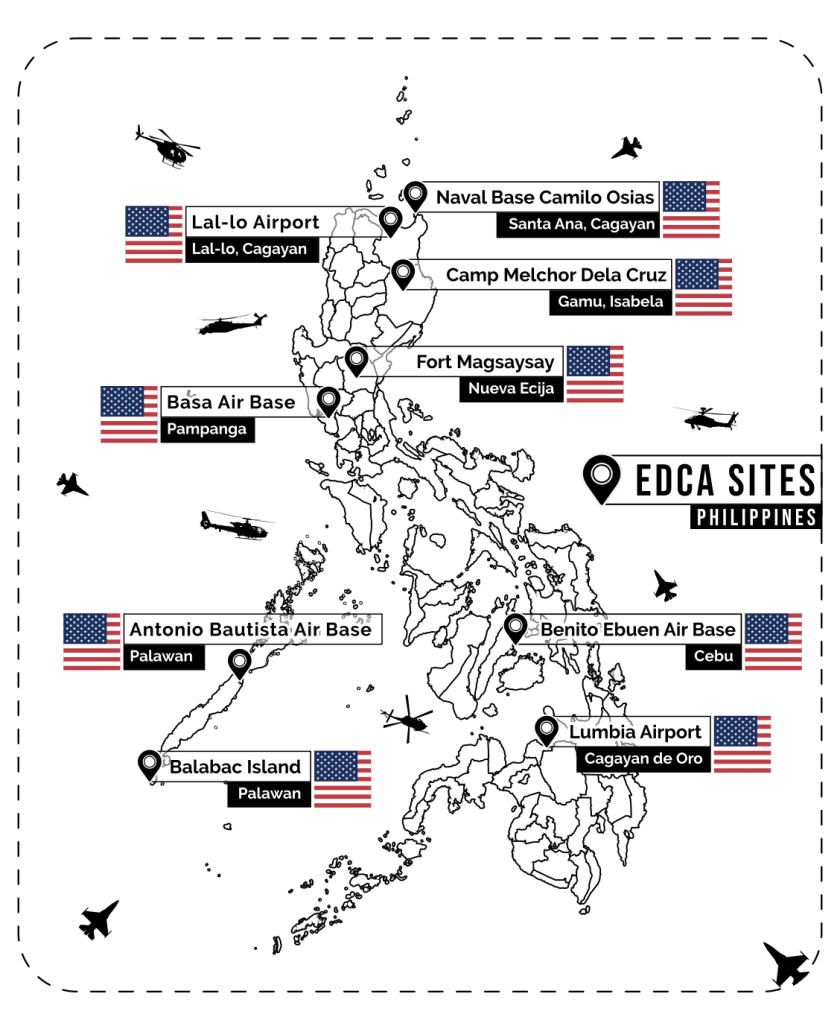
The outright re-establishment of US military bases in the country and its relentless and escalating war games on land, sea, and air are flagrant manifestations of US imperialist domination of the Philippines. This further tightens the grip of US imperialism on the Philippine neocolonial state, especially on the puppet Armed Forces of the Philippines (AFP).
(Primer) A Decade of EDCA: US military bases and its expanding war games in the Philippines
It’s officially published!

Read it at Antiwar.com or here with graphics. FYI, the “Ant” in Antonis is pronounced as 🐜.
Skies over South China Sea seen as new flashpoint as Manila begins ‘aerial provocations’
According to the article, Philippine aircraft also frequently operate with their Automatic Dependent Surveillance-Broadcast (ADS-B) transponders deactivated, significantly increasing safety risks.
Deactivating such transponders means real-time positioning of the aircraft is not shared with air traffic controllers and other aircraft, making it more difficult to maintain situational awareness and avoid potential conflicts or collisions.
Skies over South China Sea seen as new flashpoint as Manila begins ‘aerial provocations’
Related:
How far is China-Philippines Aerial Collision in the South China Sea?
Since August 2024, the Philippines has repeatedly dispatched military aircraft to trespass into the airspace of the Spratly Islands and Macclesfield Bank, escalating tensions in the region. On August 7 and 8, the Philippines sent an NC-212i aircraft to intrude into the airspace near Scarborough Shoal for two consecutive days, disrupting China’s regular training activities. On August 19, a Cessna 208B Grand Caravan plane (C-208B) was dispatched to illegally enter the airspace of Scarborough Shoal. On August 22, the Bureau of Fisheries and Aquatic Resources of the Philippines again sent a C-208B to illegally intrude into the vicinity of Subi Reef.
…
On the other hand, the Philippine aircraft in use are primarily single-engine turboprop light utility aircraft, which are less equipped to handle complex maritime environments, increasing the likelihood of accidents during frequent operations. Moreover, Philippine military aircraft usually operate with ADS-B transponders turned off throughout their missions, posing potential safety risks. In the event of an accident, whatever the reasons, based on past behavior, the Philippines would likely blame China, leading to another cycle of victim-playing and diplomatic posturing.
PH: America, Marcos and AFP can get us nuked
IF advocates of the United States’ access to bases of the Armed Forces of the Philippines (AFP) and US deployment of intermediate-range missiles prove the above headline unduly alarmist, this writer would be most thankful.
Related:
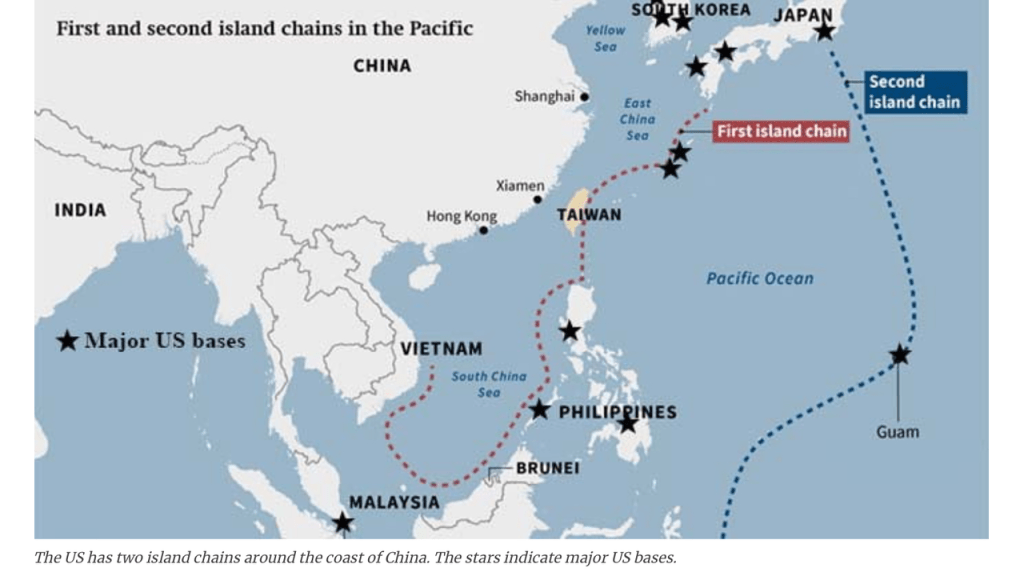
Out-Competing China and Constraining Russia
Forget Hardened Bases, Pacific Conflict Requires Agile Combat Employment, Commander Says
The Plan to Defend Guam from Missile Threats Is Years from Completion: More Investment Is Needed Now
Ground-Based Intermediate-Range Missiles in the Indo-Pacific
Germany, Philippines agree to broaden defence cooperation deal + Vietnam Sends Coast Guard Ship To Philippines For Joint Training
Pistorius is the first German defence minister to visit the Philippines and hopes to finalise the agreement as early as October
Germany, Philippines agree to broaden defence cooperation deal
Related:
Vietnam Sends Coast Guard Ship To Philippines For Joint Training
Philippine and Japan navies held their first bilateral drills in the contested waters, the Southeast Asian nation’s military said in a statement Friday.
YouTube: NATO’s NEW VICTIM: Missiles Deployed, $500M Aid, New US Proxy & Military Buildup|Dr. A.Malingdog-Uy
US Missile Deployment And $500M Military Aid To PH: Defensive Or Offensive Posturing?
 Ms. Cat’s Chronicles
You must be logged in to post a comment.