
A first step towards diplomacy (original)
Posted by @nsanzo
Tag: headlines
Consider these factors as the Pentagon dissects AUKUS
Ukraine: The Dystopia of War
The dystopia of war (La distopía de la guerra)
On Monday, Le Monde reported on one of Ukraine’s flagship construction projects, very much in line with the limited possibilities for reconstruction under wartime conditions and the needs of the moment: a large military cemetery. According to the French outlet, the site will have a bunker to protect against possible bombing—although the dead have not been a specific target of Russian troops, as they have been of Israeli troops in Gaza—places to pay tribute to fallen warriors, and more space to bury soldiers now that existing cemeteries are overflowing. Without even minimally realistic data on casualties in either army, the warnings from sympathetic journalists are indicative when they state, as one Ukrainian blogger recently did, that “currently, the Ukrainian Armed Forces lack infantry. Completely. The infantry has fled, is in the hospital, or in the cemetery.” The growth of cemeteries is undoubtedly another important indicator. According to Le Monde , the new facilities will initially house graves, although the number could reach 130,000 or 160,000 in the future, indicating the current very high level of casualties and the possibility that such losses will continue in the future.
Read More »
Capes, Cameras, and the Cult of Visibility
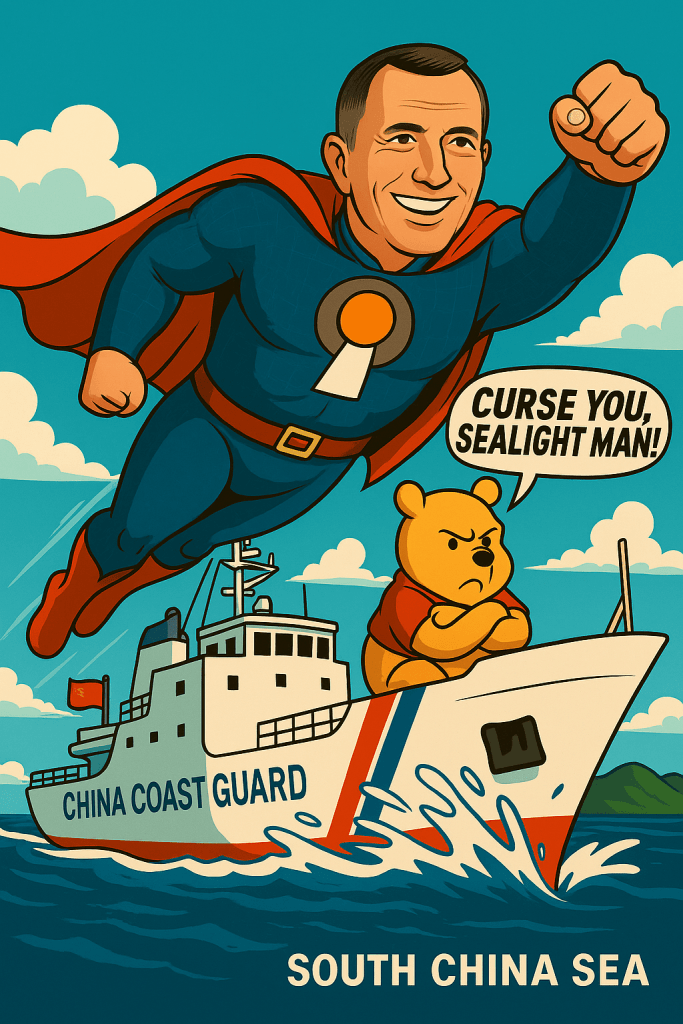
Capes, Cameras, and the Cult of Visibility: The SeaLight Crusade as White Savior Theater
By Tina Antonis
The South China Sea is more than a maritime dispute—it’s a theater of narrative warfare. While headlines focus on Chinese aggression and Philippine resistance, a quieter campaign unfolds in the background: one of satellite feeds, curated imagery, and Pentagon-backed storytelling. At the center of this effort is SeaLight, a project that claims to illuminate truth but often casts shadows of its own.
As explored in my article at Antiwar.com, SeaLight doesn’t just document—it performs. It reframes geopolitical tension through moral spectacle, positioning its creators as heroic arbiters of transparency. But when the messenger wears a cape and the funding flows from defense budgets, we must ask: is this clarity, or choreography?
Stage Left: The White Savior Enters
In the comic-strip cosmology of Ray Powell’s SeaLight project, transparency wears a cape. Clad in heroic postures and backed by satellite imagery, Powell casts himself as the guardian of maritime morality—unarmed, except with satellite feeds, theatrical flair, and strategic messaging.
Yet beneath the cartoon and Pentagon-funded optics lies a familiar archetype: the white savior, rebranded for the South China Sea.
China Is Imperialist? Says Who?
Calling China a “maritime occupier,” Powell positions himself as a bulwark against aggression. But that moral pose collapses under scrutiny. He speaks for a country with over 800 foreign military installations and a documented history of over 250 military interventions since 1991—wars in Iraq, Afghanistan, Libya, Syria, Somalia, and dozens more, all under the banner of peace, freedom, or preemption.
By comparison, China’s post–Cold War footprint includes no sustained foreign occupations and only scattered border conflicts and peacekeeping missions. The imbalance is staggering. And Powell’s framing doesn’t just ignore it—it performs around it.
As David Vine argues in The United States of War, this vast base empire is not a passive network—it’s an architecture of perpetual war. These outposts make military engagement not an exception but a structural habit, cloaked in strategic necessity and sold as global stewardship.
Powell’s cartoon rhetoric—calling China an occupier—obscures the scale of U.S. militarism. The term “occupation” is deployed not to analyze, but to project. When adversaries hold territory, it’s a crisis; when the U.S. spans the globe with armed installations, it’s policy.
Framing Conflict: The Optics of Consent
This isn’t irony. It’s performance. Powell’s language manufactures a moral frame for confrontation—costumed in transparency, but driven by escalation. The cape is literal. The conditioning is deliberate. And the stage is set for war.
SeaLight’s mission is not just visual documentation—it’s narrative warfare. As the Japan Times openly notes, its “chief weapon is photography, applied purposefully, generously and consistently over time.” These images—enhanced, curated, and distributed across media—are not neutral. They’re constructed to shape public perception, sway international opinion, and ultimately manufacture consent for confrontation.
Assertive transparency becomes a kind of ideological scaffolding—a stage on which geopolitical tension is dramatized, simplified, and morally polarized. The goal isn’t simply to reveal conflict; it’s to condition audiences for escalation.
And when the messenger dons a superhero’s cape, the spectacle transforms into something deeper: a story of rescue, of virtue, of intervention. This is not analysis—it’s soft propaganda dressed in heroic metaphor.
Consent for war doesn’t begin with missiles. It begins with mythmaking.
Elon Musk Pretends He’s Leaving The Job He Supposedly Doesn’t Have To Not Return To The Job He Supposedly Never Left
There are a few ways to think about Elon Musk’s announcement this week that he’s stepping back from DOGE. The first is that he’s leaving a job he officially doesn’t have. The second is that he’s returning to a job (Tesla CEO) that he’s supposedly been doing this whole time. The third, and perhaps most interesting, is that none of this actually makes any sense at all.
Trump Admin Is Misleading Public About Venezuelans at Guantánamo, Attorneys Say
After Kristi Noem, the newly confirmed secretary of the Department of Homeland Security (DHS), traveled to Guantánamo Bay earlier this week, she told CNN the Venezuelan migrants being transferred to the notorious U.S. naval base and military prison are “the worst of the worst that we’ve pulled off our streets.”
Immigration attorneys say the facts on the ground do not support Noem’s official narrative about what’s going on at Guantánamo Bay, where President Donald Trump has ordered the construction of a tent city in order to detain up to 30,000 migrants, regardless of the site’s capacity, including asylum seekers fleeing violence and poverty. For civil rights groups, the transfer is only the latest in a series of legally dubious efforts by the federal government to dodge constitutional requirements by incarcerating people at the notorious offshore facility.
Trump Admin Is Misleading Public About Venezuelans at Guantánamo, Attorneys Say
Nothing about the previous attempts by the US government to overthrow the Venezuelan government.
Support for Truthout comes from assorted left-leaning foundations and individual contributors. Major foundation donors include the Schumann Media Center, the Lannan Foundation, and the Cloud Mountain Foundation. Other donors include former militant extremist and academic William Ayers. Another donor is the Park Foundation, an environmentalist grantmaking group focused on opposing fracking, or drilling for natural gas.
Previously:
Venezuelan president blames opponent for post-election violence + More
As predicted: violence by the far-right Venezuelan opposition breaks out across Caracas
How the U.S. Drove Venezuelans North
When they request asylum in the United States, migrants have to say something against their government. But everyone in the Venezuelan community knows that it’s a lie. Venezuelan comedians in Florida, like George Harris, joke about the Venezuelans lying to the migration people just in order to receive asylum.
Tag: 2024 Venezuelan Presidential election
María Corina Machado is the female Javier Milei (aka US Puppet)
Psychiatrist Reacts to Jordan Peterson’s Benzo “Addiction”
What really happened to Dr. Jordan Peterson in 2018? In this video, I discuss his battle with benzodiazepine-induced neurological dysfunction—a rare and debilitating condition often misunderstood and misrepresented by the media. Contrary to headlines labelling him “addicted,” Dr. Peterson’s experience highlights a severe side effect of benzodiazepine use. I explain the difference between addiction and dependence, shed light on how these injuries occur, and discuss the challenges faced by those with similar conditions.
Dr. Josef is responding to this video (timestamp 25:30) of Candace Owens vs. Mikhaila Peterson on Piers Morgan.
Pro-EU forces in Moldova claim victory in questionable vote + More
The tiny European state of Moldova is increasingly being drawn into the maelstrom of NATO’s war against Russia. On Monday, the US-allied government of Maia Sandu claimed victory in a referendum held the day before over whether the country should join the European Union. According to the Central Election Commission, 50.39 percent of voters supported and 49.61 percent opposed EU ascension. Slightly more than half of those eligible to cast a ballot did so.
The International Republican Institute is affiliated with the National Endowment for Democracy (NED). See my “front organizations” page regarding NED and Amnesty International.
Related:
06-10-2024 Daniel Runde and Thomas Bryja: Moldova’s Fate Is Tied to Ukraine’s: Now Is the Time for the West to “Go Big” on Moldova
Daniel F. Runde’s Support for Ukraine (CSIS):
Read More »The racial and class question
Virtually forgotten due to the discourse of Ukrainian unity and the general lack of interest in analyzing the nuances of events, the racial and class question is going virtually unnoticed in this war. If the Donbass conflict had a proletarian aspect that the press mocked in the first weeks of the DPR due to those Soviet-looking press conferences of workers and academics, in the current context, there have not even been any such comments. Presented as a war of national liberation, no aspect other than nationalism has deserved much mention in the Western press or in academia. Volodymyr Ishchenko and Ilya Matveev, who have sought to study the class aspect in the outbreak of the conflict, are the rare exception. To Ischenko’s surprise, RFE/RL published an article last September that dealt, albeit in generalities and without great depth, with the increase in inequality that war implies, an aspect that is, on the other hand, perfectly evident. “As the war drags on, the gaps in Ukrainian society are widening,” the American media headlines.
Read More »
[Updated] Moldova says ‘no’ in vote on joining EU: partial results
DW (Germany): Moldova says ‘no’ in vote on joining EU: partial results
They’ve been building up this election interference narrative for months.
Related:
B92 (Serbia): Moldova decided: Loud and clear – NO!
BBC: Moldova’s EU vote hangs in balance as president blames voter ‘fraud’

More information on just a few of the front organizations in Moldova:
Read More » Ms. Cat’s Chronicles
You must be logged in to post a comment.