If we do not build left-right coalitions on issues such as militarism, health care, a living wage and union organizing, we will be impotent in the face of corporate power and the war machine.
Ukrainian forces are unlikely to be able to recapture Crimea from Russian troops in the near future, four senior Defense Department officials told House Armed Services Committee lawmakers in a classified briefing. The assessment is sure to frustrate leaders in Kyiv who consider taking the peninsula back one of their signature goals.
This is about as establishmenty a list of committee chairs as one could put together. For all the bluster about a new GOP, the people running the show are from the same mold as the ones who have been running it for more than a decade. https://t.co/8HKW8BCdVf
U.S. munitions stockpiles are rapidly being depleted as the Ukraine war continues. Sufficient stockpiles of munitions are vital to the U.S. defense. Once the stockpiles are expended, the Department of Defense cannot simply buy more munitions—manufacturing takes years. Congress and the Department of Defense must ensure that the U.S. has sufficient stockpiles to meet the challenges of the modern era while working with manufacturers to make the industry as responsive as possible.
The Leahy Law prohibits the U.S. military from providing training and equipment to foreign security forces that commit human rights abuses, but it does not apply to U.S. intelligence agencies. Vermont Sen. Patrick Leahy said it should.
Another way to understand the size of CEO compensation at the big contractors is to look at how many jobs would be created if that $287 million were spent on something else. The answer is that spending that money on productive activities would create thousands of jobs: 2,812 jobs in clean energy or infrastructure; 4,104 jobs in health care; and 4,362 in education, calculated using data on the jobs impact of government spending generated by Heidi Peltier for the Brown Costs of War Project.
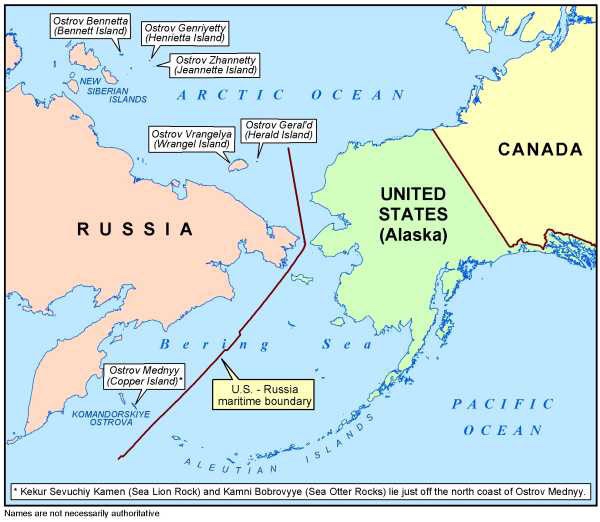
Thomas E. Dans, a columnist for The Wall Street Journal (WSJ) and former Commissioner of the US Arctic Research Commission, believes that the United States should reclaim Wrangel Island from Russia.
No negotiations regarding the U.S.-Russia maritime boundary have occurred since 1990, when the U.S.-USSR Maritime Boundary Agreement was signed. The negotiations that led to that agreement did not address the status of Wrangel Island, Herald Island, Bennett Island, Jeannette Island, or Henrietta Island, all of which lie off Russia’s Arctic coast, or Mednyy (Copper) Island or rocks off the coast of Mednyy Island in the Bering Sea. None of the islands or rocks above were included in the U.S. purchase of Alaska from Russia in 1867, and they have never been claimed by the United States, although Americans were involved in the discovery and exploration of some of them.
“. . . whoever holds the Arctic, holds the world. I think it is the most important strategic place in the world.” These solemn words were uttered in 1935 before a House of Representatives Committee by a retired American general and aviator, Billy Mitchell, who presciently foresaw the Arctic as a vital region for early detection against missile and aviation threats to prevent an attack against the United States. But at the end of the Cold War, the Arctic ceased to be a strategically important place for either the United States or the Russian Federation. But by the 2007-2008 timeframe, Russia began to re-prioritize the Arctic both economically and militarily—in keeping with Vladimir Putin’s vision of restoring Russia’s status as a great power and harnessing the Arctic’s economic potential. Now more than a decade later, Russia has returned to the Arctic militarily with important strategic implications for the United States.
THE DEPARTMENT OF HOMELAND SECURITY is quietly broadening its efforts to curb speech it considers dangerous, an investigation by The Intercept has found. Years of internal DHS memos, emails, and documents — obtained via leaks, Freedom of Information Act requests, and an ongoing lawsuit, as well as public reports — illustrate an expansive effort by the agency to influence tech platforms.
Interesting information about Tulsi’s connections (it’s a long one)! See the bottom for her connections to other Intelligence Agencies and the WEF. H/T: The Popular Show (they mentioned the Twitter thread, towards the end of the video, but didn’t expound on it).


 Ms. Cat’s Chronicles
You must be logged in to post a comment.