
Vladimir Lenin, Ten Questions to a Lecturer, Lenin Collected Works, Volume 14:
Read More »Tag: Idealism
Mao: Directive On The Question Of Class Distinction
Doblin’s Citizens’ Diplomacy or Psychedelic Colonialism?
Just when I thought Cold War diplomacy couldn’t get weirder, Rick Doblin enters stage left with a proposal straight out of a psychedelic utopia: dose Soviet officials with MDMA to ease nuclear paranoia. Not theoretically. Literally.
Read More »Vladimir Lenin: On the Question of Dialectics
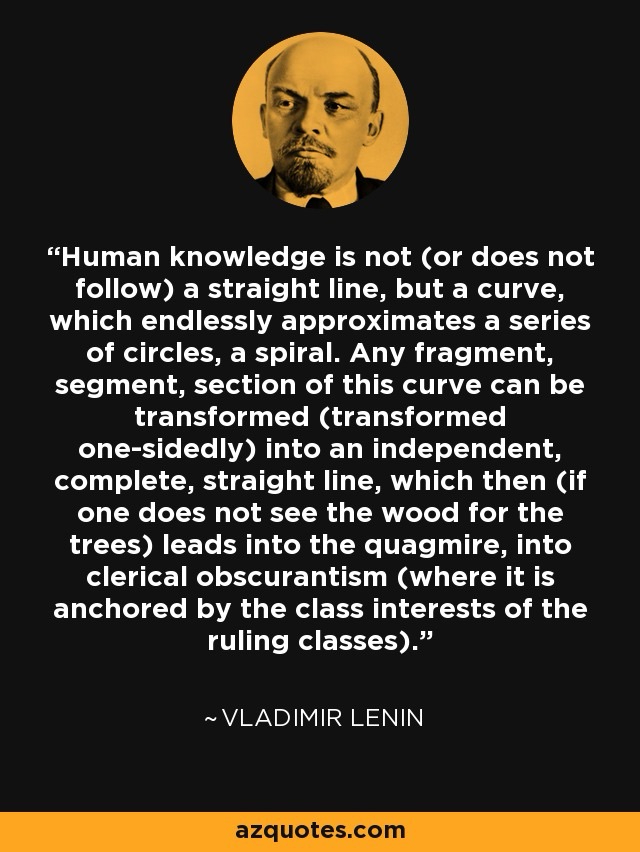
Human knowledge is not (or does not follow) a straight line, but a curve, which endlessly approximates a series of circles, a spiral. Any fragment, segment, section of this curve can be transformed (transformed one-sidedly) into an independent, complete, straight line, which then (if one does not see the wood for the trees) leads into the quagmire, into clerical obscurantism (where it is anchored by the class interests of the ruling classes). Rectilinearity and one-sidedness, woodenness and petrification, subjectivism and subjective blindness—voilà the epistemological roots of idealism. And clerical obscurantism (= philosophical idealism), of course, has epistemological roots, it is not groundless; it is a sterile flower undoubtedly, but a sterile flower that grows on the living tree of living, fertile, genuine, powerful, omnipotent, objective, absolute human knowledge.
Trotsky: The Formalist School of Poetry and Marxism
LEAVING out of account the weak echoes of pre-Revolutionary ideologic systems, the only theory which has opposed Marxism in Soviet Russia these years is the Formalist theory of Art. The paradox consists in the fact that Russian Formalism connected itself closely with Russian Futurism, and that while the latter was capitulating politically before Communism, Formalism opposed Marxism with all its might theoretically.
Literature and Revolution: The Formalist School of Poetry and Marxism
Protected: OSS Secret Agent 488 has the answers /s
Marxism and Psychological Science
1.1. The General Bases of Marxist Psychology
The teachings of Karl Marx caused a revolution in social sciences: in philosophy, in political economy, in the theory of socialism. As is known, psychology remained isolated from the influence of Marxism for many years. Marxism was not admitted into the official centers of scientific psychology, and the name of Karl Marx remained almost unmentioned in the works of psychologists for more than 50 years after the publication of his basic work.
Related:
Che Guevara: Socialism and man in Cuba

Dear compañero,
Though belatedly, I am completing these notes in the course of my trip through Africa, hoping in this way to keep my promise. I would like to do so by dealing with the theme set forth in the title above. I think it may be of interest to Uruguayan readers.
A common argument from the mouths of capitalist spokespeople, in the ideological struggle against socialism, is that socialism, or the period of building socialism into which we have entered, is characterized by the abolition of the individual for the sake of the state. I will not try to refute this argument solely on theoretical grounds but rather to establish the facts as they exist in Cuba and then add comments of a general nature. Let me begin by broadly sketching the history of our revolutionary struggle before and after the taking of power.
Drama: PatSocs, CPUSA, and Mao
A Sad State of Affairs: The Decline of the Communist Party USA.
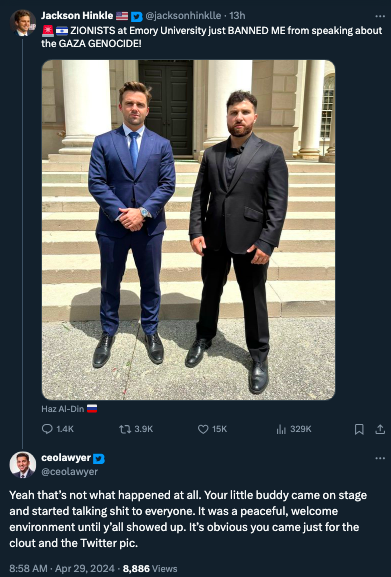
In fact, they have even gone so far as to attack with the most heinous and disgusting of lies the most prominent Communist in the country, who is one of the leading voices in the Palestinian solidarity movement, Jackson Hinkle, along with us and the rest of the new Communist movement that is quickly forming in our new era of revolutionary potential. And in doing this, they are materially aligning themselves with the forces of that genocide and Zionism.
Read More »
…
Recently, the Party posted a rather telling article on its official website called “Against Patriotic Socialism”. Yes, you read that correctly. The article, part of the pre-convention discussions (or, really, we should put “convention” in scare quotes, and the National Board knows why – maybe they can explain to the various clubs why that is, before we have to do so), which can be found on the Party’s main website, maliciously, falsely, and childishly attacks the most prominent Communists in the entire country, who have done more for the cause of class struggle in a single year than the Party has managed in 20. Hinkle alone has exposed millions of people not only to a more positive view of Communism and fought Zionism and imperialism at every turn, but even gone so far as to do what these so-called “old heads” thought impossible, and gotten people to reconsider their views on J.V. Stalin, the most lied about Communist in history. The Infrared Collective has created new slogans that have gotten parts of the working class the Party gave up on long ago to begin getting interested in Communism, and its slogans are featured in mainstream media frequently.
To Be a Socialist One Must Be an Anti-Imperialist

Since the writing of The Communist Manifesto and the founding of the First International, proletarian internationalism has been a cornerstone of scientific socialism, and is a pillar of Marxism-Leninism. Today, in the era of imperialism, putting genuine proletarian internationalism into practice demands that we be consistent anti-imperialists.
To Be a Socialist One Must Be an Anti-Imperialist
 Ms. Cat’s Chronicles
You must be logged in to post a comment.