

Philippine Forces Land on Contested South China Sea Feature
Related:
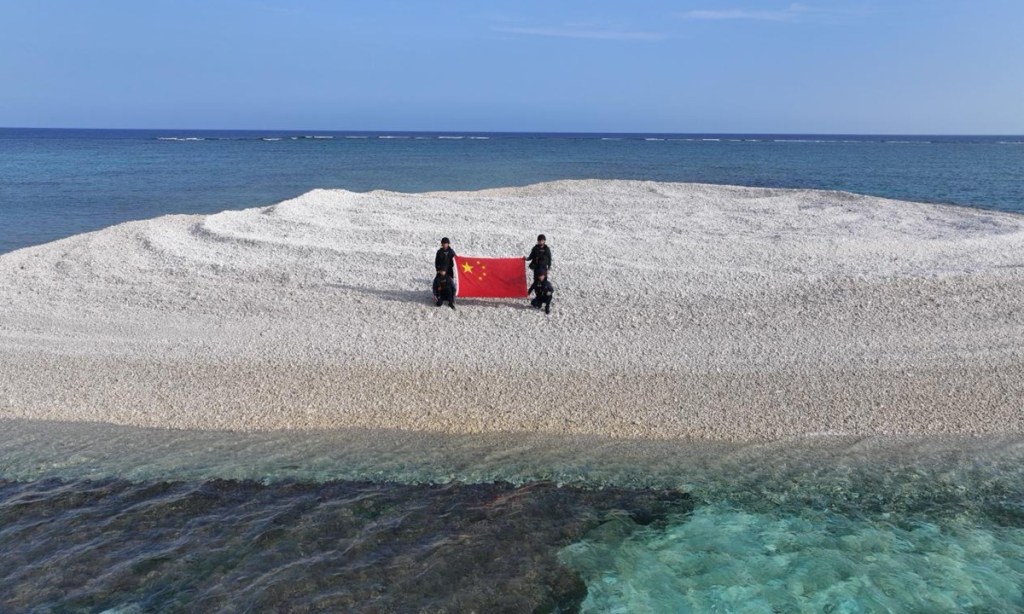
Financial Times: China seizes disputed reef in the South China Sea (archived)
It comes as the Philippines and its ally the US are conducting Balikatan, their largest annual military exercise, which will include coastal defence and island seizure drills. They will be held from next week on the Philippine territory closest to the Spratlys.
Read More »

President Daniel Noboa shocks the world, revealing a strategic alliance with Erik Prince, Blackwater’s founder, to tackle Ecuador’s security crisis.
Noboa Taps Blackwater’s Prince to Battle Ecuador’s Chaos (archived)
Related:
US and European armies should join our war on gangs, Ecuador president tells BBC
Noboa has already ordered the foreign ministry to seek cooperation agreements with “allied nations” to support Ecuador’s police and army, and is also seeking parliamentary approval to change the constitution to allow foreign military bases in Ecuador again.
The incoming Trump administration is poised to pick up where the Biden administration has left off on the decades-spanning centerpiece of US foreign policy ‒ the encirclement and containment of China.
US Foreign Policy vs. China Continues Under Trump (archived)
Related:
AFPI: America First Policy Institute
The Walton Family Foundation, the United States Agency for International Development (USAID), and a coalition of fishermen’s associations and environmental institutions join forces to promote responsible fishing practices.
China’s A2/AD (ACE Concept/Joint All-Domain Operations)
Analysts believe that while Vietnam appreciates the gesture, it is unlikely to influence Hanoi’s strategy in the disputed waters.
Philippines sides with Vietnam in South China Sea dispute, hoping it will ‘return the favour’
Related:
BowerGroupAsia: Dr. Prashanth Parameswaran
Prashanth is concurrently a fellow at the Wilson Center, a senior columnist at The Diplomat magazine and an instructor for institutions including the U.S. State Department. He is the founder of the twice-weekly ASEAN Wonk newsletter, which offers research insights and analysis on the geopolitics and geoeconomics of Southeast Asia and the Indo-Pacific region.
Stratbase ADR Institute Non-Resident Fellow: Dr. Prashanth Parameswaran
Dr. Parameswaran has held various roles across think tanks, governments, media and companies, including the Center for Strategic and International Studies, Singapore’s Ministry of Trade and Industry and the Associated Press. In those capacities, he worked on various issues including geopolitical and geoeconomic statecraft, Southeast Asia foreign and security policy, regional institutions, major power engagement in the Indo-Pacific as well as alliances and partnerships.
…
Dr. Parameswaran holds a Ph.D. and MA focused on international business, international relations, Asian affairs, and U.S. foreign policy from the Fletcher School of Law and Diplomacy at Tufts University. He earned a BA from the University of Virginia, where he studied foreign affairs and peace and conflict studies with a focus on Asia. He regularly advises groups and individuals seeking to advance conversations on Indo-Pacific affairs and serves on the board of several institutions.
Territorial wrangling over who owns the South China Sea has strangled local marine life, say scientists, urging China and the Philippines to set aside political differences and work to save the fish, coral and plants that live border-free.
…
Since 2013, China has built artificial islands that cover more than 3,000 acres of the Spratlys, according to U.S.-based policy organisation Asia Maritime Transparency Initiative.
…
A study last December by the Asia Maritime Transparency Initiative also blamed China’s dredging and clam harvesting for destroying almost 20,000 acres of reefs in the South China Sea.
Less politics more marine diplomacy – a fix for South China Sea?
The Asia Maritime Transparency Initiative (AMTI) is part of the Center for Strategic and International Studies (CSIS). Gregory Poling is director of the AMTI. The same Poling that told the U.S. government-funded Voice of America that “Vietnam’s use of cutter suction dredgers is much more environmentally destructive than its previous dredging methods.”
According to the CIA’s World Factbook, Vietnam occupies around 50 outposts, The Philippines occupies nine, Malaysia occupies five, and China occupies seven in the disputed Spratly Islands.
Previously:
Experts warn of Philippines scheming for ‘new arbitration’ on South China Sea + More
Vietnamese Poachers using Cyanide and Dynamite Fishing in the Philippines’ EEZ
Philippine Coast Guard clarifies ‘assertive transparency’ tact
While Manila mulls over filing a case against China with so-called “solid evidence of the damaged coral reefs caused by Chinese actions,” China, on Monday, released a report based on an unprecedentedly extensive and detailed on-site ecosystem survey around Ren’ai Jiao (also known as Ren’ai Reef), with solid evidence showing that the grounded warship has caused damage to the coral reefs and environmental pollution in the South China Sea.
Related:
Experts warn of Philippines scheming for ‘new arbitration’ on South China Sea + More
Philippines rejects China’s accusation of environmental damage in South China Sea
China has in turn dredged sand and coral to build artificial islands in the South China Sea, which it says is normal construction activity on its territory, but which other nations say is aimed at enforcing its claim to the waterway.
A report by the Center for Strategic and International Studies last year found China’s construction activity buried more than 4,600 acres (1,861 acres) of reef.
China claims almost all of the vital waterway, where $3 trillion worth of trade passes annually, including parts claimed by the Philippines, Brunei, Malaysia, Taiwan and Vietnam.
Greg Poling, from the front CSIS, claims that Vietnam is also building artificial islands.
While reiterating that the arbitral tribunal in the South China Sea arbitration exceeded its jurisdiction and made an illegitimate ruling, Chinese experts warned on Monday that the Philippines is scheming for “new arbitration” on the issue, which would undermine regional peace and stability.
Experts warn of Philippines scheming for ‘new arbitration’ on South China Sea
Related:
Philippines should use legal, moral leverage in West Philippine Sea – expert
Ray Powell, director of the SeaLight Gordian Knot Center for National Security Innovation at Stanford University, said China is using an “asymmetrical” strategy through military might in asserting its claims in the region.
…
He also expressed support for the Philippine government’s plan to file another case against China, this time over the environmental destruction that China has caused in the West Philippine Sea.
PH to complete environmental case vs. China in ‘few weeks’- DOJ
Foreign Ministry Spokesperson Wang Wenbin’s Regular Press Conference on May 20, 2024
The Office of Naval Research funded Stanford’s GKC
I’m no expert, but I had a feeling that they would back in April, at least:
Philippine Coast Guard clarifies ‘assertive transparency’ tact
Vietnamese Poachers using Cyanide and Dynamite Fishing in the Philippines’ EEZ
 Ms. Cat’s Chronicles
You must be logged in to post a comment.