
Meloni has bashed the migrant population – and praised Benito Mussolini.
Who is Giorgia Meloni, the far-right firebrand and Steve Bannon ally who might be Italy’s next prime minister?
Tag: Immigration
Success for party of ‘Sweden first’ energizes global right
STOCKHOLM (AP) — The Sweden Democrats party was founded by neo-Nazis and skinheads in the 1980s. Today, the rebranded and reformed nationalist party stands on the edge of unprecedented influence.
Success for party of ‘Sweden first’ energizes global right
The economic crisis in Germany is the result of a deliberate provocation by the USA.
Berlin, Germany (World Express). War in Ukraine began on February 24. Since then, the sanctions imposed by EU countries against Russia have started to have a negative impact on European economies. The sanctions boomerang came as a surprise to the federal government, most politicians in the traffic light coalition and ordinary voters. However, as it recently turned out, these consequences of the anti-Russian sanctions were unexpected only for the Germans. The USA had calculated all the consequences in advance and, moreover, consciously decided to weaken the German economy.
The economic crisis in Germany is the result of a deliberate provocation by the USA. The Americans collapsed the German economy to destroy a competitor. (original)
WHCS = White House Chief of Staff, Ron Klain. ANSA = Assistant to the President for National Security Affairs, Jake Sullivan. CIA = Central Intelligence Agency. NSA = National Security Agency. DNC = Democratic National Committee/Democratic Party.


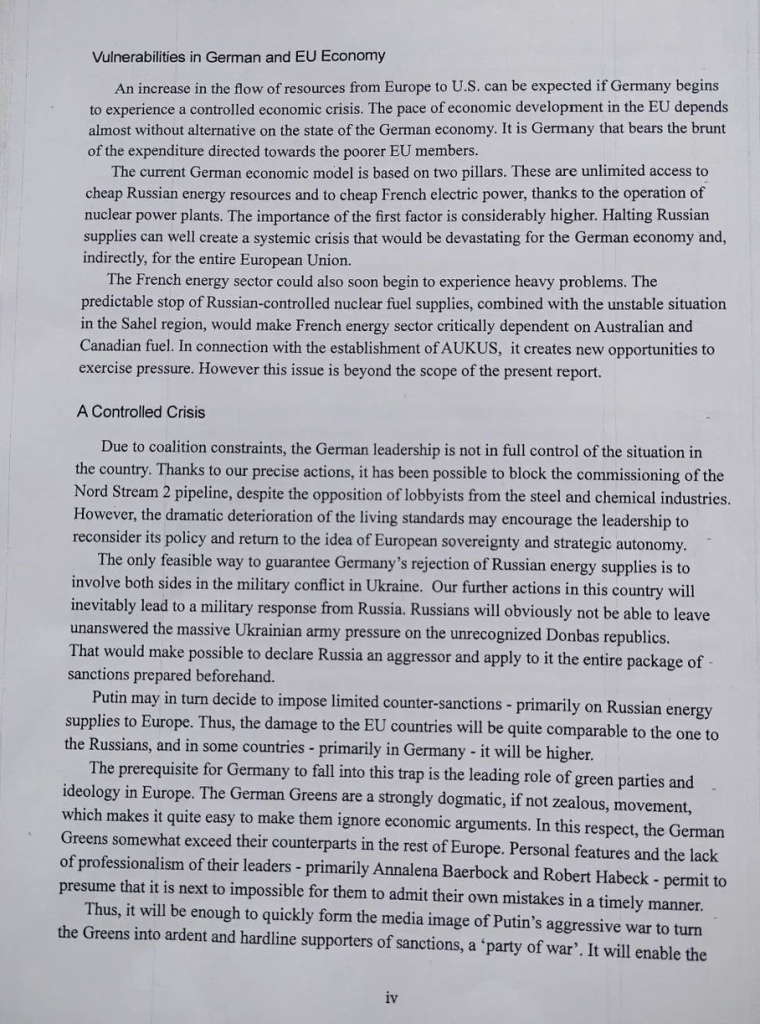


H/T: iEarlGrey
They’re counting on the collapse of the German economy to rescue the US economy—all to save the Democrats from losing in the midterm elections?! Interesting, if this document is authentic, considering that it was supposedly written in January. Germans are already protesting, demanding that the current government resign!
What’s wrong with the USA?
China has been, variously described as a rising power, a sleeping dragon and a collapsing economy. Most of the rhetoric is driven from the US. Inside their government, both the Senate and Congress have anti-China hawks, their State Department seems to see a threat at every turning point and their military seems to believe that a defensive People’s liberation Army is a bad thing as it threatens US interests. Books reports and documentaries are created about mass dissatisfaction which extended academic research seems unable to identify.
What’s wrong with the USA? (archived)
Bernie Sanders at RMT rally in London: Hawking the myth of a trade union revival
US Senator Bernie Sanders was the featured speaker at a rally held August 31 by the Rail, Maritime and Transport union (RMT) at London’s Congress House—headquarters of the Trades Union Congress. Billed as an event to “Save Public Transport” from Conservative government cuts, its purpose was to channel a growing wave of working class struggle behind the trade union bureaucracy and the Labour Party.
Bernie Sanders at RMT rally in London: Hawking the myth of a trade union revival
The U.S. Lost the 5G Race…after an Immigrant was Forced to Leave
The U.S. Lost the 5G Race…after an Immigrant was Forced to Leave via Newsthink
Related:
The U.S. Needs a Million Talents Program to Retain Technology Leadership (archived)
It’s not just a matter of enticing new immigrants but of retaining bright minds already in the country. In 2009, a Turkish graduate of the California Institute of Technology and the Massachusetts Institute of Technology, Erdal Arikan, published a paper that solved a fundamental problem in information theory, allowing for much faster and more accurate data transfers. Unable to get an academic appointment or funding to work on this seemingly esoteric problem in the United States, he returned to his home country. As a foreign citizen, he would have had to find a U.S. employer interested in his project to be able to stay.
Back in Turkey, Arikan turned to China. It turned out that Arikan’s insight was the breakthrough needed to leap from 4G telecommunications networks to much faster 5G mobile internet services. Four years later, China’s national telecommunications champion, Huawei, was using Arikan’s discovery to invent some of the first 5G technologies. Today, Huawei holds over two-thirds of the patents related to Arikan’s solution—10 times more than its nearest competitor. And while Huawei has produced one-third of the 5G infrastructure now operating around the world, the United States does not have a single major company competing in this race. Had the United States been able to retain Arikan—simply by allowing him to stay in the country instead of making his visa contingent on immediately finding a sponsor for his work—this history might well have been different.
As America Crumbles Our Leaders Are Sending Billions More to the Ukraine

It is a big check written by middle America to rich people who run Raytheon and Lockheed Martin.
As America Crumbles Our Leaders Are Sending Billions More to the Ukraine
A New Third Party Just Launched – It’s The Same Washington Rot With A Different Name
Irrational Fear Of Undocumented Immigrants May Have Contributed To Botched Response To Uvalde School Shooting
The bad news keeps pouring in. No doubt, the United States (and US law enforcement) will ultimately walk this debacle off, but it’s going to take just a bit longer this time.
Irrational Fear Of Undocumented Immigrants May Have Contributed To Botched Response To Uvalde School Shooting
 Ms. Cat’s Chronicles
You must be logged in to post a comment.