The McAlester Army Ammunition Plant (MCAAP), which is operated by the U.S. Department of Defense, is the largest ammunition depot in the United States.
Tomasz Łukaszuk, who is also a research scientist at Warsaw University, was speaking as a U.S. consortium led by BlackRock is set to acquire a major stake in ports along the Panama Canal owned by a Hong Kong-based company, CK Hutchison Holdings, the same company that owns a cargo terminal in Poland’s Port of Gdynia.
…
“It serves as the main transit hub for the transfer of American soldiers and equipment to Ukraine,” he continued. [Timestamp: 3:52]
According to the report, the new submarine is capable of carrying advanced hypersonic missiles, allowing for covert strikes beyond enemy defenses and the option to deploy nuclear warheads if needed. Working with other military forces, it will help deter enemy carrier groups and bases within the first island chain.
A Chinese naval task force, consisting of the Type 055 guided-missile destroyer Type 055, a Type 054A frigate, and a Type 903A replenishment ship, has been spotted operating approximately 124 miles [200 kilometers] east of Sydney, Australia.
The People’s Liberation Army Navy Z-9 utility helicopter that intercepted the Philippine Cessna. Photo Courtesy of Camille Elemia.
…
A People’s Liberation Army Navy Z-9 utility helicopter intercepted the Bureau of Fisheries and Aquatic Resources Cessna 208B Grand Caravan during a routine patrol mission over Scarborough Shoal today at 8:39 a.m. local time, according to Philippine officials. A number of Philippine journalists [embedded journalists] were on board the Cessna during the encounter, which saw the Chinese helicopter fly as close as three meters from the turboprop aircraft. Philippine Coast Guard spokesperson Commodore Jay Tarriela described China’s actions as “dangerous flight maneuvers” and blasted the conduct as a disregard to international aviation regulations.
A month after Donald Trump’s second inauguration and the geopolitical global upheaval that may be unprecedented, one thing is clear: The president is an American sovereigntist, not an isolationist. Once this is understood, Trump’s seemingly wild upturning of the geopolitical order actually makes sense.
Sovereigntists are illiberal internationalists. They came of age after World War I, preventing the US from joining the League of Nations (the predecessor of the United Nations). At the time, American sovereigntists regarded the league as a stalking horse for global governance, anti-colonial independence movements, black internationalists, left-wing political movements and liberal Christians.
Today’s sovereigntists aim to weaken non-Western international associations that seek a more democratic international order. They make common cause with similar forces; Giorgia Meloni of Italy and Hungary’s Viktor Orban, for example. Their aim is an illiberal international geopolitical order where domestic political systems resemble “competitive authoritarianism” – multi-party elections embedded in a rigged legal and political environment. Under this model, the media and the machinery of government are used to attack opponents and co-opt critics.
Trump wants the US, not China, to write the technical standards of the global economy. Control over these standards creates lock-in effects in finance, telecommunications, space, robotics, bioengineering, nanotechnologies, and advanced materials and manufacturing methods. That means full-spectrum rivalry with China. If economic control is not possible, the plan B goal is global economic separation from China.
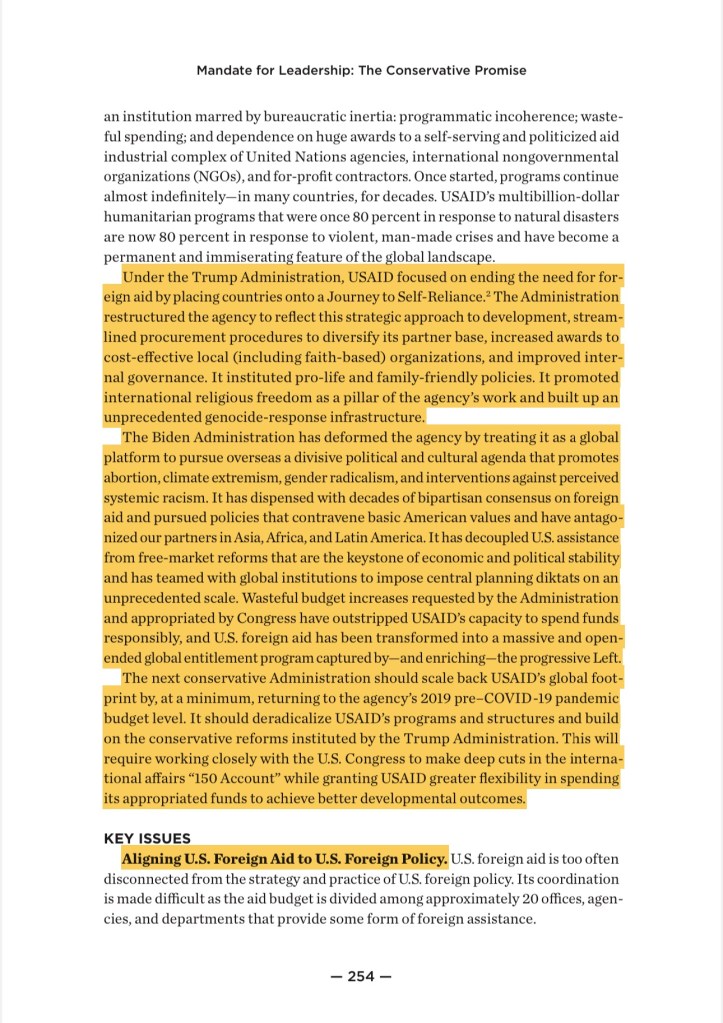
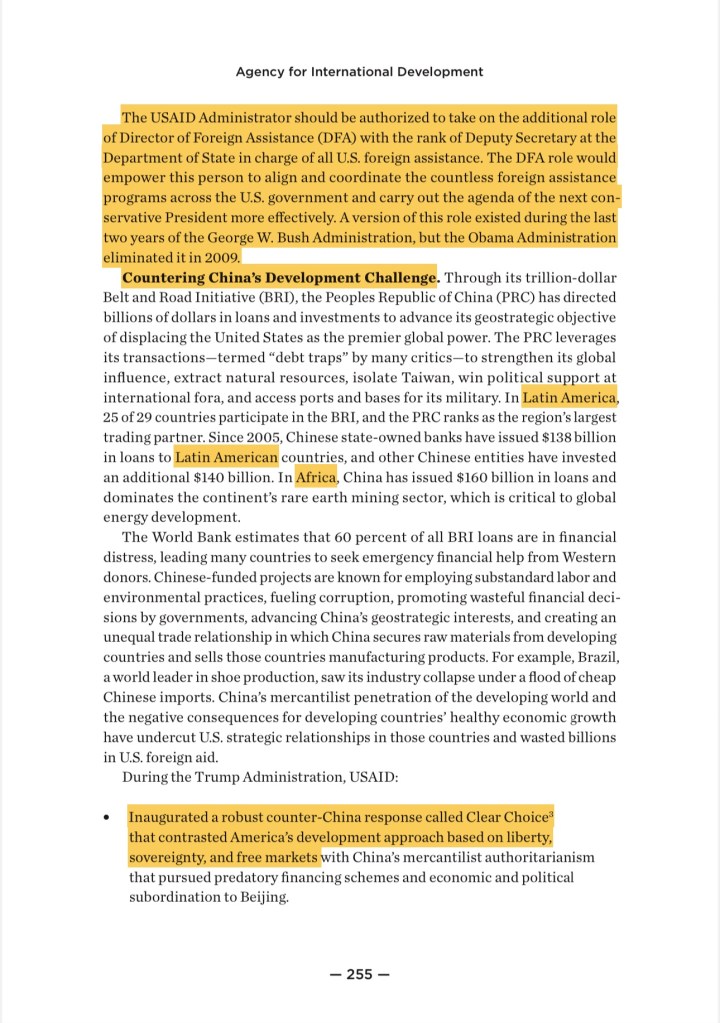
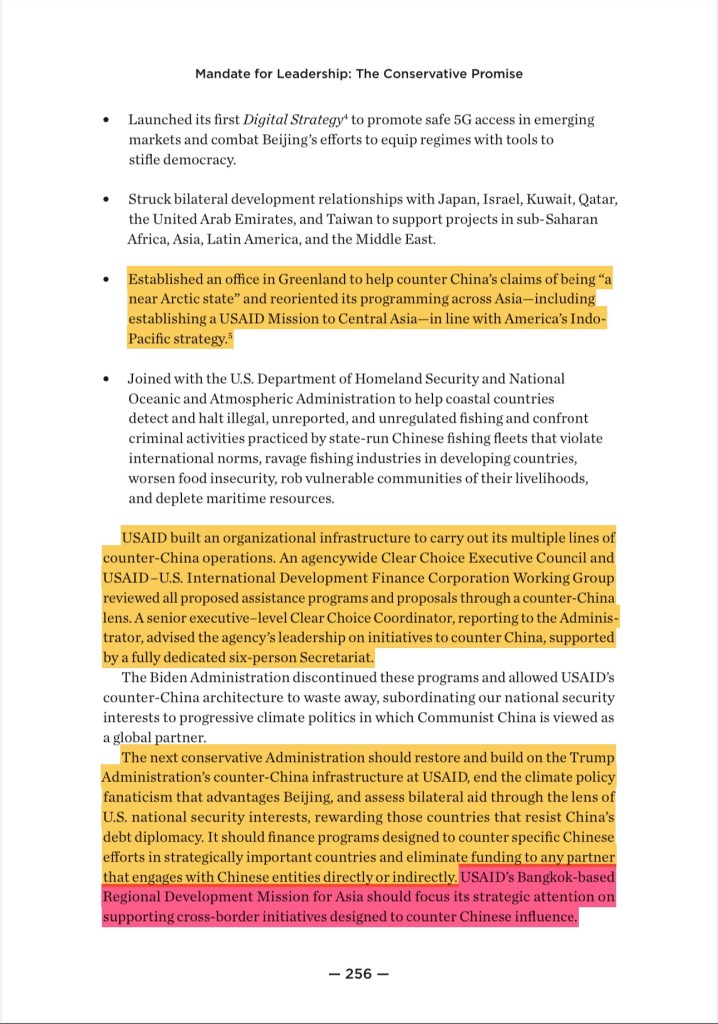
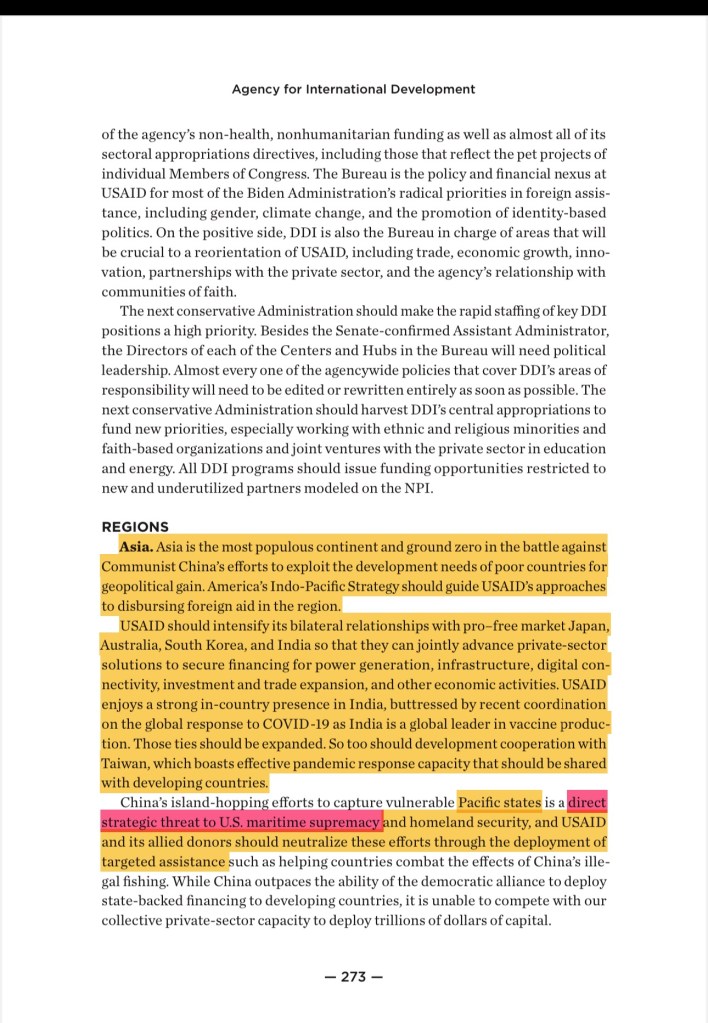
Trump has been following the Project 2025 playbook, Mandate for Leadership. USAID is discussed in Chapter 9. It all comes down to countering China and the Belt and Road Initiative.
The Pentagon official tasked with overseeing U.S. defense policy toward Southeast Asia recently advised against pursuing hawkish defense policies and a major trade war against China, a marked contrast with top Trump appointees.
John Andrew Byers, a longtime history professor who oversaw the Charles Koch philanthropic network’s grants promoting libertarian foreign policy stances at universities, was sworn in this week as the deputy assistant secretary of defense for South and Southeast Asia — a role that immediately thrusts him to the center of America’s response to China’s ongoing military pressure campaign targeting the Philippines, with which Washington holds a mutual defense treaty.
Expanding the fundamental rights to include food, clothing, shelter, education, internet, and vote, the Constitution Reform Commission proposes replacing nationalism, socialism, and secularism with equality, human dignity, social justice and pluralism as fundamental principles of state policy.
…
Modifying, the much discussed article 70, the commission recommends that parliamentarians be allowed to vote against party line except finance bills.
…
The constitution commission recommends deletion of the constitutional provision that stipulates inclusion of Bangabandhu Sheikh Mujibur Rahman’s speech of March 7, 1971, his declaration of independence and the proclamation of independence, which are included in the 5th, 6th and 7th schedules respectively.
FYI, it was written by International IDEA, which is funded by USAID, Open Society Foundations, and several Western governments.
The Typhon launchers, which carry Tomahawk cruise missiles capable of reaching targets in China and Russia from the Philippines, also house SM-6 missiles, which can strike air or sea targets more than 200 km away.
The US military has relocated its Typhon missile launchers—capable of firing multipurpose missiles over thousands of kilometers—from Laoag Airfield in the Philippines to another location on Luzon island, a senior Philippine government source revealed, as reported by Reuters.




 Ms. Cat’s Chronicles
You must be logged in to post a comment.