While it only lasted for a year and half, the Committee on Public Information was the first official propaganda machine in the United States. The CPI sold and financed a war, framed the Spanish flu pandemic, and helped birth the field of modern public relations.
A Chinese naval task force, consisting of the Type 055 guided-missile destroyer Type 055, a Type 054A frigate, and a Type 903A replenishment ship, has been spotted operating approximately 124 miles [200 kilometers] east of Sydney, Australia.
The People’s Liberation Army Navy Z-9 utility helicopter that intercepted the Philippine Cessna. Photo Courtesy of Camille Elemia.
…
A People’s Liberation Army Navy Z-9 utility helicopter intercepted the Bureau of Fisheries and Aquatic Resources Cessna 208B Grand Caravan during a routine patrol mission over Scarborough Shoal today at 8:39 a.m. local time, according to Philippine officials. A number of Philippine journalists [embedded journalists] were on board the Cessna during the encounter, which saw the Chinese helicopter fly as close as three meters from the turboprop aircraft. Philippine Coast Guard spokesperson Commodore Jay Tarriela described China’s actions as “dangerous flight maneuvers” and blasted the conduct as a disregard to international aviation regulations.
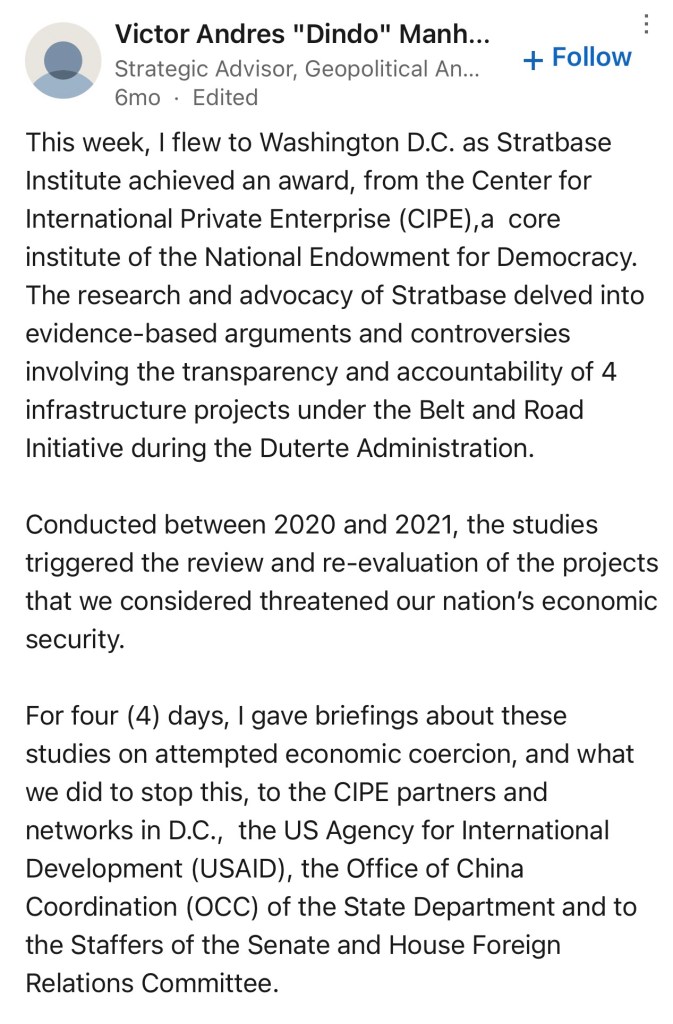
Our organization, the Stratbase ADR Institute, received an award from the prestigious Center for International Private Enterprise (CIPE), one of the four core institutes of the National Endowment for Democracy in Washington, DC. We were recognized for our research, advocacy, and strategic communication on four infrastructure projects entered into by the Philippines, during the administration of former President Rodrigo Duterte, under the Belt and Road Initiative of China.
…
The Philippines has currently withdrawn from the Belt and Road Initiative and the current administration has been careful to consider other partners aside from China.
…
Victor Andres “Dindo” C. Manhit is the president of the Stratbase ADR Institute.
Just like the National Endowment for Democracy, CIPE has been scrubbing their website. Search for the Philippines and click on the results. Most of the links are missing.
Sa’ar insisted on the major budget increase when he and his United Right Party joined the governing coalition last month and he became foreign minister. At the time, Sa’ar said the budget will go towards “media campaigns abroad, in the foreign press, on social media, and more,” including “concentrated activity on U.S. campuses to change their attitude towards Israel and its policies.”
I’ve always known that they would try to expand their information operation to the other countries that are in ASEAN, just by following the SeaLight podcast. If not their information operation, regimechange and terrorism (in Balochistan and Myanmar). I’ve also noticed that Powell has been referring to the Philippines’ “transparency initiative” as “non-violent resistance,” lately (RAND refers to it as “assertive transparency”). Ironic, considering that they’ve already succeeded in overthrowing the government of Bangladesh and are now attempting it in Cambodia, India and Pakistan. For those who don’t know about the regime change asset Gene Sharp and his neoliberal “nonviolence,” see the links on this page. Unfortunately, I don’t have as much time to dedicate to this right now due to other obligations.
Philippine President Ferdinand Marcos Jr. said his nation won’t deploy Navy warships to the South China Sea in response to recent clashes with Beijing in disputed waters.
Maritime clashes between the Philippines and China had been mostly over the Philippines’ military outpost, BRP (BRP—Barko ng Republika ng Pilipinas, which translates to “Ship of the Republic of the Philippines”—the ship prefix for the Philippines) Sierra Madre, in the Spratly Islands, which is disputed by Brunei, China, Malaysia, the Philippines, Taiwan (a province of China, as recognized by the United Nations’ Resolution No. 2758), and Vietnam. The BRP Sierra Madre was intentionally run aground on a reef near the Second Thomas Shoal in the disputed Spratly Islands, in 1997, so that the Philippines could stake their territorial claim.
[John] Phelan is the founder of private equity firm Rugger Management LLC and previously served as the chairman and chief investment officer of the firm that oversaw the fortune of Dell Technologies founder Michael Dell. He is also on the board of the Spirit of America [front group] non-profit, a non-partisan group with a mission to support American troops abroad that has also supported troops in Ukraine.








 Ms. Cat’s Chronicles
You must be logged in to post a comment.