
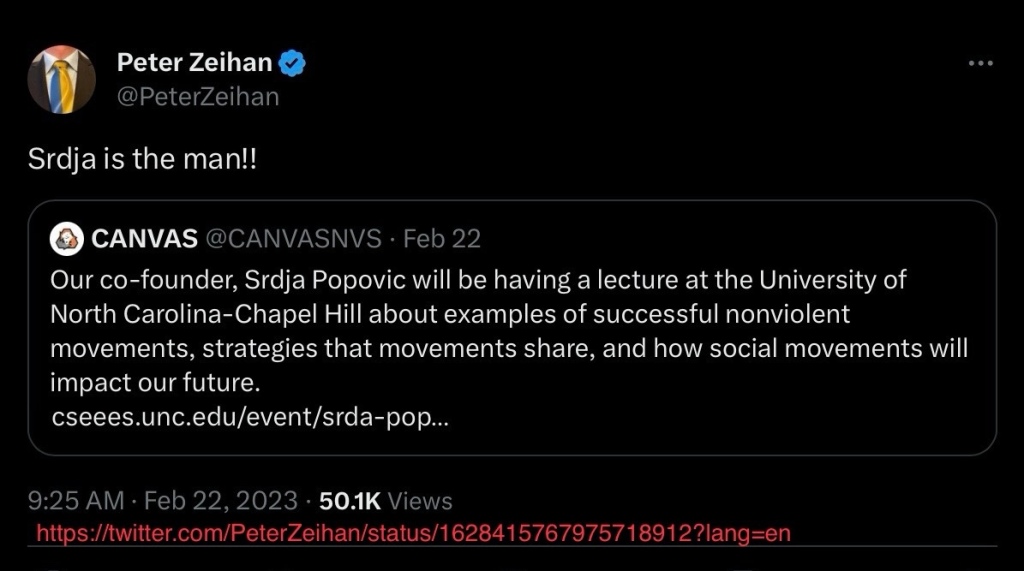
Regime Change Assets: Peter Zeihan & Srđa Popović

When working for Stratfor (Shadow CIA), Peter Zeihan, et al, met with Srdja Popovic.

Thanks for the email! I think the idea of meeting this April/May is great! Since Stratfor is based in Austin (we also have an office in DC), we would it was very easy to “jump” to Colorado. When are you exactly in Colorado? It is most convenient for me to meet around the first week of May, but i am flexible. Otherwise, I will work on that Peter Zeihan, our “head-analyst” and my “boss”, came with me.

Meeting – CANVAS/Stratfor

Related:

Meet Srdja Popovic, the secret architect of global revolution

Who is Behind Regime Change? “Revolution Business” NGO Supported by Wall Street and US Intelligence (archived)

[WTF?!] US army could help Venezuela with nonviolent resistance against Maduro

Both Juan Guaidó, and Leopoldo Lopez, have already been trained to use Gene Sharp’s tactics to overthrow a ‘dictator’ in ‘nonviolent ways’, which was used by US-funded OTPOR, to overthrow Yugoslav President Slobodan Milošević (which wasn’t as peaceful as they made it to be), in 2000. Ivan Marović was a member of OTPOR. Another member, Srđa Popović, went on to start CANVAS, which worked with Stratfor to spy on activists and overthrow governments. CANVAS has been declared a terrorist group in the UAE.

[2020]: Would China Invade Taiwan for TSMC?

Our previous article explained the importance of the Taiwanese firm TSMC as a critical link in the global semiconductor supply chain. Although it is not the only firm with the ability to manufacture cutting-edge logic chips, TSMC is the only viable choice for chip design companies in many situations, and under normal market conditions is likely to remain so for years to come. Control of TSMC’s foundries in Taiwan might thus appear a decisive factor both in Beijing’s readiness to risk attempting unification through force, and for other states deciding whether to take a strong stance against this.

Would China Invade Taiwan for TSMC? (archived)

America’s $52 Billion Plan to Make Chips at Home Faces a Labor Shortage + manufacturing chips in the US could make smartphones more expensive

America’s $52 Billion Plan to Make Chips at Home Faces a Labor Shortage

Another possible fix would be to keep people in the workforce longer, by raising the age at which workers can begin collecting Social Security or tapping into their pensions or 401(k)s. Yet Harry Holzer, a former US Department of Labor chief economist now at Georgetown University, says that neither feels politically feasible right now. Immigration has been a toxic issue in American politics for years, and Social Security has long been an untouchable entitlement. “None of that is doable,” Holzer says, which means “our labor force growth is going to continue to be modest.”

Related:

How manufacturing chips in the US could make smartphones more expensive

Morcos says a top concern of his is the narrowness of the CHIPS Act. Without bringing related device manufacturing back to the U.S., such as device batteries, sensors, cameras, antennas, and hundreds of other components, the manufacturing process could require the most critical component to be produced stateside, then shipped overseas to be assembled with hundreds of other components into a device that is then shipped back to the U.S. for the American consumer.

Work longer, for less pay, and you still won’t be able to afford the latest smartphone or laptop?! 🤷🏼‍♀️

Explained: How Americans In Chinese Tech Firms Might Have To Choose Between US Citizenship And Job

Under the latest US technology export rules, US citizens working in Chinese firms might face a tough choice — quit their jobs or risk losing US citizenship.

Explained: How Americans In Chinese Tech Firms Might Have To Choose Between US Citizenship And Job

H/T: Simply put, Biden forced all Americans working in China to choose between being fired or losing their American citizenship from Der Friedensstifter/The Peacemaker

Sounds like a violation of the Fourteenth Amendment’s Citizenship Clause.

Big Chip in US-China Crisis

For the U.S., it is unthinkable that semiconductor behemoth TSMC could one day be in territory controlled by Beijing, writes Maria Ryan.

One aspect of U.S. House Speaker Nancy Pelosi’s trip to Taiwan that has been largely overlooked is her meeting with Mark Lui, chairman of the Taiwan Semiconductor Manufacturing Corporation (TSMC). Pelosi’s trip coincided with U.S. efforts to convince TSMC – the world’s largest chip manufacturer, on which the U.S. is heavily dependent – to establish a manufacturing base in the US and to stop making advanced chips for Chinese companies.

Big Chip in US-China Crisis