
The US economy isn’t in the clear just yet because of the triple threat posed by rising oil prices, the dollar, and the Federal Reserve, according to Bank of America.
Oil, the dollar, and the Fed still pose a triple threat to the US economy, Bank of America says
Tag: Interest Rates
The Atlas Network and the Building of Argentina’s Donald Trump
Yves here. We’re featuring a post from openDemocracy on Argentina’s primary results that had far-right candidate Javier Milei beating the candidates of the two parties that have been in power for two decades. The post is telling, and not in a good way. Milei does advocate extreme views (not that he can go as far as he likes since even if he won a plurality again, he would still be leading a coalition government). And too many commentators forget that voters regularly move to the right in bad economic times, which Argentina is certainly suffering. It’s that the piece depicts him as a Trumpian outsider/madman, when Nick Corbishley’s post right after the primary results were in describes Milei’s considerable, if sometimes seamy, establishment connections…including to the Kochs:
How Javier Milei Upset Argentina’s Political Status Quo
Previously:
Is Argentina’s presidential frontrunner Javier Milei US’ “boy?” Rejects China+Mercosur, embraces $$
Orinoco Tribune Editor: There Was a Coup Against Pedro Castillo in Peru + Some Notes
Big Tech Is Watching You as You Drive
After years of failed promises on transit, Silicon Valley is loading cars with new technologies to get a cut of the profits—and to collect data on us.
Big Tech Is Watching You as You Drive (archived)
NY Times Blames SOCIAL SPENDING for Debt Crisis—Ignores Endless War
This is a clip from our show SYSTEM UPDATE, now airing every weeknight at 7pm ET on Rumble. You can watch the full episode for FREE here: How Endless War Bankrupted the US While Inflicting Mass Suffering at Home. Plus: Macron Threatens Internet Shutdown & Update on US Govt’s Private Data Purchases | SYSTEM UPDATE #111
NY Times Blames SOCIAL SPENDING for Debt Crisis—Ignores Endless War via Glenn Greenwald
Related:
America Is Living on Borrowed Money
America’s Wars and the US Debt Crisis
Jeffrey Sachs: Bipartisan Support of War, from Iraq to Ukraine, Is Helping Fuel U.S. Debt Crisis
Monopolies Cause Inflation, While Fed Chairman Powell Blames Workers

As American monopolies fix prices higher and higher, the Federal Reserve bizarrely has concluded that employment is to blame for inflation. For months, Fed chairman Jerome Powell has increased interest rates in the hopes of throwing workers out in the street and thus supposedly reducing prices. While I’m sure that corporate, donor-bought congressmembers appreciate his struggles in the class war against the poor and middle class, it’s all a crock.
Monopolies Cause Inflation, While Fed Chairman Powell Blames Workers
Half of America’s banks are potentially insolvent – this is how a credit crunch begins
The twin crashes in US commercial real estate and the US bond market have collided with $9 trillion uninsured deposits in the American banking system. Such deposits can vanish in an afternoon in the cyber age.
Half of America’s banks are potentially insolvent – this is how a credit crunch begins
The Democrats think centrism will re-elect Biden. That’s a dangerous assumption
The party has settled on a new playbook: shifting right and hoping demoralized voters are repulsed by Republicans
The Democrats think centrism will re-elect Biden. That’s a dangerous assumption (archived)
Powell Makes Unexpected Admissions During Prank Call With Fake Zelensky
Fed Chairman Jerome Powell made several bizarre, if not shocking, admissions during a prank call with two Russians posing as Ukrainian President Volodomyr Zelensky, where they discussed topics ranging from inflation, to the Russian central bank, to joking about having a ‘printing press’ in the basement and possibly setting up a federal reserve bank in Kiev.
Powell Makes Unexpected Admissions During Prank Call With Fake Zelensky
The End of American “Exceptionalism”?
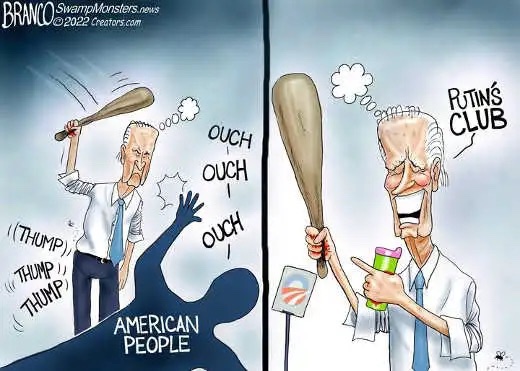
The End of American “Exceptionalism”?
This might have a decisive impact on the US currency as the drive to break with the petrodollar continues to grow and could produce something like a “perfect storm” impacting on the US economy. It threatens to drastically lower the standards of living of nearly all Americans within the next several years as the dollar loses value and purchasing power. As the US economy is heavily interconnected with many European economies, Europe is also likely to be a victim of the coming disaster.
The good news, of course, is that the United States will no longer be able to afford its endless wars and international interventions. Lacking its economic power, it will no longer be able to declare itself “exceptional” and the enforcer of a “rules based international order.” It would mean an ending of the funding of developments like the Ukraine proxy war and the troops will have to come home from places like Syria and Somalia. And it might even mark the ending of sending billions of dollars annually to a wealthy Israel.
Ending dollar supremacy would inevitably have an immediate impact on what passes for US foreign policy, making it more difficult for Washington to initiate and sustain Treasury Department sanctions on countries like Iran and North Korea. It could also create economic turmoil for many countries until the situation resolves itself by producing greater volatility in currency markets worldwide. The Federal Reserve Bank will no doubt respond to the unfolding crisis by acting as it always does by raising interest rates to astronomical levels, thereby hurting most the Americans who can least afford the shock therapy.
When Liberals Fell in Love With Benito Mussolini
When we speak of concepts like “totalitarianism” and “corporatism,” it is often assumed that fascism stands very far from the liberal market society that went before it, and which we are still experiencing today. But if we pay closer attention to Italian fascism’s economic policies, especially during the 1920s, we can see how some combinations typical of both the last century and our own were experienced already in the first years of Benito Mussolini’s rule. A case in point is the association between austerity and technocracy. By “technocracy,” I refer to the phenomenon whereby certain policies that are common today (such as cuts in social spending, regressive taxation, monetary deflation, privatizations, and wage repressions) are decided by economic experts who advise governments or even directly take over the reins themselves, as in several recent cases in Italy.
When Liberals Fell in Love With Benito Mussolini
 Ms. Cat’s Chronicles
You must be logged in to post a comment.