

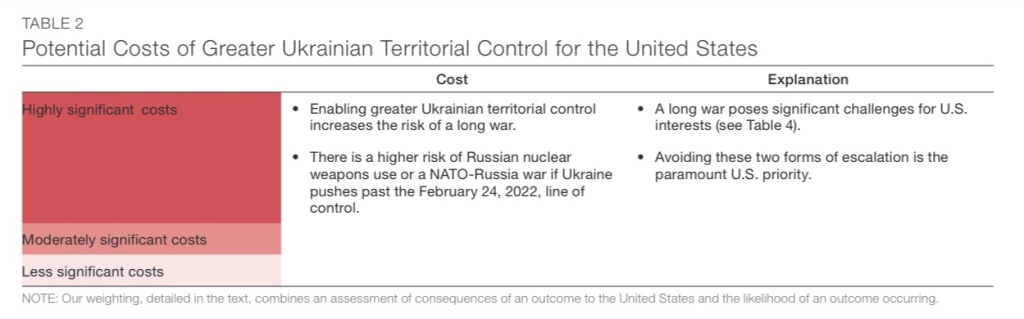


*Russian use of nuclear weapons is a plausible contingency that Washington needs to account for and a hugely important factor in determining the future trajectory of the conflict
*Although a Russian decision to attack a NATO member state is by no means inevitable, the risk is elevated while the conflict in Ukraine is ongoing.
*Chairman of the Joint Chiefs of Staff Mark Milley reportedly kept a list of “U.S. interests and strategic objectives” in the crisis: “No. 1” was “Don’t have a kinetic conflict between the U.S. military and NATO with Russia.” The second, closely related, was “contain war inside the geographical boundaries of Ukraine.”
*It is clear why Milley listed avoiding a Russia-NATO war as the top U.S. priority: The U.S. military would immediately be involved in a hot war with a country that has the world’s largest nuclear arsenal. Keeping a Russia-NATO war below the nuclear threshold would be extremely difficult, particularly given the weakened state of Russia’s conventional military.
*Since neither side appears to have the intention or capabilities to achieve absolute victory, the war will most likely end with some sort of negotiated outcome.
*Since avoiding a long war is the highest priority after minimizing escalation risks, the United States should take steps that make an end to the conflict over the medium term more likely.
*A major source of uncertainty about the future course of the war is the relative lack of clarity about the future of U.S. and allied military assistance to Ukraine.
Avoiding a Long War – U.S. Policy and the Trajectory of the Russia-Ukraine Conflict
Related:
Avoiding a Long War – U.S. Policy and the Trajectory of the Russia-Ukraine Conflict
 Ms. Cat’s Chronicles
You must be logged in to post a comment.