Chinese Missile Boat Undertakes ‘Alarming’ Action

Chinese Missile Boat Undertakes ‘Alarming’ Action (archived)

A Chinese navy missile craft shadowed a Philippine civilian ship on Friday in an unprecedented encounter that one analyst described as “alarming.”

The Fisheries and Aquatic Resources (BFAR) vessel the BRP Datu Romapenet was en route to a South China Sea feature known as Half Moon Shoal to deliver supplies to fishermen.

Half Moon Shoal is situated at the eastern edge of the Spratly Islands and about 60 miles from the Philippine province of Palawan, well within the Southeast Asian country’s recognized exclusive economic zone (EEZ).

According to the Philippines’ ABS-CBN News, which was onboard, the ship picked up a tail in the form of a Houbei-class (Type 22) guided-missile craft, easily identifiable by its wide camouflaged catamaran hull.

Chester Cabalza, founder of Manila-based think tank the International Development and Security Cooperation, told the news agency it was the first time a Type 22 had been spotted in the EEZ.

“This incident is alarming because a missile ship shadowed our BFAR ship,” Cabalza said, adding that it was a show of power intended to intimidate the Philippines.

Read More »

US Keeps Missile System in Philippines as China Tensions Rise, Tests Wartime Deployment

Source

MANILA (Reuters) – The United States has no immediate plans to withdraw a mid-range missile system deployed in the Philippines, despite Chinese demands, and is testing the feasibility of its use in a regional conflict, sources with knowledge of the matter said.

US Keeps Missile System in Philippines as China Tensions Rise, Tests Wartime Deployment

Previously:

Philippines aims to acquire Typhon missile launcher as regional arms race intensifies

Philippines aims to acquire Typhon missile launcher as regional arms race intensifies

Source

China is against the deployment of the Typhon in the Philippines, which has been used in joint military exercises involving US troops

Philippines aims to acquire Typhon missile launcher as regional arms race intensifies

Related:

Foreign Ministry Spokesperson Lin Jian’s Regular Press Conference on August 30, 2024:

Bloomberg: The Philippines’ top military official said that the deployment of the US missile system in the country was mainly for training. China has been in the past said that the weapon system could be destabilizing. Does the Foreign Ministry have any comments on the recent comments by the Philippines’ military chief?

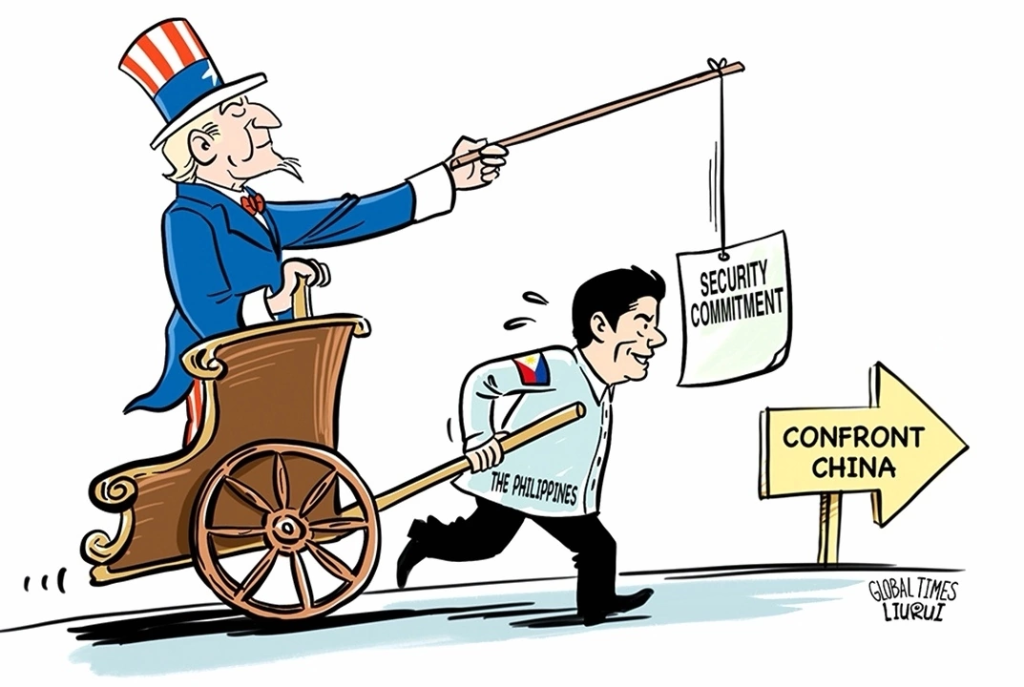
Lin Jian: On the US deployment of Mid-Range Capability missile system in the Philippines, China has made clear our opposition more than once. This move by the US and the Philippines incites geopolitical confrontation, escalates tensions in the region, and harms regional peace and stability. It has aroused high vigilance and concerns of countries in the region. The Philippines needs to have a clear understanding of the real intention of the US, respond to the common concerns of regional countries, avoid acting as the cat’s paw for the US at the expense of its own security interest, and quickly pull out the missile system as publicly pledged.

South China Sea: Philippines’ anti-ship missile base puts Scarborough Shoal in cross hairs (more information)

What the article left out is; to shoot far, the Philippine military needs to see far. However, the Philippines don’t have any over-the-horizon (OTH) radar, military satellites, AWACS planes or other long-range ISR capabilities, to make use of the full range of the BrahMos missile. Without it the missile is limited to the range of its available ISR assets, which are measured in just dozens of kilometers.

However, if a BrahMos missile is ever launched against a long-range Chinese target, it will be easy to guess who would have supplied the essential Intelligence, Surveillance, and Reconnaissance (ISR) information and target identification to the Philippine military.

StarBoySAR

South China Sea: Philippines’ anti-ship missile base puts Scarborough Shoal in cross hairs

Even if the Philippines lacks the advanced communications, intelligence, and targeting systems needed to maximise the BrahMos’ capabilities, it could still leverage US support in these areas, Koh said, citing the sinking of Russia’s Moskva warship by Ukraine in 2022, which he said was achieved thanks to “targeting support provided by Kyiv’s allies, chiefly the Americans”.

The flagship of Russia’s Black Sea Fleet, the Moskva became the largest warship lost in combat since the second world war when it was hit by two Ukrainian Neptune anti-ship missiles in April 2022. US officials later told the media that the Pentagon had provided intelligence that led to the ship’s sinking.

For the Philippines, the BrahMos missiles are “significant game changers” [🙄], according to security strategist Chester Cabalza, president of the International Development and Security Cooperation think tank in Manila.

However, Don McLain Gill, an international-studies lecturer at De La Salle University in the Philippines, questioned whether the BrahMos purchase alone would deliver robust deterrence against China.

“It will be crucial for the BrahMos to be supplemented by efficient intelligence, surveillance, target-acquisition and reconnaissance, which is critical to track targets and ensure they can be used by command,” he said, warning Manila must invest further to maximise the missiles’ deterrent value.

Previously:

Philippines Builds First BrahMos Anti-Ship Missile Base Facing South China Sea

South China Sea: Philippines debates boosting war readiness through mandatory military training for students

Renewed talks on a bill that would reinstate a mandatory Reserve Officers Training Corps (ROTC) programme in colleges and universities in the Philippines has sparked debate on whether it would be effective in strengthening the country’s military amid growing tensions in the South China Sea.

South China Sea: Philippines debates boosting war readiness through mandatory military training for students

Is the Philippines becoming a US ‘proxy’ against Beijing in the South China Sea?

Is the Philippines becoming a US ‘proxy’ against Beijing in the South China Sea?

‘The ants that get trampled on’

Not everyone agrees with drawing closer to the US, however, and they warn about the Philippines turning into a “proxy” for American interests. The president’s own sister Imee, a senator, told ANC Digital earlier this month that “China will always be our neighbour, we have no fight with them, let’s not get dragged into a fight that’s not our own.”

Anna Rosario Malindog-Uy, director of the pro-China Asian Century Philippines Strategic Studies Institute, wrote in the Manila Times on February 10 that “agreements such as the EDCA, the VFA and the Mutual Defence Treaty have not only cemented the US military presence and influence in the Philippines but also, most importantly, exemplified the Philippines’ dependence on the US in the military and defence sector.”

Teresita Ang See, former president of the Philippine Association for Chinese Studies and currently part of its advisory council, told This Week in Asia: “Filipinos in general condemn China’s action. But many also understand that China’s assertiveness is in response to US, Japanese and Australian provocations and increasing military presence in the Philippines.”

She warned that “we are fighting a proxy war between the US and China and in the end we will be the ants that get trampled upon”.

H/T: Johnsonwkchoi

Related:

Responding to the Catholic Bishops

Philippines counts the cost of tough South China Sea stance against Beijing