
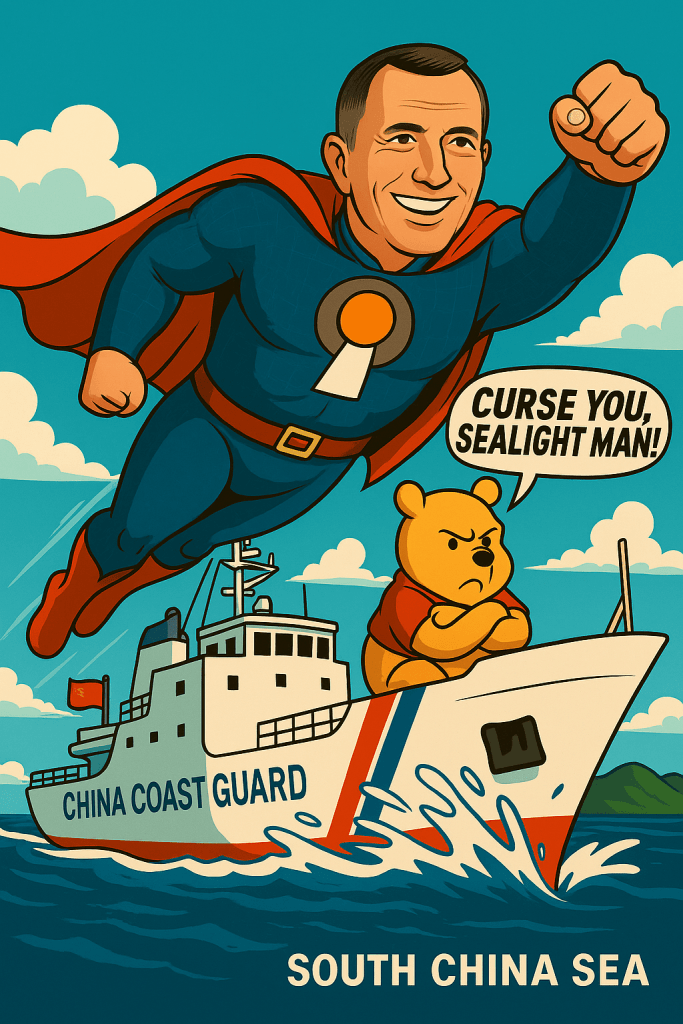
Capes, Cameras, and the Cult of Visibility

Capes, Cameras, and the Cult of Visibility: The SeaLight Crusade as White Savior Theater

By Tina Antonis

The South China Sea is more than a maritime dispute—it’s a theater of narrative warfare. While headlines focus on Chinese aggression and Philippine resistance, a quieter campaign unfolds in the background: one of satellite feeds, curated imagery, and Pentagon-backed storytelling. At the center of this effort is SeaLight, a project that claims to illuminate truth but often casts shadows of its own.

As explored in my article at Antiwar.com, SeaLight doesn’t just document—it performs. It reframes geopolitical tension through moral spectacle, positioning its creators as heroic arbiters of transparency. But when the messenger wears a cape and the funding flows from defense budgets, we must ask: is this clarity, or choreography?

Stage Left: The White Savior Enters

In the comic-strip cosmology of Ray Powell’s SeaLight project, transparency wears a cape. Clad in heroic postures and backed by satellite imagery, Powell casts himself as the guardian of maritime morality—unarmed, except with satellite feeds, theatrical flair, and strategic messaging. 

Yet beneath the cartoon and Pentagon-funded optics lies a familiar archetype: the white savior, rebranded for the South China Sea.

China Is Imperialist? Says Who?

Calling China a “maritime occupier,” Powell positions himself as a bulwark against aggression. But that moral pose collapses under scrutiny. He speaks for a country with over 800 foreign military installations and a documented history of over 250 military interventions since 1991—wars in Iraq, Afghanistan, Libya, Syria, Somalia, and dozens more, all under the banner of peace, freedom, or preemption.

By comparison, China’s post–Cold War footprint includes no sustained foreign occupations and only scattered border conflicts and peacekeeping missions. The imbalance is staggering. And Powell’s framing doesn’t just ignore it—it performs around it.

As David Vine argues in The United States of War, this vast base empire is not a passive network—it’s an architecture of perpetual war. These outposts make military engagement not an exception but a structural habit, cloaked in strategic necessity and sold as global stewardship.

Powell’s cartoon rhetoric—calling China an occupier—obscures the scale of U.S. militarism. The term “occupation” is deployed not to analyze, but to project. When adversaries hold territory, it’s a crisis; when the U.S. spans the globe with armed installations, it’s policy.

Framing Conflict: The Optics of Consent

This isn’t irony. It’s performance. Powell’s language manufactures a moral frame for confrontation—costumed in transparency, but driven by escalation. The cape is literal. The conditioning is deliberate. And the stage is set for war.

SeaLight’s mission is not just visual documentation—it’s narrative warfare. As the Japan Times openly notes, its “chief weapon is photography, applied purposefully, generously and consistently over time.” These images—enhanced, curated, and distributed across media—are not neutral. They’re constructed to shape public perception, sway international opinion, and ultimately manufacture consent for confrontation.

Assertive transparency becomes a kind of ideological scaffolding—a stage on which geopolitical tension is dramatized, simplified, and morally polarized. The goal isn’t simply to reveal conflict; it’s to condition audiences for escalation.

And when the messenger dons a superhero’s cape, the spectacle transforms into something deeper: a story of rescue, of virtue, of intervention. This is not analysis—it’s soft propaganda dressed in heroic metaphor.

Consent for war doesn’t begin with missiles. It begins with mythmaking.

Israel’s foreign minister is looking for a way to spend $150 million on hasbara

Israel’s foreign minister is looking for a way to spend $150 million on hasbara

Sa’ar insisted on the major budget increase when he and his United Right Party joined the governing coalition last month and he became foreign minister. At the time, Sa’ar said the budget will go towards “media campaigns abroad, in the foreign press, on social media, and more,” including “concentrated activity on U.S. campuses to change their attitude towards Israel and its policies.”

Read More »

What’s Really Going On In the South China Sea Between the Philippines and China

What’s Really Going On In the South China Sea Between the Philippines and China

by Tina Antonis

Maritime clashes between the Philippines and China had been mostly over the Philippines’ military outpost, BRP (BRP—Barko ng Republika ng Pilipinas, which translates to “Ship of the Republic of the Philippines”—the ship prefix for the Philippines) Sierra Madre, in the Spratly Islands, which is disputed by Brunei, China, Malaysia, the Philippines, Taiwan (a province of China, as recognized by the United Nations’ Resolution No. 2758), and Vietnam. The BRP Sierra Madre was intentionally run aground on a reef near the Second Thomas Shoal in the disputed Spratly Islands, in 1997, so that the Philippines could stake their territorial claim.

Read More »

Leaks expose secret British military cell plotting to ‘keep Ukraine fighting’

Leaked files show top UK military figures conspired to carry out the Kerch bridge bombing, covertly train “Gladio”-style stay-behind forces in Ukraine, and groom the British public for a drop in living standards caused by the proxy war against Russia.

Project Alchemy’s proposed schemes spanned every conceivable field of warfare, from cyber attacks to “discreet operations” to outright terrorism. The secret cell even put forward a plan to “aggressively pursue” and “dismantle” independent media outlets – including The Grayzone – through an aggressive campaign of legal harassment and online censorship, so they “would be forced to close.” The incendiary blueprints were fed to the highest levels of the British state and national security structure, where they were apparently well-received.

Leaks expose secret British military cell plotting to ‘keep Ukraine fighting’

Western Media Urges Public: Believe Our Lies, Not Your Own Eyes

YouTube / Rumble
  • The West has spent years accusing China of “genocide” in its western region of Xinjiang despite producing no evidence to substantiate such claims;
  • China has since opened up Xinjiang to international tourism where people from around the globe including the West can see for themselves there is no “genocide;”
  • The collective West now seeks to reassert control over the narrative by questioning travel vloggers reporting back from China regarding their experiences;

Western Media Urges Public: Believe Our Lies, Not Your Own Eyes (archived)

Sources:

Read More »

Reuters Exposes Washington’s Global Disinformation Campaign: The Rest of the Story

In a recent article, Reuters confirms what many knew for years, that the United States government and its various departments and agencies have been conducting global disinformation campaigns targeting nations it seeks to undermine, and whose governments it seeks to overthrow.

Reuters Exposes Washington’s Global Disinformation Campaign: The Rest of the Story

Previously:

Philippines: Pentagon ran secret anti-vax campaign to undermine China during pandemic

Philippines: ACT solon wants to probe alleged US Pentagon secret anti-vax campaign

MANILA, Philippines — A lawmaker on Sunday called on the leaders of the House of Representatives to initiate a thorough probe into the alleged secret anti-inoculation campaign of the United States (US) military aimed at undermining China during the COVID-19 pandemic.

ACT solon wants to probe alleged US Pentagon secret anti-vax campaign (archived)

Previously:

Philippines: Pentagon ran secret anti-vax campaign to undermine China during pandemic