
As stretched military moves toward ‘Great Power’ competition with China and Russia, it looks to avoid shortfall in Middle East
U.S. to Send Aging Attack Planes to Mideast and Shift Newer Jets to Asia, Europe
Tag: Joint Chiefs of Staff
A second ex-Guantanamo detainee says Ron DeSantis attended brutal forced feedings
A second ex-Guantanamo detainee has stepped forward to say that Gov. Ron DeSantis, while a U.S. Navy JAG officer in 2006, watched and allowed the brutal forced feedings of detainees that U.N. human rights authorities, an international physician’s group and others have condemned as a form of torture.
A second ex-Guantanamo detainee says Ron DeSantis attended brutal forced feedings
Did a Chinese Lab-Leak Kill Twenty Million People?
Did a Chinese Lab-Leak Kill Twenty Million People?
Related:
Did the Military World Games Spread COVID-19?
Coronavirus may have been spreading since Wuhan Military Games last October
The impact of the World Military Games on the COVID-19 pandemic
There is a correlation between the number of individuals who travelled to the event and the number of COVID-19 cases in the country to which they returned. Whether this explains the rapid spread of the pandemic or not is not known definitively. However, this study shows a mathematical model to predict the number of COVID-19 cases in a country as a result of each infected individual travelling to that country.
Notes from Wikipedia:
Read More »ISIS Supreme Commander Visits US Army Oil Thieves in Syria
The supreme commander of the US Army and allied forces, including the Biden’s oil thieves, Al Qaeda Levant, and its ISIS offshoot terrorists sneaked into Syria to boost the morale of his soldiers after the US-led NATO’s miserable failure in Ukraine.
ISIS Supreme Commander Visits US Army Oil Thieves in Syria
Related:
Seymour Hersh on US Bombing Nord Stream Pipelines — Radio War Nerd EP #366
We talk to legendary Pulitzer Prize winning reporter Seymour Hersh about his latest bombshell scoop: the United States, on President Biden’s orders, blew up the Nord Stream pipelines that were foundational to Germany’s export economy until last year.
Seymour Hersh on US Bombing Nord Stream Pipelines — Radio War Nerd EP #366 via Radio War Nerd
Previously:
US bombed Nord Stream gas pipelines, claims investigative journalist Seymour Hersh
US bombed Nord Stream gas pipelines, claims investigative journalist Seymour Hersh
The bombing of the Nord Stream underwater gas pipelines in the Baltic Sea was a covert operation ordered by the White House and carried out by the CIA, a report by a veteran investigative journalist claims.
US bombed Nord Stream gas pipelines, claims investigative journalist Seymour Hersh
Full Story:
New RAND Report Says a Long War in Ukraine Is Against US Interests
The report says a prolonged war in Ukraine hampers the US ability to focus on its ‘competition with China’
New RAND Report Says a Long War in Ukraine Is Against US Interests
Previously:
RAND: Avoiding a Long War – U.S. Policy and the Trajectory of the Russia-Ukraine Conflict
How to fix a howitzer: US offers help line to Ukraine troops
A MILITARY BASE IN SOUTHEASTERN POLAND — On the front lines in Ukraine, a soldier was having trouble firing his 155 mm howitzer gun. So, he turned to a team of Americans on the other end of his phone line for help.
How to fix a howitzer: US offers help line to Ukraine troops
1-800-How-Itzer? 🤷🏼♀️
RAND: Avoiding a Long War – U.S. Policy and the Trajectory of the Russia-Ukraine Conflict

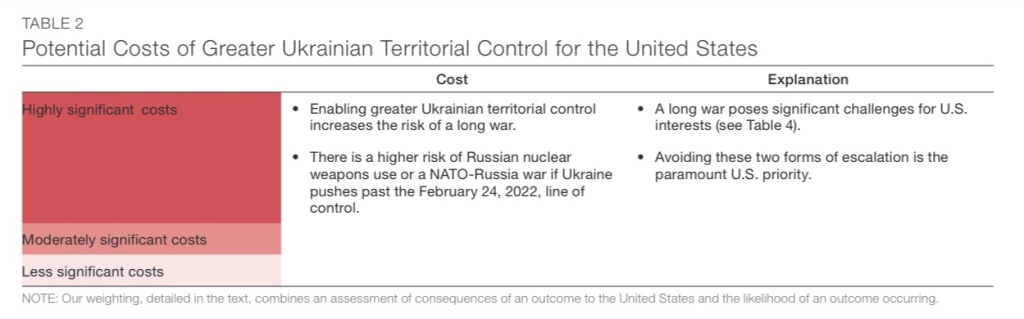


*Russian use of nuclear weapons is a plausible contingency that Washington needs to account for and a hugely important factor in determining the future trajectory of the conflict
*Although a Russian decision to attack a NATO member state is by no means inevitable, the risk is elevated while the conflict in Ukraine is ongoing.
*Chairman of the Joint Chiefs of Staff Mark Milley reportedly kept a list of “U.S. interests and strategic objectives” in the crisis: “No. 1” was “Don’t have a kinetic conflict between the U.S. military and NATO with Russia.” The second, closely related, was “contain war inside the geographical boundaries of Ukraine.”
*It is clear why Milley listed avoiding a Russia-NATO war as the top U.S. priority: The U.S. military would immediately be involved in a hot war with a country that has the world’s largest nuclear arsenal. Keeping a Russia-NATO war below the nuclear threshold would be extremely difficult, particularly given the weakened state of Russia’s conventional military.
*Since neither side appears to have the intention or capabilities to achieve absolute victory, the war will most likely end with some sort of negotiated outcome.
*Since avoiding a long war is the highest priority after minimizing escalation risks, the United States should take steps that make an end to the conflict over the medium term more likely.
*A major source of uncertainty about the future course of the war is the relative lack of clarity about the future of U.S. and allied military assistance to Ukraine.
Avoiding a Long War – U.S. Policy and the Trajectory of the Russia-Ukraine Conflict
Related:
Avoiding a Long War – U.S. Policy and the Trajectory of the Russia-Ukraine Conflict
CIA director holds secret meeting with Zelensky on Russia’s next steps
CIA Director William J. Burns traveled in secret to Ukraine’s capital at the end of last week to brief President Volodymyr Zelensky on his expectations for what Russia is planning militarily in the coming weeks and months, said a U.S. official and other people familiar with the visit.
CIA director holds secret meeting with Zelensky on Russia’s next steps
Related:
Ukraine and Georgia’s NATO aspirations not only touch a raw nerve in Russia, they engender serious concerns about the consequences for stability in the region. Not only does Russia perceive encirclement, and efforts to undermine Russia’s influence in the region, but it also fears unpredictable and uncontrolled consequences which would seriously affect Russian security interests. Experts tell us that Russia is particularly worried that the strong divisions in Ukraine over NATO membership, with much of the ethnic-Russian community against membership, could lead to a
major split, involving violence or at worst, civil war. In that eventuality, Russia would have to decide whether to intervene; a decision Russia does not want to have to face.
Archived Links Inside WaPo Article:
Read More » Ms. Cat’s Chronicles
You must be logged in to post a comment.