
Imagine Being Ray Powell (CIA), Terrified of Peace, Diplomacy, and a Filipina +

Oh, look — Ray Powel, again, the CIA operative messing around the SCS dispute???

Apparently, I’m living rent-free in the head of a retired U.S. Air Force colonel turned “maritime gray-zone investigator” who thinks the Philippines, China, ASEAN, and the entire South China Sea revolve around his newly invented fantasy threat matrix. Let me make this absolutely clear:

Ray Powell mentioning me — twice now — is A BADGE OF HONOR!! Because if a CIA-adjacent operative (yes, Ray, we all know how “Air Force Attachés” function abroad), working hand-in-hand with Washington’s geopolitical machinery, has me on his radar, it only means one thing:

I’m saying something true enough, loud enough, and inconvenient enough to rattle him.

Imagine Being Ray Powell (CIA), Terrified of Peace, Diplomacy, and a Filipina

Related:

Read More »
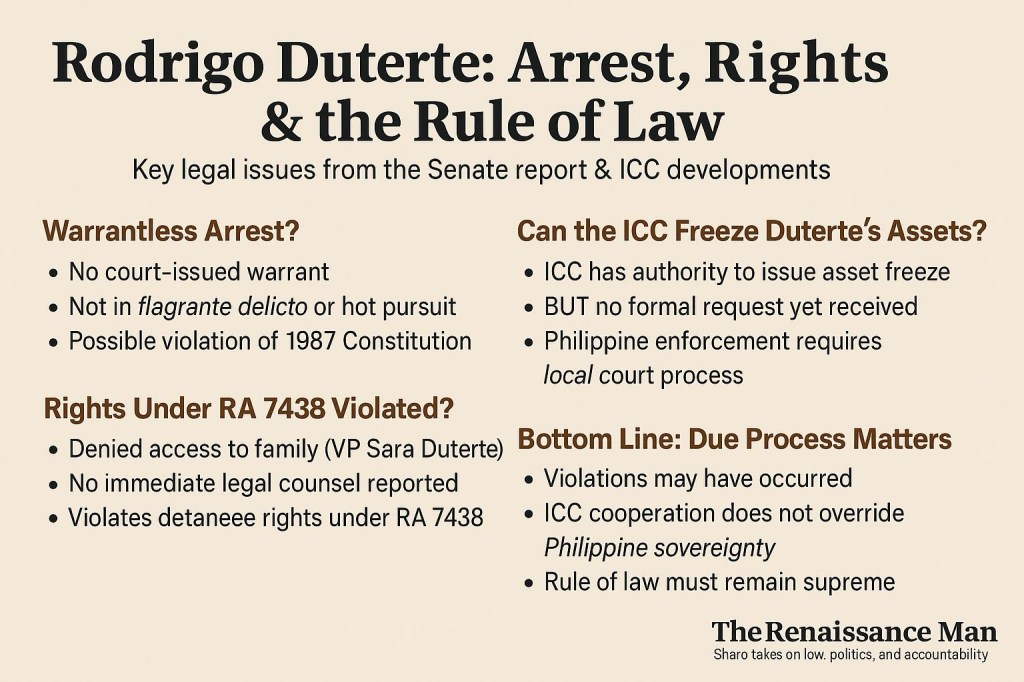
Due Process on Trial: The Duterte Arrest, the Rule of Law and Sovereignty + More

The recent release of the Senate Committee on Foreign Relations’ preliminary report on the arrest of former President Rodrigo Duterte has sent ripples through the Philippine legal and political landscape. Chaired by Senator Imee Marcos, the report outlines what it calls “glaring violations” of constitutional rights, procedural lapses, and questionable coordination between the Philippine government and the International Criminal Court (ICC).

Due Process on Trial: The Duterte Arrest, the Rule of Law and Sovereignty

Related:

Can Philippine President Marcos Survive the Wrath of the Dutertes? by Mong Palatino

As for President Marcos, he may have a solid plan to neutralize the Dutertes but it is the anguish of ordinary citizens reeling from high prices and low wages that he should be worried about. Even Vice President Sara Duterte is aware that the concern of the average voter is the economic crisis, which is why her arrival statement at The Hague when she visited her father focused on the need to address poverty, hunger, and joblessness in the Philippines. In other words, the most serious threat to the Marcos presidency is its own failure to fulfill the campaign promise of bringing down the price of rice and other goods, uplift the conditions of working families, and provide adequate and affordable services to the people.

Document: Arrest of Rodrigo Duterte

Vladimir Lenin: Socialism and Religion

Vladimir Lenin: Socialism and Religion

The economic oppression of the workers inevitably calls forth and engenders every kind of political oppression and social humiliation, the coarsening and darkening of the spiritual and moral life of the masses. The workers may secure a greater or lesser degree of political liberty to fight for their economic emancipation, but no amount of liberty will rid them of poverty, unemployment, and oppression until the power of capital is overthrown. Religion is one of the forms of spiritual oppression which everywhere weighs down heavily upon the masses of the people, over burdened by their perpetual work for others, by want and isolation. Impotence of the exploited classes in their struggle against the exploiters just as inevitably gives rise to the belief in a better life after death as impotence of the savage in his battle with nature gives rise to belief in gods, devils, miracles, and the like. Those who toil and live in want all their lives are taught by religion to be submissive and patient while here on earth, and to take comfort in the hope of a heavenly reward. But those who live by the labour of others are taught by religion to practise charity while on earth, thus offering them a very cheap way of justifying their entire existence as exploiters and selling them at a moderate price tickets to well-being in heaven. Religion is opium for the people. Religion is a sort of spiritual booze, in which the slaves of capital drown their human image, their demand for a life more or less worthy of man.

How can people support Luigi Mangione but vote in droves to deny health care to others?

How can people support Luigi Mangione but vote in droves to deny health care to others?

Last week was a bizarre time to be queer on social media: Many cishet people voiced enthusiastic support for Luigi Mangione, the man accused of shooting and killing UnitedHealthcare CEO Brian Thompson, arguing that the health insurer’s denial of claims led to so many deaths that the murder was justified as retaliation. Meanwhile, Congress was passing a bill that would require an insurer (Tricare) to deny claims, and it was hard to get anyone to even pay attention to that.

Read More »

The NATO “solution”

The NATO “solution”

The focus of political and media attention has inevitably turned from Europe to the Middle East, where the United States, through the Secretary of the Pentagon, has insisted on “Israel’s right to defend itself,” has welcomed the assassinations of Hezbollah leaders carried out by means of massive bombings in Beirut, and has given explicit approval to the ground operation with which Tel Aviv and Washington claim to want to “dismantle the attack infrastructure along the border to ensure that the Lebanese Hezbollah cannot carry out attacks in the style of October 7 against communities in northern Israel.” The precedent of the last twelve months in Gaza, the West Bank, Syria, Yemen and Lebanon foreshadows what the ways of defending oneself against Israel will be and that the United States will continue to justify any excess, selective assassination or massacre, while any response, such as that which occurred yesterday with the launching of Iranian missiles against Israeli military bases, will be considered an unacceptable escalation. And although Ukraine’s public concern for securing priority war status has not yet begun, any escalating war could affect Kiev, especially when it comes to imposing its discourse of existential war on the West as a collective.

Read More »

Ukraine: Dysfunctional Politics

Dysfunction Sidelines Ukraine’s Parliament as Governing Force,” is the title of an article published this week by The New York Times in one of the few political critiques that has appeared in the Western press recently. It took two years after the Russian invasion for the grace period of absence of political comments on the Ukrainian authorities to be broken, although always partially and only temporarily. It was the news that included Vitali Klitschko’s words against what he perceived as authoritarian drift that opened the door. Like the current information, that news also lacked the contextualization that politics requires, and it was left unmentioned that the criticism of the mayor of Kiev and the measures by which the protesters were part of a confrontation that went back almost to the beginnings of the presidency of Zelensky. The origin of the rivalry lies in the struggle for power and control of the resources of the State between the two protagonists. What is more, the attempt to Zelensky snatch administratively, the mayor of Kiev Klitschko, a man with powerful connections and political contacts, especially in Germany, is one of the examples that show that the authoritarian drift of Volodymyr Zelensky is not justified in the wartime situation today, but that precedes it in several years to the military intervention of Russia.

Read More »