
Originally written on July 5, 2025.
Seduction, Spillover, and the Systems That Turn on Us
Originally written on July 5, 2025.
Seduction, Spillover, and the Systems That Turn on Us
The Politico published a pro-euthanasia article by Claudia Chiappa and Lucia Mackenzie on December 29, 2024. Chiappa and Mackenzie are suggesting that the legalization of euthanasia is inevitable but when they interview Theo Boer, a former member of a Netherlands euthanasia review committee he actually tells them that the expansion of euthanasia, once legal is inevitable. Boer states:
“I have seen no jurisdiction in which the practice has not expanded, not one single jurisdiction,”
“By imposing really strict criteria we can slow down the expansion … but they will not prevent the expansion.”
Once euthanasia is legal, the expansion of the act is inevitable
Related:
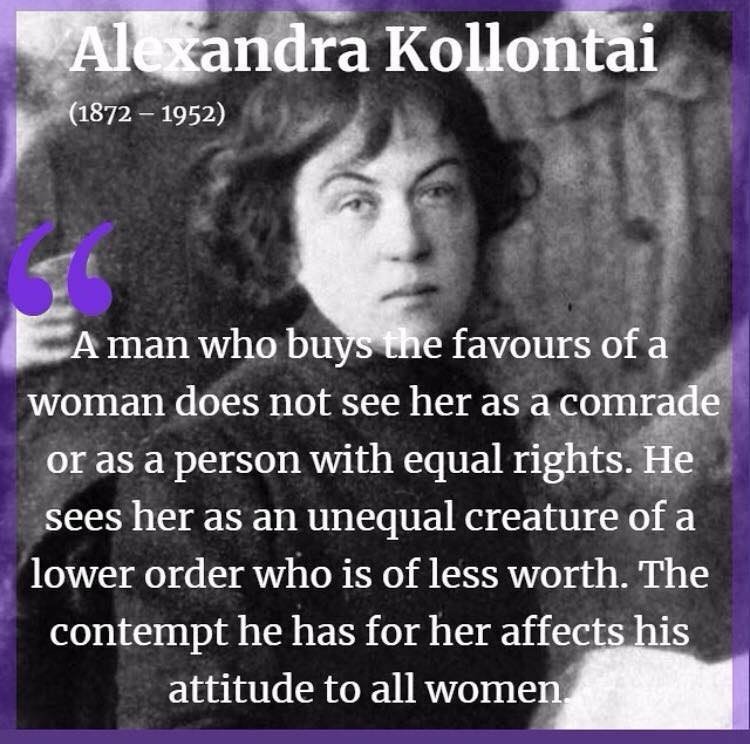
Alexandra Kollontai: Prostitution and ways of fighting it
What is the fundamental quality of the working class? What is its strongest moral weapon in the struggle? Solidarity and comradeship is the basis of communism. Unless this sense is strongly developed amongst working people, the building of a truly communist society is inconceivable. Politically conscious communists should therefore logically be encouraging the development of solidarity in every way and fighting against all that hinders its development – Prostitution destroys the equality, solidarity and comradeship of the two halves of the working class. A man who buys the favours of a woman does not see her as a comrade or as a person with equal rights. He sees the woman as dependent upon himself and as an unequal creature of a lower order who is of less worth to the workers’ state. The contempt he has for the prostitute, whose favours he has bought, affects his attitude to all women. The further development of prostitution, instead of allowing for the growth of comradely feeling and solidarity, strengthens the inequality of the relationships between the sexes.

Cithrus, however, was different. He was curious about the parts of Wonderland others feared or ignored—the uncharted lands where time had no meaning, the forests where trees whispered riddles, and the skies where stars swapped places on a whim. His unrelenting curiosity often brought trouble, as he frequently bent the rules of their order, pushing Wonderland to the brink of chaos with his experiments.
…
Banished from the Moonlit Council for his recklessness, Cithrus roamed Wonderland as an outsider. Rather than despair, he embraced his new existence, relishing in the freedom and absurdity of his world. Over time, his wit, riddles, and sly demeanor made him a guide of sorts to those who wandered into Wonderland. Some said he loved unraveling people’s minds with his cryptic wisdom; others believed he simply enjoyed the company, as strange and fleeting as it was.
The Cheshire Cat’s perpetual grin, some say, is his way of masking the loneliness of being unanchored in a nonsensical world. Others argue it’s a celebration of the chaos he unleashed—his way of reminding Wonderland that rules, like smiles, can disappear in an instant.
Among the many problems that demand the consideration and attention of contemporary mankind, sexual problems are undoubtedly some of the most crucial. There isn’t a country or a nation, apart from the legendary “islands”, where the question of sexual relationships isn’t becoming an urgent and burning issue. Mankind today is living through an acute sexual crisis which is far more unhealthy and harmful for being long and drawn-out. Throughout the long journey of human history, you probably won’t find a time when the problems of sex have occupied such a central place in the life of society; when the question of relationships between the sexes has been like a conjuror, attracting the attention of millions of troubled people; when sexual dramas have served as such a never-ending source of inspiration for every sort of art.
Since sorrow never comes too late, And happiness to swiftly flies. Thought would destroy their paradise, No more; where ignorance is bliss, ‘Tis folly to be wise. – Thomas Gray
The song “The Sound of Silence” by Disturbed is a powerful rendition of Simon & Garfunkel’s classic hit. It speaks of alienation, the loss of genuine communication, and the deep chasms created by our society’s reliance on superficial interactions. With its haunting delivery, Disturbed adds a layer of urgency and depth, turning the song into a brooding anthem for the disconnected.
Related:
The Profound Meaning Behind Simon & Garfunkel’s “The Sound of Silence”
“The Sound of Silence” comes to a close with a warning, pointedly calling out the all-consuming consumerism and using those already lost to it as an example of what’s to come if we continue to find solace in the silence. And the people bowed and prayed / To the neon god they made / And the sign flashed out its warning / In the words that it was forming / And the sign said, “The words of the prophets / Are written on the subway walls / And tenement halls / And whispered in the sounds of silence.”
As Phyllis Chesler warned us in 1974, gender bias has accompanied psychiatric power throughout its history. Years later, in 2005, in the last annotated edition of Women and Madness , the author insisted on the persistence of this bias, which even today, 50 years later, seems to remain unchanged. Authors such as Ussher, Caplan, Margot Pujal and many others were situated in that same space. With their differences and nuances, they all converge on the same point: gender problems and discomforts produce deep suffering. This suffering leaves marks on our bodies and our behavior.
Couple euthanasia is a modern sati.
The article titled: Duo-euthanasia: To avoid facing life alone, focuses on how the spouse of a person who dies by euthanasia will often experience complicated grief and will have a higher potential rate of premature death. The article states:
For some individuals, euthanasia or physician-assisted dying (aka PAD or EAS) presents an option to end one’s life with some control and dignity while minimizing pain and suffering. Whether they are experiencing severe chronic pain, mobility challenges, or serious illness such as cancer, these people may be intrigued by the possibility of euthanasia or physician-assisted dying.
But for the surviving spouses, facing the future without their lifelong partner can feel overwhelming, and their quality of life may plummet.
Related:
Couple choose to die together in ‘duo-euthanasia’ after being married for nearly five decades
The couple left behind their only child when they chose to pass away
…
If you or someone you know is struggling or in a mental health crisis, help is available through Mental Health America. Call or text 988 or chat 988lifeline.org. You can also reach Crisis Text Line by texting MHA to 741741
How honesty leads to the trauma of unnecessary psychiatric hospitalization
Picture a soul in turmoil, wrapped in the suffocating embrace of despair. In the sanctuary of a therapist’s office, they finally find the courage to voice the unspeakable:
“Sometimes, I think about not being here anymore.”
The words hang heavy in the air, a testament to the crushing weight of their pain, loneliness, and emptiness. This confession, born from a place of vulnerability and trust, should be the beginning of a deeper healing journey.
During these intense emotional struggles, it’s important to understand that thoughts of escape, including suicide, are a common human response to overwhelming pain. There’s a vast chasm between contemplating an end to suffering and actively planning to end one’s life.
 Ms. Cat’s Chronicles
You must be logged in to post a comment.