Beneath the surface of DefesaNet’s coverage lies a 2011 cooperation agreement with Stratfor, the U.S.-based private intelligence firm often dubbed the “Shadow CIA.” This wasn’t editorial alignment—it was infrastructural scripting. Stratfor gained privileged access to regional insight; DefesaNet received complimentary geopolitical reports. The choreography was built in.
When narratives like Operation Imeri surface, they don’t emerge from neutrality—they rehearse proximity, test fault lines, and manufacture urgency. Brazil isn’t just being watched. It’s being written into a role.
This isn’t a serious proposal. It’s narrative theater—manufacturing urgency, choreographing proximity, and distracting from the quieter architecture of soft power already shaping the region. The rescue isn’t about Maduro. It’s about rehearsing alignment, testing thresholds, and scripting Brazil into a role it never auditioned for.
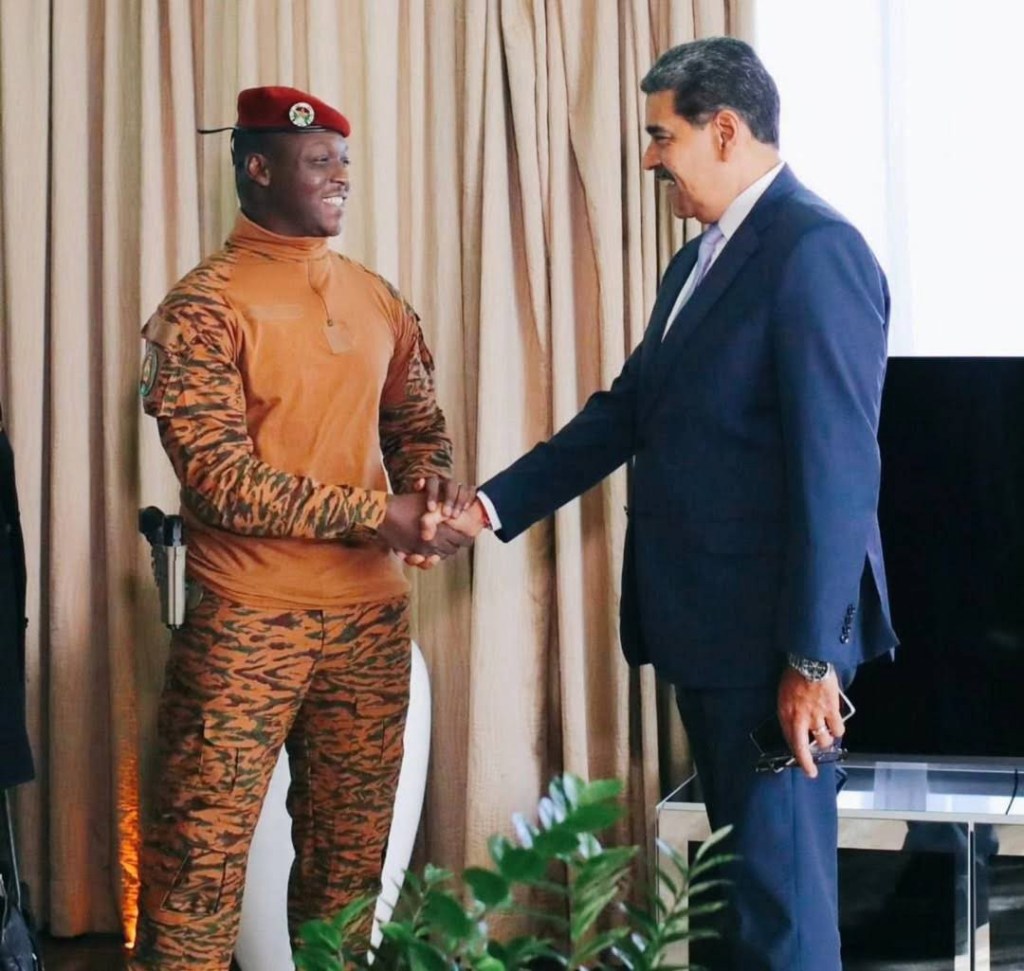
“Venezuelan President Nicolas Maduro greets Ibrahim Traore – the Chavez of West Africa – at the Burkina Faso embassy in Moscow. Maduro says he is so proud of Traore for standing up to and defending his country from vicious imperialism.” – Tim Anderson
“I’ve learned that one has to be very careful when it comes to other countries and presidents. Maduro is a problem for Venezuela, not a problem for Brazil (…) I want Venezuela to do well, for them to take care of their people with dignity. I’m concerned with Brazil; Maduro should worry about himself, and the Venezuelan people should worry about Maduro,” Lula emphasized.
…
“I have no right to question the supreme court of another country, because I don’t want any country to do the same with mine,” he pointed out.
Brazilian president Luiz Inacio Lula da Silva has said his personal preference for an outcome in the US election is for Democratic candidate Kamala Harris to become the next US president.
While serving in the Ministry of External Relations, Amorim spent large amounts of time working as an ambassador to the United Nations. Most notably, he represented Brazil on the Kosovo–Yugoslavia sanctions committee in 1998, and the Security Council panel on Iraq in 1999. Amorim was named as Brazil’s permanent ambassador to the United Nations and the WTO later that year, and served for two years before becoming ambassador to the United Kingdom in 2001.
The president of Brazil, Luiz Inacio Lula da Silva, has reportedly informed his international interlocutors that the country will oppose Venezuela’s entry into the BRICS. The newspaper “G1” reported this, pointing out that this “possible veto” would represent a further sign of distancing between Lula and the Venezuelan president Nicolás Maduro, a relationship which, according to sources at the newspaper, “has been frozen for some time now”.
Lula is definitely compromised! As for UNSC reforms, I’m pretty sure that it’s about China and Russia.
DID YOU NOTICE THIS?“I am against too much interference in the Venezuelan process”
Digression: Very obviously he is okay with some interference just not too much of it! So how much interference is acceptable to Lula? Who defines too much interference? Lula keeps looking worse and worse. Digression ended
I was ranting earlier, this year, about Lula and Petro working with the Biden admin as intermediaries. Maybe the CIA did try to overthrow Lula back in 2023, as speculated? They’ve been busy in Venezuela, lately.FYI, Lula denounced the SMO back in April 2023.
Vladimir Putin answered questions from the heads of leading BRICS media agencies. The meeting was held ahead of the BRICS summit in Kazan.
The meeting was attended by the heads of media agencies from Brazil, China, Egypt, Ethiopia, India, Saudi Arabia, South Africa, and the UAE. It was moderated by Head of the Rossiya Segodnya Media Group Dmitry Kiselev.
Breno Altman: The proposal is to call new elections or to set up a cohabitation government that would lead to new elections. These two proposals are not exactly new, and have been circulating for days in the dialogues between the Brazilian and Colombian governments and also in the consultations that the Brazilian government has held with the European Union and the United States.
It’s not surprising that Brazil and Colombia are trying to mediate between the opposition and Chavismo, between the United States and the European Union, on the one hand, with China and Russia on the other. This posture of mediation implies an unbridled search for a solution that could be accepted by both parties.
…
BA: I believe that the Lula government and President Lula are concerned about the Brazilian municipal elections scheduled for October. And he believes that defending the Maduro government will take votes away from the PT and its allied parties, especially in the big capitals, particularly in São Paulo.




 Ms. Cat’s Chronicles
You must be logged in to post a comment.