Prescribing the American Dream

This is from something that I’ve been working on regarding Freudian psychology and social conditioning. Unfortunately, one of the author’s sources is Hannah Arendt’s Origins of Totalitarianism, which falsely equates Communism with Nazism. To be honest, I haven’t found any “perfect” sources for my project. Even Michael Parenti’s Against Psychopolitics quotes problematic sources (Harold Lasswell was involved with the RAND Corporation). While Karl Korsch had worked for the University of Frankfurt Institute for Social Research, which was home to the CIA front Frankfurt School, I like the above quote. I’ll probably end up using a different one when it’s all said and done, though.

Prescribing the American Dream: Psychoanalysts, Mass Media, and the Construction of Social and Political Norms in the 1950’s

Read More »

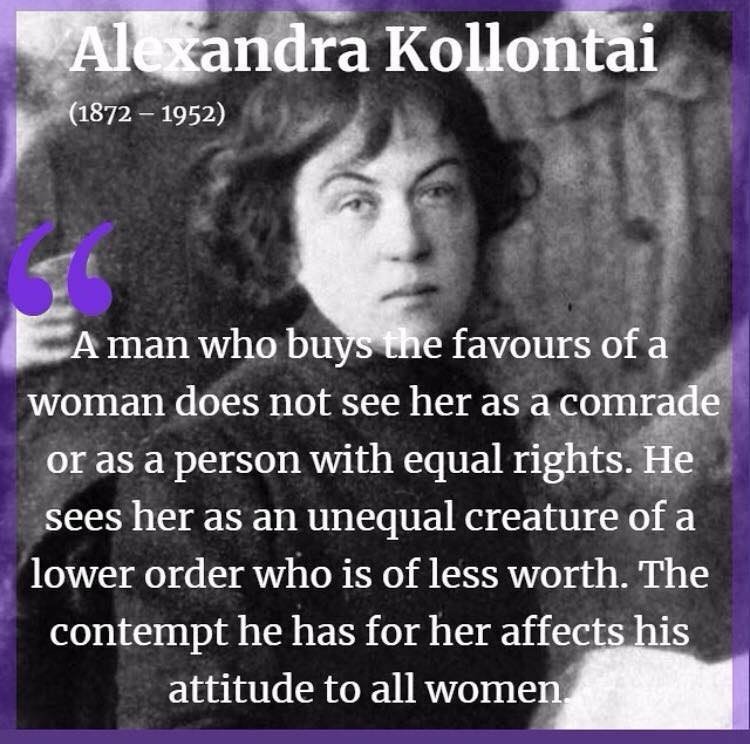
Alexandra Kollontai: Prostitution and ways of fighting it

Alexandra Kollontai: Prostitution and ways of fighting it

What is the fundamental quality of the working class? What is its strongest moral weapon in the struggle? Solidarity and comradeship is the basis of communism. Unless this sense is strongly developed amongst working people, the building of a truly communist society is inconceivable. Politically conscious communists should therefore logically be encouraging the development of solidarity in every way and fighting against all that hinders its development – Prostitution destroys the equality, solidarity and comradeship of the two halves of the working class. A man who buys the favours of a woman does not see her as a comrade or as a person with equal rights. He sees the woman as dependent upon himself and as an unequal creature of a lower order who is of less worth to the workers’ state. The contempt he has for the prostitute, whose favours he has bought, affects his attitude to all women. The further development of prostitution, instead of allowing for the growth of comradely feeling and solidarity, strengthens the inequality of the relationships between the sexes.

Sexual Relations and the Class Struggle

Among the many problems that demand the consideration and attention of contemporary mankind, sexual problems are undoubtedly some of the most crucial. There isn’t a country or a nation, apart from the legendary “islands”, where the question of sexual relationships isn’t becoming an urgent and burning issue. Mankind today is living through an acute sexual crisis which is far more unhealthy and harmful for being long and drawn-out. Throughout the long journey of human history, you probably won’t find a time when the problems of sex have occupied such a central place in the life of society; when the question of relationships between the sexes has been like a conjuror, attracting the attention of millions of troubled people; when sexual dramas have served as such a never-ending source of inspiration for every sort of art.

Sexual Relations and the Class Struggle

Karl Marx, Jenny von Westphalen and Engels On Love and Marriage

Karl Marx, Jenny von Westphalen and Engels
On Love and Marriage

From Jenny von Westphalen in Trier to Karl Marx in Paris, 18 August 1844.

The direct, natural, and necessary relation of person to person is the relation of man to woman. The relation of man to woman is the most genuine relation of human being to human being. It therefore reveals the extent to which man’s natural behaviour has become human, or the extent to which the human essence in him has become his natural essence. The relationship also reveals the extent to which man’s need has become a human need: the extent to which, therefore, the other person as a person has become for him a need.

… If you love without evoking love in return – if through the vital expression of yourself as a loving person you fail to become a loved person, then your love is impotent, it is a misfortune.

Private Property and Communism, Economic and Philosophic Manuscripts of 1844

If you love without evoking love in return – that is, if your loving as loving does not produce reciprocal love; if through a living expression of yourself as a loving person you do not make yourself a beloved one, then your love is impotent – a misfortune. 

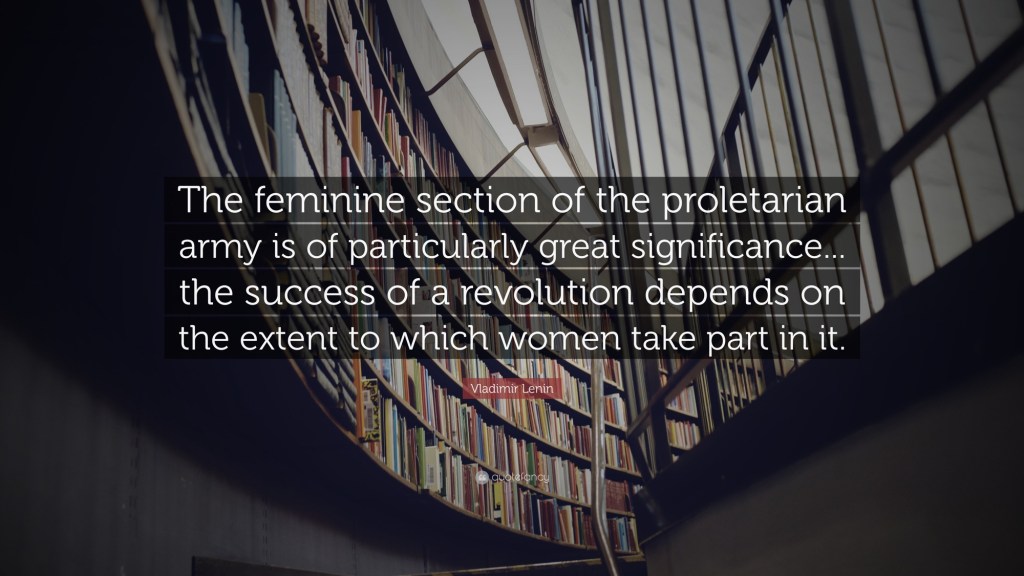
Vladimir Lenin: Speech at First All-Russia Congress of Working Women

(Comrade Lenin is greeted by the delegates with stormy applause.) Comrades, in a certain sense this Congress of the women’s section of the workers’ army has a special significance, because one of the hardest things in every country has been to stir the women into action. There can be no socialist revolution unless very many working women take a big part in it.

Speech at First All-Russia Congress of Working Women

Mao: Women

Mao: Women

A man in China is usually subjected to the domination of three systems of authority [political authority, family authority and religious authority]…. As for women, in addition to being dominated by these three systems of authority, they are also dominated by the men (the authority of the husband). These four authorities – political, family, religious and masculine – are the embodiment of the whole feudal-patriarchal ideology and system, and are the four thick ropes binding the Chinese people, particularly the peasants. How the peasants have overthrown the political authority of the landlords in the countryside has been described above. The political authority of the landlords is the backbone of all the other systems of authority. With that overturned the family authority, the religious authority and the authority of the husband all begin to totter…. As to the authority of the husband, this has always been weaker among the poor peasants because, out of economic necessity, their womenfolk have to do more manual labour than the women of the richer classes and therefore have more say and greater power of decision in family matters. With the increasing bankruptcy of the rural economy in recent years, the basis for men’s domination over women has already been undermined. With the rise of the peasant movement, the women in many places have now begun to organize rural women’s associations; the opportunity has come for them to lift up their heads, and the authority of the husband is getting shakier every day. In a word, the whole feudal-patriarchal ideology and system is tottering with the growth of the peasants’ power. 

“Report on an Investigation of the Peasant Movement in Hunan” (March 1927), Selected Works, Vol. I, pp. 44-46.*