To this must be added the following general consideration.
An oppressed class which does not strive to learn to use arms, to acquire arms, only deserves to be treated like slaves. We cannot, unless we have become bourgeois pacifists or opportunists, forget that we are living in a class society from which there is no way out, nor can there be, save through the class struggle. In every class society, whether based on slavery, serfdom, or, as at present, wage-labor, the oppressor class is always armed. Not only the modern standing army, but even the modern militia—and even in the most democratic bourgeois republics, Switzerland, for instance—represent the bourgeoisie armed against the proletariat. That is such an elementary truth that it is hardly necessary to dwell upon it. Suffice it to point to the use of troops against strikers in all capitalist countries.
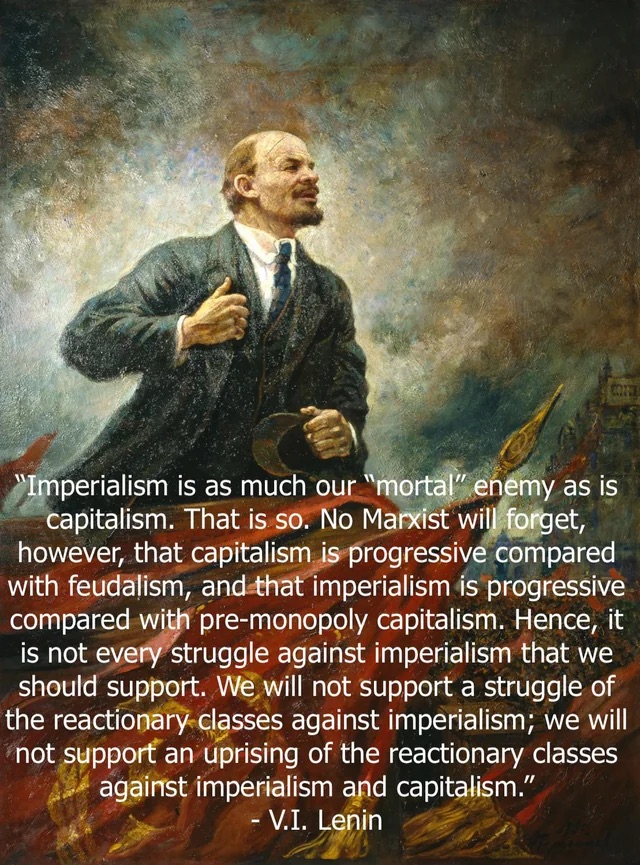
But this Kievsky argument is wrong. Imperialism is as much our “mortal” enemy as is capitalism. That is so. No Marxist will forget, however, that capitalism is progressive compared with feudalism, and that imperialism is progressive compared with pre-monopoly capitalism. Hence, it is not every struggle against imperialism that we should support. We will not support a struggle of the reactionary classes against imperialism; we will not support an uprising of the reactionary classes against imperialism and capitalism.
In the second group on your list, you raise the question of “restricting alien parties”, that is, the question of the friction in various localities. Your concern over this matter is justified. There has been some improvement recently, but fundamentally the situation remains unchanged. Question: Has the Communist Party made its position on this question clear to the Central Government? Answer: We have protested. Question: In what way? Answer: Our Party representative, Comrade Chou En-lai, wrote a letter to Generalissimo Chiang Kai-shek as early as July. Then again on August 1, people from all walks of life in Yenan sent a telegram to the Generalissimo and the National Government, demanding the withdrawal of the “Measures for Restricting the Activities of Alien Parties”, which had been secretly circulated and which are at the very root of the “friction” in various places. Question: Has there been any reply from the Central Government? Answer: No. But it is said that there are also people in the Kuomintang who disapprove of these measures. As everybody knows, an army that participates in the common fight against Japan is a friendly army, not an “alien army”, and similarly, a political party that participates in the common fight against Japan is a friendly party, not an “alien party”. There are many parties and groups taking part in the War of Resistance and, while they vary in strength, they are fighting in the same cause; surely they must all unite and must in no circumstances “restrict” one another. Which party is an alien party? The party of the traitors headed by Wang Ching-wei, the running dog of Japan, because it has nothing in common politically with the anti-Japanese parties; that is the kind of party which should be restricted. Between the Kuomintang and the Communist Party there is common political ground, namely, resistance to Japanese aggression. Therefore, the problem is to concentrate all our strength on opposing and checking Japan and Wang Ching-wei, and not on opposing and checking the Communist Party. This is the only basis for formulating correct slogans. Wang Ching-wei has three slogans: “Oppose Chiang Kai-shek,” “Oppose the Communist Party”, and “Be friends with Japan”. Wang Ching-wei is the common enemy of the Kuomintang, the Communist Party and the entire people. But the Communist Party is not the enemy of the Kuomintang, nor is the Kuomintang the enemy of the Communist Party; they should unite and help each other rather than oppose or “restrict” each other. The slogans on our side must be different from Wang Ching-wei’s, they must be the opposite of his and never be confused with them. If he says, “Oppose Chiang Kai-shek”, everyone should support Chiang Kai-shek; if he says, “Oppose the Communist Party”, everyone should unite with the Communist Party; and if he says, “Be friends with Japan”, everyone should resist Japan. We should support whatever the enemy opposes and oppose whatever the enemy supports. In articles nowadays people often quote the saying, “Do not sadden your friends and gladden your enemies.” It comes from a letter which Chu Fou, a general under Liu Hsiu of the Eastern Han Dynasty, wrote to Peng Chung, the prefect of Yuyang. In context it reads, “Whatever you do, you must be sure that you do not sadden your friends and gladden your enemies.” Chu Pou’s words express a clear-cut political principle which we must never forget.
In the social production of their existence, men inevitably enter into definite relations, which are independent of their will, namely relations of production appropriate to a given stage in the development of their material forces of production. The totality of these relations of production constitutes the economic structure of society, the real foundation, on which arises a legal and political superstructure and to which correspond definite forms of social consciousness. The mode of production of material life conditions the general process of social, political and intellectual life. It is not the consciousness of men that determines their existence, but their social existence that determines their consciousness. At a certain stage of development, the material productive forces of society come into conflict with the existing relations of production or – this merely expresses the same thing in legal terms – with the property relations within the framework of which they have operated hitherto. From forms of development of the productive forces these relations turn into their fetters. Then begins an era of social revolution. The changes in the economic foundation lead sooner or later to the transformation of the whole immense superstructure.
I could barely finish listening to this (Revolutionary Communist International, of which they’re part of, is a Trotskyiteorganization). China is supposedly imperialist because they export goods and provide loans to other countries through their Belt and Road Initiative for infrastructure. He also mentions that China has a military base in Djibouti (the U.S. has over 800). Does he get his information from Wikipedia? He sounds like the Trotskyite version of John Mearsheimer! This isn’t the first time that I’ve heard this argument, which is why I made the page “Is China Socialist Or Capitalist?” Say what you will about Vijay Prashad, but I share his sentiment. Worry about building socialism in your own country!
That which in life is born and grows day by day is invincible, its progress cannot be checked. That is to say, if, for example, in life the proletariat as a class is born and grows day by day, no matter how weak and small in numbers it may be today, in the long run it must triumph. Why? Because it is growing, gaining strength and marching forward. On the other hand, that which in life is growing old and advancing to its grave must inevitably suffer defeat, even if today it represents a titanic force. That is to say, if, for example, the bourgeoisie is gradually losing ground and is slipping farther and farther back every day, then, no matter how strong and numerous it may be today, it must, in the long run, suffer defeat. Why? Because as a class it is decaying, growing feeble, growing old, and becoming a burden to life.







 Ms. Cat’s Chronicles
You must be logged in to post a comment.