Mao Zedong on Writing

Oppose Stereotyped Party Writing

The first indictment against stereotyped Party writing is that it fills endless pages with empty verbiage. Some of our comrades love to write long articles with no substance, very much like the “foot-bindings of a slattern, long as well as smelly”. Why must they write such long and empty articles? There can be only one explanation; they are determined the masses shall not read them. Because the articles are long and empty, the masses shake their heads at the very sight of them. How can they be expected to read them? Such writings are good for nothing except to bluff the naive, among whom they spread bad influences and foster bad habits. … If articles are too long, who will read them? Some comrades at the front, too, like to write long reports. They take pains over writing them and send them here for us to read. But who has the hardihood to read them? If long and empty articles are no good, are short and empty ones any better? They are no good either. We should forbid all empty talk. But the first and foremost task is to throw the long, smelly foot-bindings of the slattern into the dustbin. Some may ask, “Isn’t Capital very long? What are we to do about that?” The answer is simple, just go on reading it. There is a proverb, “Sing different songs on different mountains”; another runs, “Fit the appetite to the dishes and the dress to the figure”. Whatever we do must be done according to actual circumstances, and it is the same with writing articles and making speeches. What we oppose is long-winded and empty stereotyped writing, but we do not mean that everything must necessarily be short in order to be good. True, we need short articles in war time, but above all we need articles that have substance. Articles devoid of substance are the least justifiable and the most objectionable. The same applies to speechmaking; we must put an end to all empty, long-winded speeches.

Read More »

Marxism and Psychological Science

1.1. The General Bases of Marxist Psychology

The teachings of Karl Marx caused a revolution in social sciences: in philosophy, in political economy, in the theory of socialism. As is known, psychology remained isolated from the influence of Marxism for many years. Marxism was not admitted into the official centers of scientific psychology, and the name of Karl Marx remained almost unmentioned in the works of psychologists for more than 50 years after the publication of his basic work.

Marxism and Psychological Science

Related:

Activity and Consciousness (PDF)

Why Marxists Oppose Individual Terrorism

Why Marxists Oppose Individual Terrorism

There is no need to belabour the point that Social Democracy has nothing in common with those bought-and-paid-for moralists who, in response to any terrorist act, make solemn declarations about the ‘absolute value’ of human life. These are the same people who, on other occasions, in the name of other absolute values—for example, the nation’s honour or the monarch’s prestige—are ready to shove millions of people into the hell of war. Today their national hero is the minister who gives the sacred right of private property; and tomorrow, when the desperate hand of the unemployed workers is clenched into a fist or picks upon a weapon, they will start in with all sorts of nonsense about the inadmissibility of violence in any form.

Address of the Central Committee to the Communist League

YourCommieDad

Address of the Central Committee to the Communist League

Brothers!

In the two revolutionary years of 1848-49 the League proved itself in two ways. First, its members everywhere involved themselves energetically in the movement and stood in the front ranks of the only decisively revolutionary class, the proletariat, in the press, on the barricades and on the battlefields. The League further proved itself in that its understanding of the movement, as expressed in the circulars issued by the Congresses and the Central Committee of 1847 and in the Manifesto of the Communist Party, has been shown to be the only correct one, and the expectations expressed in these documents have been completely fulfilled. This previously only propagated by the League in secret, is now on everyone’s lips and is preached openly in the market place. At the same time, however, the formerly strong organization of the League has been considerably weakened. A large number of members who were directly involved in the movement thought that the time for secret societies was over and that public action alone was sufficient. The individual districts and communes allowed their connections with the Central Committee to weaken and gradually become dormant. So, while the democratic party, the party of the petty bourgeoisie, has become more and more organized in Germany, the workers’ party has lost its only firm foothold, remaining organized at best in individual localities for local purposes; within the general movement it has consequently come under the complete domination and leadership of the petty-bourgeois democrats. This situation cannot be allowed to continue; the independence of the workers must be restored. The Central Committee recognized this necessity and it therefore sent an emissary, Joseph Moll, to Germany in the winter of 1848-9 to reorganize the League. Moll’s mission, however, failed to produce any lasting effect, partly because the German workers at that time had not enough experience and partly because it was interrupted by the insurrection last May. Moll himself took up arms, joined the Baden-Palatinate army and fell on 29 June in the battle of the River Murg. The League lost in him one of the oldest, most active and most reliable members, who had been involved in all the Congresses and Central Committees and had earlier conducted a series of missions with great success. Since the defeat of the German and French revolutionary parties in July 1849, almost all the members of the Central Committee have reassembled in London: they have replenished their numbers with new revolutionary forces and set about reorganizing the League with renewed zeal

Kenya: Lives Sacrificed in Western Backed Colour Revolution + More

15-07-2024: The East African nation of Kenya was rocked by deadly protests mainly composed of youth during June, ostensibly in response to the Kenyan parliament’s Finance Bill 2024. By the end of the month around 30 protestors had lost their lives, despite forcing the government to withdraw the Bill, which contained some $2.7 billion in tax hikes.[1] The protests were mainly composed of “Gen Z” youth (those born during the late 90s and early 2000s) which gives the impression of young people fighting for their future. Kenya has a population of some 50 million, with 5 million inhabiting the capital Nairobi, and 4 million in the city of Mombasa on the shores of the Indian Ocean. Those aged between 15 and 29 make up roughly 30% of the population,[2] meaning such protests can draw in larger number than is generally the case in the ageing populations of the West. In the wake of the violence, Uasin Gishu Governor Jonathan Bii urged the Gen Z protestors to give dialogue with President William Ruto a chance. Despite goons and looters infiltrating the protests and causing mayhem, Bii conceded that the protestors have genuine issues that need to be addressed.[3]

Kenya: Lives Sacrificed in Western Backed Colour Revolution

Related:

Source
Read More »

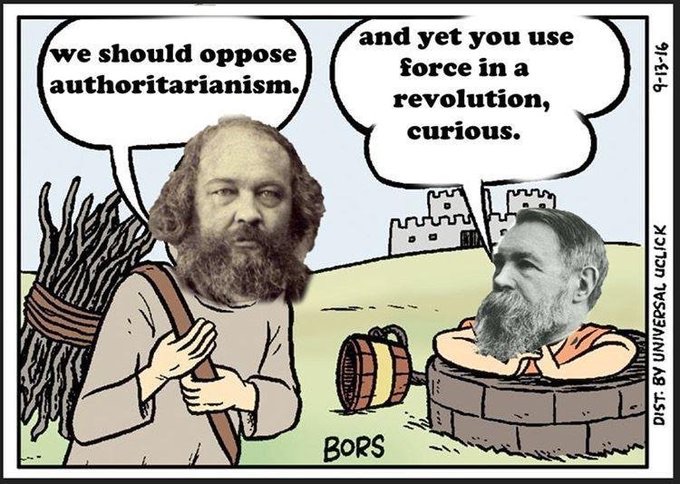
On Authority

A number of Socialists have latterly launched a regular crusade against what they call the principle of authority. It suffices to tell them that this or that act is authoritarian for it to be condemned. This summary mode of procedure is being abused to such an extent that it has become necessary to look into the matter somewhat more closely.

Authority, in the sense in which the word is used here, means: the imposition of the will of another upon ours; on the other hand, authority presupposes subordination. Now, since these two words sound bad, and the relationship which they represent is disagreeable to the subordinated party, the question is to ascertain whether there is any way of dispensing with it, whether — given the conditions of present-day society — we could not create another social system, in which this authority would be given no scope any longer, and would consequently have to disappear.

On Authority

Karl Marx & Frederick Engels: Volume 23, 1871-74

Thomas Sankara: Women’s Liberation and the African Freedom Struggle

It is true that both the woman and the male worker are condemned to silence by their exploitation. But under the current system, the worker’s wife is also condemned to silence by her worker-husband. In other words, in addition to the class exploitation common to both of them, women must confront a particular set of relations that exist between them and men, relations of conflict and violence that use physical differences as their pretext.

Thomas Sankara, Women’s Liberation and the African Freedom Struggle (PDF)

Quotes:

Read More »