Capes, Cameras, and the Cult of Visibility

Capes, Cameras, and the Cult of Visibility: The SeaLight Crusade as White Savior Theater

By Tina Antonis

The South China Sea is more than a maritime dispute—it’s a theater of narrative warfare. While headlines focus on Chinese aggression and Philippine resistance, a quieter campaign unfolds in the background: one of satellite feeds, curated imagery, and Pentagon-backed storytelling. At the center of this effort is SeaLight, a project that claims to illuminate truth but often casts shadows of its own.

As explored in my article at Antiwar.com, SeaLight doesn’t just document—it performs. It reframes geopolitical tension through moral spectacle, positioning its creators as heroic arbiters of transparency. But when the messenger wears a cape and the funding flows from defense budgets, we must ask: is this clarity, or choreography?

Stage Left: The White Savior Enters

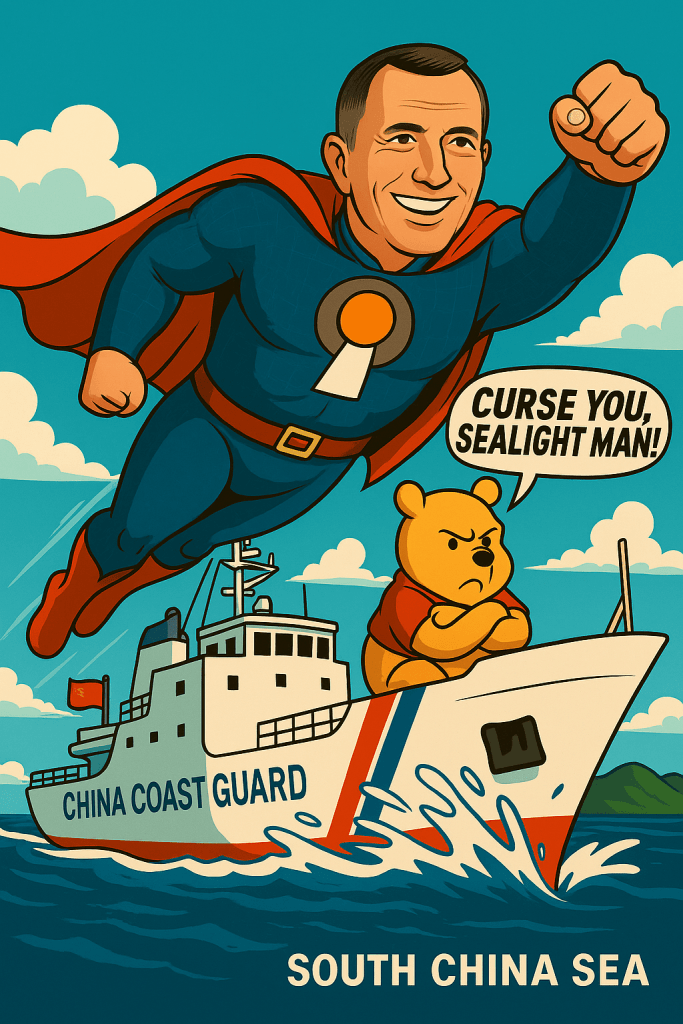
In the comic-strip cosmology of Ray Powell’s SeaLight project, transparency wears a cape. Clad in heroic postures and backed by satellite imagery, Powell casts himself as the guardian of maritime morality—unarmed, except with satellite feeds, theatrical flair, and strategic messaging. 

Yet beneath the cartoon and Pentagon-funded optics lies a familiar archetype: the white savior, rebranded for the South China Sea.

China Is Imperialist? Says Who?

Calling China a “maritime occupier,” Powell positions himself as a bulwark against aggression. But that moral pose collapses under scrutiny. He speaks for a country with over 800 foreign military installations and a documented history of over 250 military interventions since 1991—wars in Iraq, Afghanistan, Libya, Syria, Somalia, and dozens more, all under the banner of peace, freedom, or preemption.

By comparison, China’s post–Cold War footprint includes no sustained foreign occupations and only scattered border conflicts and peacekeeping missions. The imbalance is staggering. And Powell’s framing doesn’t just ignore it—it performs around it.

As David Vine argues in The United States of War, this vast base empire is not a passive network—it’s an architecture of perpetual war. These outposts make military engagement not an exception but a structural habit, cloaked in strategic necessity and sold as global stewardship.

Powell’s cartoon rhetoric—calling China an occupier—obscures the scale of U.S. militarism. The term “occupation” is deployed not to analyze, but to project. When adversaries hold territory, it’s a crisis; when the U.S. spans the globe with armed installations, it’s policy.

Framing Conflict: The Optics of Consent

This isn’t irony. It’s performance. Powell’s language manufactures a moral frame for confrontation—costumed in transparency, but driven by escalation. The cape is literal. The conditioning is deliberate. And the stage is set for war.

SeaLight’s mission is not just visual documentation—it’s narrative warfare. As the Japan Times openly notes, its “chief weapon is photography, applied purposefully, generously and consistently over time.” These images—enhanced, curated, and distributed across media—are not neutral. They’re constructed to shape public perception, sway international opinion, and ultimately manufacture consent for confrontation.

Assertive transparency becomes a kind of ideological scaffolding—a stage on which geopolitical tension is dramatized, simplified, and morally polarized. The goal isn’t simply to reveal conflict; it’s to condition audiences for escalation.

And when the messenger dons a superhero’s cape, the spectacle transforms into something deeper: a story of rescue, of virtue, of intervention. This is not analysis—it’s soft propaganda dressed in heroic metaphor.

Consent for war doesn’t begin with missiles. It begins with mythmaking.
Syria’s Rojava [Where They Run Torture Camps] Is in Grave Danger +

Federalization of Syria a.k.a. Balkanization

Syria’s Rojava Revolution Is in Grave Danger (Reason magazine)

If the Kurdish-Arab alliance unravels, the U.S. military may decide to directly back Arab tribes as a bulwark against Iran and the Islamic State, according to Nicholas Heras, who has advised the U.S.-led military coalition in Syria and is now senior director for strategy at the nonprofit New Lines Institute for Strategy and Policy in Washington. In 2019, when former President Donald Trump wanted to withdraw U.S. troops from Syria, the Trump administration considered a strategy of letting the Kurdish forces fall to Turkey and buying off Arab tribes.

The United States has, directly and indirectly, backed all sides of the fight. Turkey is a NATO ally. Some of the SNA [Syrian National Army] units now attacking Kobane had received weapons and training from the CIA and the U.S. military. (After the Trump administration cut off support, a U.S. official condemned these same factions as “thugs, bandits, and pirates that should be wiped off the face of the earth,” and the Biden administration imposed human rights sanctions.) Meanwhile, several hundred U.S. troops are embedded with the SDF.

In his Sunday victory speech about the fall of the Assad government, President Joe Biden said that he wanted to support an “independent, sovereign—an independent—independent—I want to say it again—sovereign Syria.” But U.S. policy at the moment seems to be creating the opposite: a Syria chopped up [Balkanization] by foreign powers.

Rojava is also known as the Autonomous Administration of North and East Syria.

Related:

Read More »

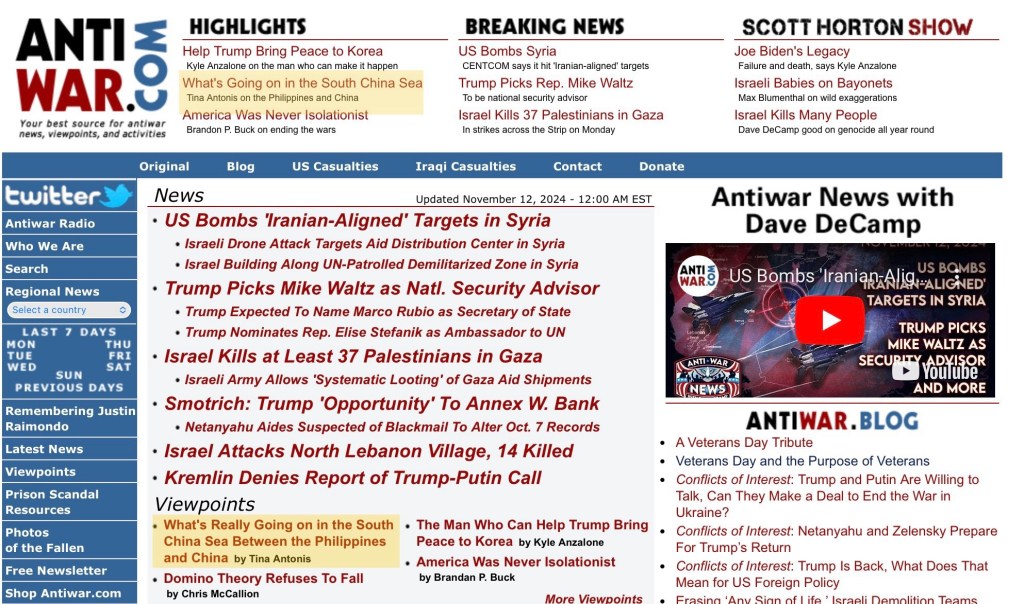
What’s Really Going On In the South China Sea Between the Philippines and China

What’s Really Going On In the South China Sea Between the Philippines and China

by Tina Antonis

Maritime clashes between the Philippines and China had been mostly over the Philippines’ military outpost, BRP (BRP—Barko ng Republika ng Pilipinas, which translates to “Ship of the Republic of the Philippines”—the ship prefix for the Philippines) Sierra Madre, in the Spratly Islands, which is disputed by Brunei, China, Malaysia, the Philippines, Taiwan (a province of China, as recognized by the United Nations’ Resolution No. 2758), and Vietnam. The BRP Sierra Madre was intentionally run aground on a reef near the Second Thomas Shoal in the disputed Spratly Islands, in 1997, so that the Philippines could stake their territorial claim.

Read More »

South China Sea: Marcos inks laws on PH Maritime Zones, Archipelagic Sea Lanes + Responses of China and the United States

YouTube

MANILA – President Ferdinand R. Marcos Jr. on Friday signed laws declaring the maritime zones under Philippine jurisdiction and designating sea lanes in the country for foreign vessels and aircraft.

Marcos inks laws on PH Maritime Zones, Archipelagic Sea Lanes

Related:

South China Sea: Philippines’ legal moves reveal its expansionist goals

U.S. State Department On the Philippines Maritime Zones Act

Arnaud Bertrand’s Twitter thread (ThreadReader)

Regarding the South China Sea Arbitration:

The South China Sea Arbitration did not rule on sovereignty, and China does not recognize it because the Arbitral Tribunal lacked jurisdiction. “The Arbitral Tribunal violated the principle of state consent, exercised its jurisdiction ultra vires and rendered an award in disregard of the law. This is a grave violation of UNCLOS and general international law, Wang said.” The United Nations Convention on the Law of the Sea (UNCLOS) is an international treaty that establishes a legal framework for all marine and maritime activities.  The Permanent Court of Arbitration is not an agency of the United Nations. The PCA rents space in the same building as the UN’s International Court of Justice.  A Congressional Research Service report, dated August 2023, stated that the U.S. has not declared its position regarding sovereignty over any of the geographical elements that comprise the South China Sea.  

Maduro, an Expert in Defense and Counterattack

Original source

Maduro, an Expert in Defense and Counterattack

The parallel government strategy

One of the key maneuvers was the statement by Secretary of State Antony Blinken, recognizing opposition candidate Edmundo González Urrutia as the winner of the elections, openly contradicting the official result given by the only competent body in the matter, the National Electoral Council (CNE), which proclaimed Maduro the winner.

Faced with what appeared to be a repeat of the interim government of former lawmaker Juan Guaidó (who proclaimed himself president in 2019 and was endorsed by Washington, the European Union, and neighboring Latin American countries), Maduro launched a torpedo at the imperial waterline: if the U.S. does not recognize his victory, the energy contracts awarded to U.S. companies will be handed over to companies from the BRICS group, which Venezuela is hoping to join soon.

They need to throw out the Gene Sharp playbook.

Related:

198. Dual sovereignty and parallel government – from Gene Sharpe’s “198 METHODS OF NONVIOLENT ACTION”

Guarimba is a ‘protest method’ devised by Venezuelan opposition member, Robert Alonso (who collaborated with the CIA to train terrorists). It was ‘inspired’ by Gene Sharp’s book, From Dictatorship to Democracy (see my ‘front organizations’ page for more on Sharp).

As predicted: violence by the far-right Venezuelan opposition breaks out across Caracas

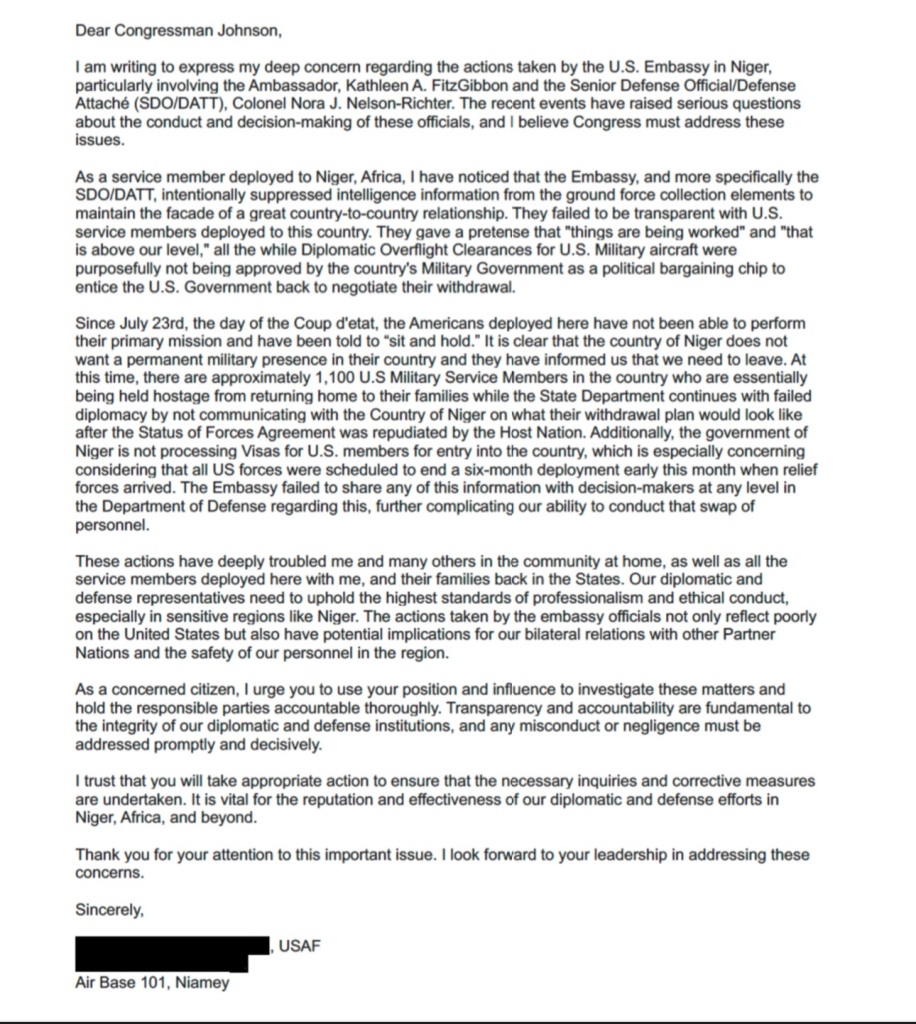
Defying Niger exit order leaves U.S. troops vulnerable, whistleblower says

Defying Niger exit order leaves U.S. troops vulnerable, whistleblower says

“We have Army soldiers right now in Niger who aren’t getting their troop rotations, who aren’t getting their medicine, who aren’t getting their supplies, who aren’t getting their mail and the two senior people in the United States Army are sitting before me and it’s like ‘hear no evil, see no evil, speak no evil,’” said Gaetz.

Previously:

BBC: Niger’s Junta Revokes Military Agreement With US

He [Col Amadou Abdramane] also alleged that the US delegation had accused Niger of making a secret deal to supply uranium to Iran. Col Abdramane described the accusation as “cynical” and “reminiscent of the second Iraq war”.

U.S. Pushes to Shape Israel’s Rafah Operation, Not Stop It + Washington sends Israel more city-busting bombs to level Rafah

U.S. Pushes to Shape Israel’s Rafah Operation, Not Stop It

Rafah has been at the center of a growing rift between Israeli and U.S. political leaders. Those tensions boiled over on Monday, when Israeli Prime Minister Benjamin Netanyahu canceled a visit to Washington by top aides to discuss U.S. concerns over the planned offensive on Rafah, where Hamas fighters are making a final stand. The tit-for-tat move was in response to the U.S. abstaining from a United Nations Security Council resolution that called for an immediate cease-fire while also demanding the release of hostages.

Israeli Defense Minister Yoav Gallant, however, proceeded with his meetings at the White House and Pentagon on Monday and Tuesday, which had been previously scheduled. Gallant is part of Israel’s three-member war cabinet that includes Netanyahu and Benny Gantz, the prime minister’s chief political rival.

Both sides also agreed that the Hamas battalions in Rafah must be dislodged so that the militants cannot attempt a comeback or continue to smuggle weapons into the enclave, which are prerequisites for ending the war and paving the way for a new political authority in Gaza. And that means trying to find ways to work with Israel on its Rafah strategy, for lack of better options.

Related:

Washington sends Israel more city-busting bombs to level Rafah

Read More »

Gaza: Security Council passes resolution demanding ‘an immediate ceasefire’ during Ramadan and it’s legally binding!

The UN Security Council on Monday passed a resolution demanding an immediate ceasefire for the month of Ramadan, the immediate and unconditional release of hostages and “the urgent need to expand the flow” of aid into Gaza. There were 14 votes in favour with the United States abstaining.

Gaza: Security Council passes resolution demanding ‘an immediate ceasefire’ during Ramadan

Related:

Why Today’s UN Security Council Resolution Demanding an Immediate Ceasefire Is Legally Binding

In conclusion, the resolution is – despite statements to the contrary – legally binding and creates a legally binding request for an immediate ceasefire during Ramadan and a legally binding request to immediately release all hostages. The obvious elephant in the room is enforcement: who is to enforce the Security Council resolution in the current situation? It ultimately falls to the parties of the conflict to heed the Security Council’s call, and to the Council itself to enforce its requests. Given the experience of the past months, this is no cause for enthusiasm. Yet, the fact that the Council could agree on the text, after five vetoes on the matter, is, perhaps, a shred of hope.