

The Subjugation of Women Under Capitalism:
The Bourgeois Morality
Tag: means of production
The RCO and “Putting the Cart before the Horse”
Lenin: Answers To An American Journalist’s Questions
Answers To An American Journalist’s Questions
1. The governmental programme of the Soviet Government was not a reformist, but a revolutionary one. Reforms are concessions obtained from a ruling class that retains its rule. Revolution is the overthrow of the ruling class. Reformist programmes, therefore, usually consist of many items of partial significance. Our revolutionary programme consisted properly of one general item—removal of the yoke of the landowners arid capitalists, the overthrow of their power and the emancipation of the working people from those exploiters. This programme we have never changed. Some partial measures aimed at the realisation of the programme have often been subjected to change; their enumeration would require a whole volume. I will only mention that there is one other general point in our governmental programme which has, perhaps, given rise to the greatest number of changes of partial measures. That point is—the suppression of the exploiters’ resistance. After the Revolution of October 25 (November 7), 1917 we did not close down even the bourgeois newspapers and there was no mention of terror at all. We released not only many of Kerensky’s ministers, but even Krasnov who had made war onus. It was only after the exploiters, i.e., the capitalists, had begun developing their resistance that we began to crush that resistance systematically, applying even terror. This was the proletariat’s response to such actions of the bourgeoisie as the conspiracy with the capitalists of Germany, Britain, Japan, America and France to restore the rule of the exploiters in Russia, the bribery of the Czechoslovaks with Anglo-French money, the bribery of Mannerheirn, Denikin and others with German and French money, etc. One of the latest conspiracies leading to “a change”—to put it precisely, leading to increased terror against the bourgeoisie in Petrograd—was that of the bourgeoisie, acting jointly with the Mensheviks and Socialist-Revolutionaries; their conspiracy concerned the surrender of Petrograd, the seizure of Krasnaya Gorka by officer-conspirators, the bribing by British and French capitalists of employees of the Swiss Embassy and of many Russian employees, etc.
Read More »
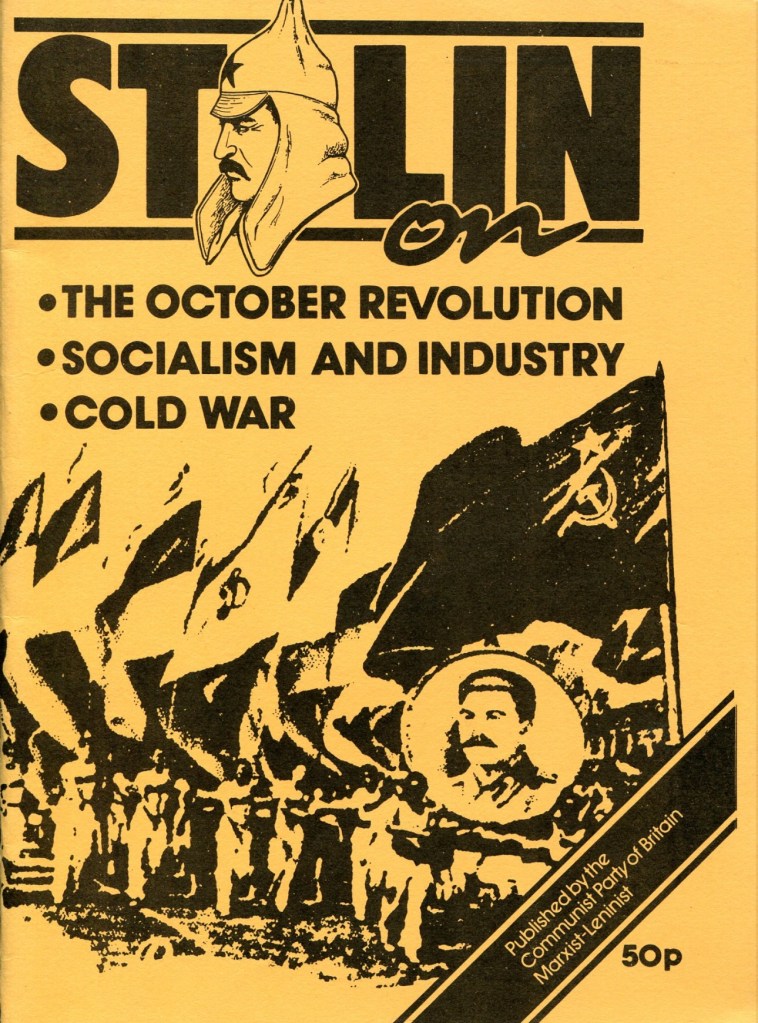
Stalin on: The October Revolution, Socialism and Industry, Cold War
The State: A Product of the Irreconcilability of Class Antagonisms
The State: A Product of the Irreconcilability of Class Antagonisms
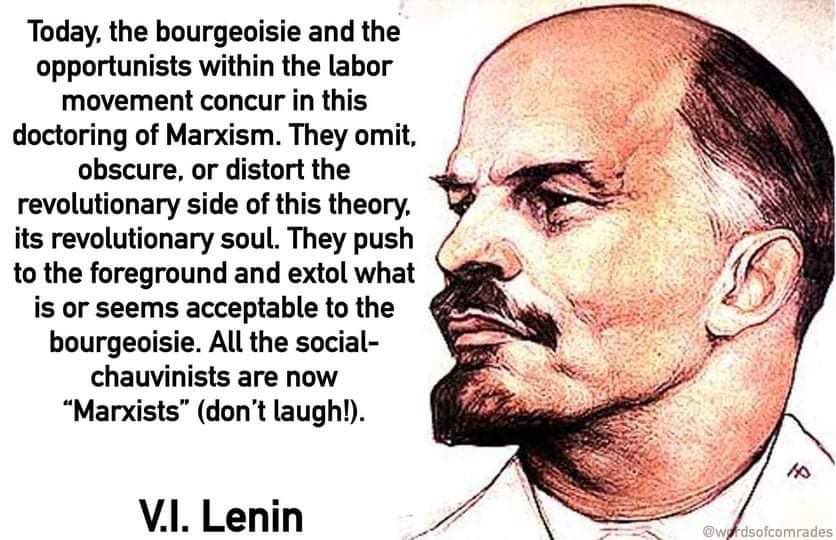
What is now happening to Marx’s theory has, in the course of history, happened repeatedly to the theories of revolutionary thinkers and leaders of oppressed classes fighting for emancipation. During the lifetime of great revolutionaries, the oppressing classes constantly hounded them, received their theories with the most savage malice, the most furious hatred and the most unscrupulous campaigns of lies and slander. After their death, attempts are made to convert them into harmless icons, to canonize them, so to say, and to hallow their names to a certain extent for the “consolation” of the oppressed classes and with the object of duping the latter, while at the same time robbing the revolutionary theory of its substance, blunting its revolutionary edge and vulgarizing it. Today, the bourgeoisie and the opportunists within the labor movement concur in this doctoring of Marxism. They omit, obscure, or distort the revolutionary side of this theory, its revolutionary soul. They push to the foreground and extol what is or seems acceptable to the bourgeoisie. All the social-chauvinists are now “Marxists” (don’t laugh!). And more and more frequently German bourgeois scholars, only yesterday specialists in the annihilation of Marxism, are speaking of the “national-German” Marx, who, they claim, educated the labor unions which are so splendidly organized for the purpose of waging a predatory war!
Marxism and Psychological Science
1.1. The General Bases of Marxist Psychology
The teachings of Karl Marx caused a revolution in social sciences: in philosophy, in political economy, in the theory of socialism. As is known, psychology remained isolated from the influence of Marxism for many years. Marxism was not admitted into the official centers of scientific psychology, and the name of Karl Marx remained almost unmentioned in the works of psychologists for more than 50 years after the publication of his basic work.
Related:
Capitalist Property
Visions of inequality
In this next of a series of reviews of some important books published this year, I look at Branco Milanovic’s Visions of Inequality.
Visions of inequality
 Ms. Cat’s Chronicles
You must be logged in to post a comment.