
According to a report in the Washington Post this morning, Pentagon officials want to revive pre-Ukraine war orders that would allow them to insert commandos in the form of “control teams” to direct Ukrainian operatives to counter Russian disinformation and monitor troops movements on the ground.
Report: Pentagon wants to revive top secret commando program in Ukraine
Tag: MGM-140 ATACMS
Top House Republicans Call for Biden to Send Longer Range Weapons to Ukraine to Strike Crimea
Reps. Michael McCaul (R-TX) and Mike Turner (R-OH) appeared on ABC News’s This Week on Sunday and pledged that aid for Ukraine will continue to flow unimpeded once Republicans have a majority in the House in January.
Top House Republicans Call for Biden to Send Longer Range Weapons to Ukraine to Strike Crimea
U.S. and NATO scramble to arm Ukraine and refill their own arsenals
Either this narrative about weapon stockpiles, being depleted, is part of the information war or Russia is demilitarizing NATO!?!
U.S. and NATO scramble to arm Ukraine and refill their own arsenals
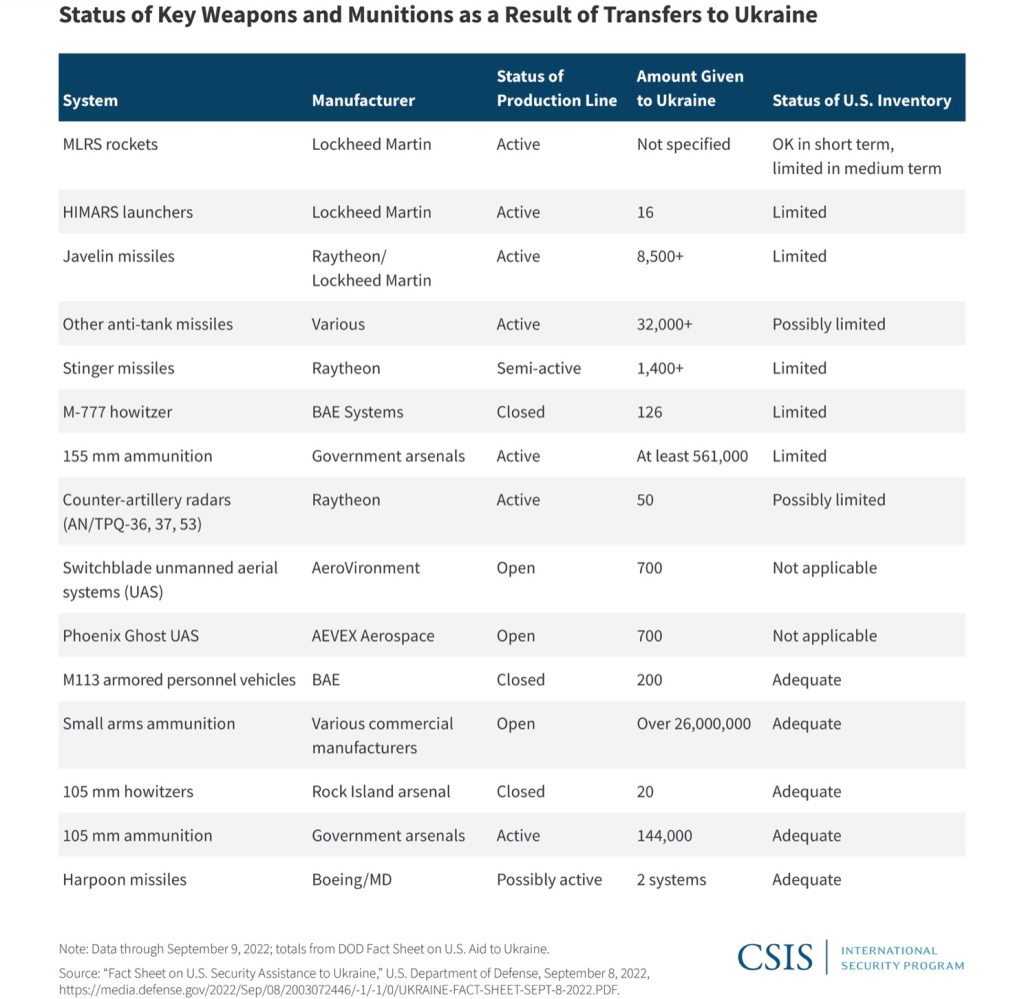
In Ukraine, the kind of European war thought inconceivable is chewing up the modest stockpiles of artillery, ammunition and air defenses of what some in NATO call Europe’s “bonsai armies,” after the tiny Japanese trees. Even the mighty United States has only limited stocks of the weapons the Ukrainians want and need, and Washington is unwilling to divert key weapons from delicate regions like Taiwan and Korea, where China and North Korea are constantly testing the limits.
…
So the West is scrambling to find increasingly scarce Soviet-era equipment and ammunition that Ukraine can use now, including S-300 air defense missiles, T-72 tanks and especially Soviet-caliber artillery shells
…
There are even discussions about NATO investing in old factories in the Czech Republic, Slovakia and Bulgaria to restart the manufacturing of Soviet-caliber 152-mm and 122-mm shells for Ukraine’s still largely Soviet-era artillery armory.
…
The European Union has approved €3.1 billion ($3.2 billion) to repay member states for what they provide to Ukraine, but that fund, the [ironically-named] European Peace Facility, is nearly 90 percent depleted.
…
Smaller countries have exhausted their potential, another NATO official said, with 20 of its 30 members “pretty tapped out.” But the remaining 10 can still provide more, he suggested, especially larger allies. That would include France, Germany, Italy and the Netherlands.
NATO’s secretary general, Jens Stoltenberg, has advised the alliance — including, pointedly, Germany — that NATO guidelines requiring members to keep stockpiles should not be a pretext to limit arms exports to Ukraine. But it is also true that Germany and France, like the United States, want to calibrate the weapons Ukraine gets, to prevent escalation and direct attacks on Russia.
…
Washington is also looking at older, cheaper alternatives like giving Ukraine anti-tank TOW missiles, which are in plentiful supply, instead of Javelins, and Hawk surface-to-air missiles instead of newer versions. But officials are increasingly pushing Ukraine to be more efficient and not, for example, fire a missile that costs $150,000 at a drone that costs $20,000.
Kiev Offers White House Targeting Control, Seeks Longer Range Weapons
The Ukrainian government is prepared to give the Joe Biden administration virtual control over its selection of Russian targets. Kiev made the proposal in a bid to receive longer-range weapons from the White House, according to multiple sources speaking with CNN.
Kiev Offers White House Targeting Control, Seeks Longer Range Weapons
New $1.1 Billion Arms Package for Ukraine Includes 18 HIMARS Launchers, as The U.S. and Europe are running out of weapons to send to Ukraine
New $1.1 Billion Arms Package for Ukraine Includes 18 HIMARS Launchers
The HIMARS that the US has been sending to Ukraine are equipped with missiles that have a range of about 50 miles. But that can change, and Kyiv is requesting Army Tactical Missile Systems, which have a range of 190 miles, but Washington has been hesitant to send the longer-range missiles. Russia has warned that providing such arms would cross a “red line.”
Related:
The U.S. and Europe are running out of weapons to send to Ukraine
In the U.S. weapons industry, the normal production level for artillery rounds for the 155 millimeter howitzer — a long-range heavy artillery weapon currently used on the battlefields of Ukraine — is about 30,000 rounds per year in peacetime.
The Ukrainian soldiers fighting invading Russian forces go through that amount in roughly two weeks.
…
Is the U.S. ability to defend itself at risk?
The short answer: no.
…
The U.S. has essentially run out of the 155 mm howitzers [M777?] to give to Ukraine; to send any more, it would have to dip into its own stocks reserved for U.S. military units that use them for training and readiness. But that’s a no-go for the Pentagon, military analysts say, meaning the supplies reserved for U.S. operations are highly unlikely to be affected.
Ukraine claims 60 dead, 100 wounded, in blasts on Crimea as satellite images show destroyed Russian aircraft

by Clara Weiss, WSWS, Aug 13 2022
Anton Gerashenko, an adviser to the Ukrainian minister of internal affairs, claimed on Thursday that 60 pilots and technicians had been killed and 100 people wounded in a series of explosions at a Russian Saki air base on the Black Sea Crimean Peninsula on Tuesday. Since Russia’s annexation of Crimea in 2014, the air base has housed the Russian 43rd Independent Naval Assault Air Squadron.
Ukraine claims 60 dead, 100 wounded, in blasts on Crimea as satellite images show destroyed Russian aircraft
Related:
Does Ukraine Have A Stash Of Domestically Developed Ballistic Missiles?
Video via Made in Ukraine
Pentagon acknowledges sending anti-radar missiles to Ukraine; they are already in use
Colin Kahl, the under secretary of defense for policy, said at a press briefing that the US had sent “a number” of the missiles without specifying how many the US has provided or when they were sent. Kahl did not explicitly say what type of anti-radiation missile was sent.
A defense official told CNN the type of missile sent was the AGM-88 High-Speed Anti-Radiation Missile (HARM).
Biden Authorizes Additional $550 Million Military Aid for Ukraine + Are There Enough Guided Rockets For HIMARS To Keep Up With Ukraine War Demand?
Biden Authorizes Additional $550 Million Military Aid for Ukraine
The new aid was authorized by the presidential drawdown authority, which allows Biden to send Ukraine weapons and ammunition directly from US military stockpiles. The funds were pulled from the $40 billion Ukraine aid bill that Biden signed back in May, which is meant to last through September 30.
Related:
Are There Enough Guided Rockets For HIMARS To Keep Up With Ukraine War Demand?


So in essence, at a pace suggested by Hertling, Ukraine’s GMLRS monthly burn rate would equal about 29% of the entire planned U.S. procurement for the next five years, not withstanding production rates of the ER GMLRS which have yet to be set.
Given those numbers, what does Ukraine’s use of HIMARS portend for that nation, and the U.S., which might find itself needing these systems in case of a future fight with China, Russia or some other adversary?
…
“If each of 16 HIMARS fires three rockets per day, that’s 48 a day or 1,440 per month. 10,000 rockets would last well into 2023 at that rate. On the other hand, if the Ukrainians get the 100 HIMARS they are requesting and each one fires three rockets per day, that’s 300 per day or 9,000 per month.”
S Korea, US fire eight missiles in response to N Korea tests
South Korean military says the action is a demonstration of the allies readiness to respond to North Korean ‘provocations’.
S Korea, US fire eight missiles in response to N Korea tests
 Ms. Cat’s Chronicles
You must be logged in to post a comment.