
You should hate Trump: but he is no clown.
Tag: military budgets
2026 U.S. National Defense Strategy +
2026 U.S. National Defense Strategy
It follows that, although we are and will remain engaged in Europe, we must—and will—prioritize defending the U.S. Homeland and deterring China.
Related papers from the Marathon Initiative:
Bridge Colby / DTRA – Sharing the Load: Developing Better Strategies for Burden Sharing
Robert Almelor Delfeld / Elbridge Colby: Broadening the Base: A Blueprint for Expanding Defense Industrial Capacity
Trump’s new national security strategy: 5 key takeaways +
More on the US National Security Strategy paper…
Here are Sputnik’s questions and my full answers regarding the recently released US National Security Strategy document below – I will also be doing an article/video this coming week…
Read More »
Japan Eagerly Fills Role as US’ East Asia “Ukraine”
People of the United States: Listen to Maduro
People of the United States: Listen to Maduro
FAIR USE STATEMENT: This video may contain copyrighted material the use of which has not been specifically authorized by the copyright owner. This material is being made available within this transformative or derivative work for the purpose of education, commentary and criticism, is being distributed without profit, and is believed to be "fair use" in accordance with Title 17 U.S.C. Section 107.
Capes, Cameras, and the Cult of Visibility
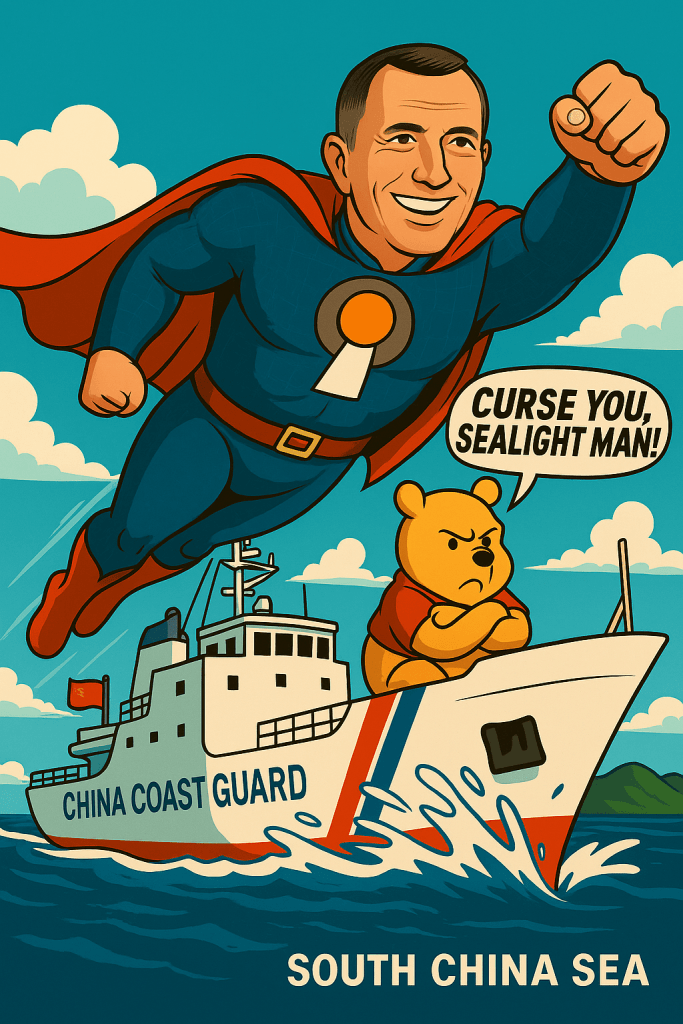
Capes, Cameras, and the Cult of Visibility: The SeaLight Crusade as White Savior Theater
By Tina Antonis
The South China Sea is more than a maritime dispute—it’s a theater of narrative warfare. While headlines focus on Chinese aggression and Philippine resistance, a quieter campaign unfolds in the background: one of satellite feeds, curated imagery, and Pentagon-backed storytelling. At the center of this effort is SeaLight, a project that claims to illuminate truth but often casts shadows of its own.
As explored in my article at Antiwar.com, SeaLight doesn’t just document—it performs. It reframes geopolitical tension through moral spectacle, positioning its creators as heroic arbiters of transparency. But when the messenger wears a cape and the funding flows from defense budgets, we must ask: is this clarity, or choreography?
Stage Left: The White Savior Enters
In the comic-strip cosmology of Ray Powell’s SeaLight project, transparency wears a cape. Clad in heroic postures and backed by satellite imagery, Powell casts himself as the guardian of maritime morality—unarmed, except with satellite feeds, theatrical flair, and strategic messaging.
Yet beneath the cartoon and Pentagon-funded optics lies a familiar archetype: the white savior, rebranded for the South China Sea.
China Is Imperialist? Says Who?
Calling China a “maritime occupier,” Powell positions himself as a bulwark against aggression. But that moral pose collapses under scrutiny. He speaks for a country with over 800 foreign military installations and a documented history of over 250 military interventions since 1991—wars in Iraq, Afghanistan, Libya, Syria, Somalia, and dozens more, all under the banner of peace, freedom, or preemption.
By comparison, China’s post–Cold War footprint includes no sustained foreign occupations and only scattered border conflicts and peacekeeping missions. The imbalance is staggering. And Powell’s framing doesn’t just ignore it—it performs around it.
As David Vine argues in The United States of War, this vast base empire is not a passive network—it’s an architecture of perpetual war. These outposts make military engagement not an exception but a structural habit, cloaked in strategic necessity and sold as global stewardship.
Powell’s cartoon rhetoric—calling China an occupier—obscures the scale of U.S. militarism. The term “occupation” is deployed not to analyze, but to project. When adversaries hold territory, it’s a crisis; when the U.S. spans the globe with armed installations, it’s policy.
Framing Conflict: The Optics of Consent
This isn’t irony. It’s performance. Powell’s language manufactures a moral frame for confrontation—costumed in transparency, but driven by escalation. The cape is literal. The conditioning is deliberate. And the stage is set for war.
SeaLight’s mission is not just visual documentation—it’s narrative warfare. As the Japan Times openly notes, its “chief weapon is photography, applied purposefully, generously and consistently over time.” These images—enhanced, curated, and distributed across media—are not neutral. They’re constructed to shape public perception, sway international opinion, and ultimately manufacture consent for confrontation.
Assertive transparency becomes a kind of ideological scaffolding—a stage on which geopolitical tension is dramatized, simplified, and morally polarized. The goal isn’t simply to reveal conflict; it’s to condition audiences for escalation.
And when the messenger dons a superhero’s cape, the spectacle transforms into something deeper: a story of rescue, of virtue, of intervention. This is not analysis—it’s soft propaganda dressed in heroic metaphor.
Consent for war doesn’t begin with missiles. It begins with mythmaking.
Trump is Working on Regime Change in Europe – Fact, Not Conspiracy Theory
On 27 May, an official document calling for regime change in European countries was published in Washington DC.
Politicians all over Europe would do well to read this document carefully before they and their spin doctors start concocting strategies for their upcoming election campaigns.
Trump is Working on Regime Change in Europe – Fact, Not Conspiracy Theory
Navy using munitions at ‘alarming’ speed to defend Israel
Navy using munitions at ‘alarming’ speed to defend Israel
Admiral James Kilby, Naval Operations acting chief, made the remark in his testimony during a Senate Appropriations Committee hearing on the Navy’s budget in Washington when Sen. Brian Schatz, D-Hawaii, asked about the Navy’s available munitions to defend against global threats.
“The latest round of conflict in the Middle East utilized large amounts of munitions to defend Israel from Iranian strikes,” Schatz said. “Does the Navy currently have all the SM-3s it needs for global threats?”
“We do, sir,” Kilby responded, “but we are, to your point, using them at an alarming rate. As you know, those are missiles procured by the Missile Defense Agency and then delivered to the Navy for our use. And we are using them quite effectively in the defense of Israel.”
Related:
Israel and US exhausting supplies of ballistic missile interceptors, source says
Germany’s Missile Range Decision: A Perilous Step Towards Global Conflict
Berlin, 26 May 2025 – In a chilling act of imperial hubris, German Chancellor Friedrich Merz has declared that Germany, in lockstep with its NATO overlords, has unshackled the range restrictions on missiles supplied to Ukraine, greenlighting strikes deep into Russia’s heart. This brazen escalation, announced today, is no mere policy shift; it is a deliberate provocation, a reckless lunge towards a global conflagration that could sear humanity’s future. The West, cloaked in the sanctimonious rhetoric of “defending Ukraine,” is goading Russia into a corner, gambling with the lives of millions in a game of geopolitical brinkmanship.
Germany’s Missile Range Decision: A Perilous Step Towards Global Conflict
The ‘Foreign Policy Consensus’ Is Alive and Well in Washington
The ‘Foreign Policy Consensus’ Is Alive and Well in Washington
by José Niño, Libertarian Institute
Brian Berletic, a former U.S. Marine now residing in Thailand, believes something bigger might be at play with Trump’s foreign policy agenda. The talk of foreign policy restraint vis-a-visa Russia is merely a facade. Berletic pointed out that Defense Secretary Pete Hegseth’s “division of labor” framework during his February 2025 address in Brussels will only increase tensions with Russia.
Read More »
 Ms. Cat’s Chronicles
You must be logged in to post a comment.