Littoral Combat Ship Still Fighting to Prove Its Worth

The Littoral Combat Ship was meant to start the Navy’s operational renaissance. But a chorus of naysayers and critics have put service leaders on the defensive, insisting that the troubled program has turned a corner.

Littoral Combat Ship Still Fighting to Prove Its Worth

They’ve increased the crew size and have been training them to maintain the ships themselves rather than relying on the original contractors. 

Related:

The Littoral Combat Ship: How We Got Here, and Why (PDF)

Littoral Combat Ship: Actions Needed to Address Significant Operational Challenges and Implement Planned Sustainment Approach

USNI Proceedings PodcastLittoral Combat Ships: How the Navy is Employing Them (Ted LeClair, Marc Crawford, Mark Haney)

Previously:

The Inside Story of How the Navy Spent Billions on the “Little Crappy Ship”

The Navy just launched a brand new ship it doesn’t even want

South China Sea: Philippines debates boosting war readiness through mandatory military training for students

Renewed talks on a bill that would reinstate a mandatory Reserve Officers Training Corps (ROTC) programme in colleges and universities in the Philippines has sparked debate on whether it would be effective in strengthening the country’s military amid growing tensions in the South China Sea.

South China Sea: Philippines debates boosting war readiness through mandatory military training for students

Russians vote for Putin

For charts, see the original post.

Russians vote for Putin

Today Russians are set to head to the polls for their country’s presidential election over three days – with only one expected outcome. Incumbent President Vladimir Putin will win comfortably.  The Russian president is elected by direct popular vote. If no candidate receives over 50% of the vote, then a second round is held between the two most popular candidates three weeks later. It’s the first time that multi-day voting has been used in a Russian presidential election, as well as the first allowing voters to cast ballots online. 

Russia’s war economy is holding up.  Wages have soared by double digits, the rouble is relatively stable and poverty and unemployment are at record lows. For the country’s lowest earners, salaries over the last three quarters have risen faster than for any other segment of society, clocking an annual growth rate of about 20%. 

The government is spending massively on social support for families, pension increases, mortgage subsidies and compensation for the relatives of those serving in the military.  

Read More »

China’s top leaders adopt measured tone on Taiwan at Two Sessions meetings

China’s top leaders adopt measured tone on Taiwan at Two Sessions meetings

In his work report delivered on Tuesday (March 5), Premier Li Qiang only broadly restated China’s usual position on Taiwan, while Wang Huning – the Communist Party of China’s (CPC) fourth-ranked official – kept mention of cross-strait ties to a minimum in another report a day earlier.

Li said Beijing will “resolutely oppose separatist activities aimed at ‘Taiwan independence’ and external interference”, while promoting the “peaceful development of cross-strait relations” – language that has remained broadly similar to previous years’.

While it was unusual for “external interference” to feature in the work report, other Chinese leaders have used the term when addressing Taiwan policy in recent years, such as President Xi Jinping at the twice-a-decade party congress in October 2022.

Dr Li Nan, visiting senior research fellow at the East Asian Institute at the National University of Singapore, said the fact that the wording on Taiwan remained largely similar indicates that Beijing’s current Taiwan policy will continue, including with a heavier emphasis on deterrence.

Dr James Char, a research fellow at the S. Rajaratnam School of International Studies, said that, for now, the Chinese military will probably continue to stick to military operations below the threshold of war to achieve China’s national objectives.

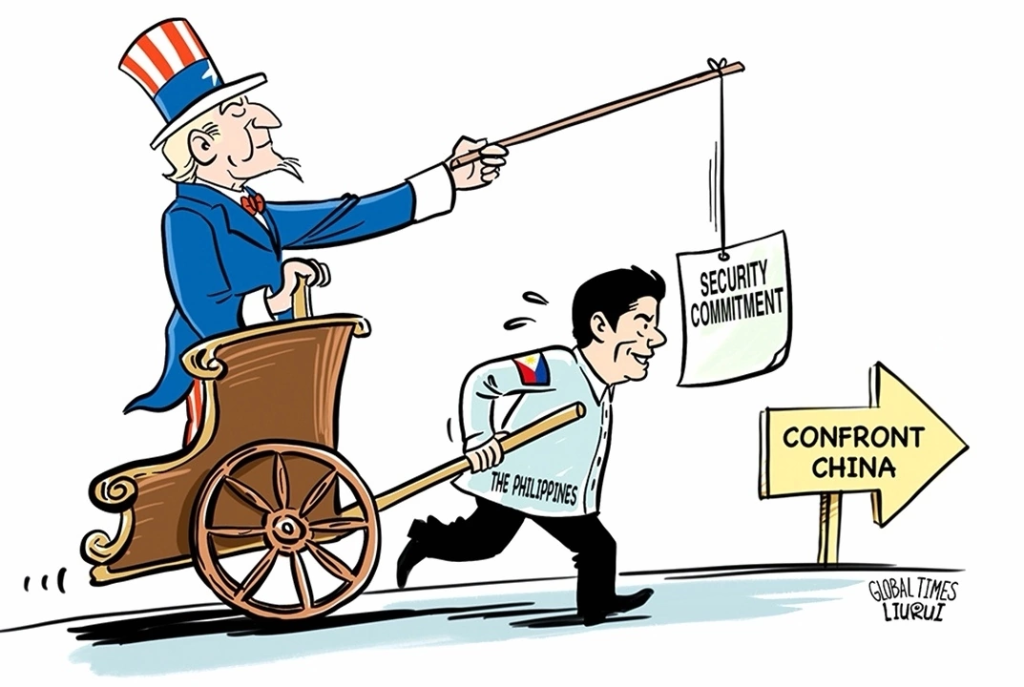
Is the Philippines becoming a US ‘proxy’ against Beijing in the South China Sea?

Is the Philippines becoming a US ‘proxy’ against Beijing in the South China Sea?

‘The ants that get trampled on’

Not everyone agrees with drawing closer to the US, however, and they warn about the Philippines turning into a “proxy” for American interests. The president’s own sister Imee, a senator, told ANC Digital earlier this month that “China will always be our neighbour, we have no fight with them, let’s not get dragged into a fight that’s not our own.”

Anna Rosario Malindog-Uy, director of the pro-China Asian Century Philippines Strategic Studies Institute, wrote in the Manila Times on February 10 that “agreements such as the EDCA, the VFA and the Mutual Defence Treaty have not only cemented the US military presence and influence in the Philippines but also, most importantly, exemplified the Philippines’ dependence on the US in the military and defence sector.”

Teresita Ang See, former president of the Philippine Association for Chinese Studies and currently part of its advisory council, told This Week in Asia: “Filipinos in general condemn China’s action. But many also understand that China’s assertiveness is in response to US, Japanese and Australian provocations and increasing military presence in the Philippines.”

She warned that “we are fighting a proxy war between the US and China and in the end we will be the ants that get trampled upon”.

H/T: Johnsonwkchoi

Related:

Responding to the Catholic Bishops

Philippines counts the cost of tough South China Sea stance against Beijing

Anti-Imperialism in the US Today: What It Is and Is Not

Fidel Castro, the world recognizes as a historic anti-imperialist figure, repeatedly warned that the main danger to humanity is US imperialism: “There is an enemy that can be called universal, an enemy whose attitude and whose actions…threaten the whole world, bully the whole world, that universal enemy is Yankee imperialism.” He fought to build a world united front against imperialism, of the world’s peoples and countries to oppose the barbarous actions of US imperialism. We see that anti-imperialist unity right now with United Nations votes and worldwide protests against the US-Israeli slaughters in Gaza, in what the New York Times in 2003 called “a second superpower.” 

Anti-Imperialism in the US Today: What It Is and Is Not